18th April, 2026
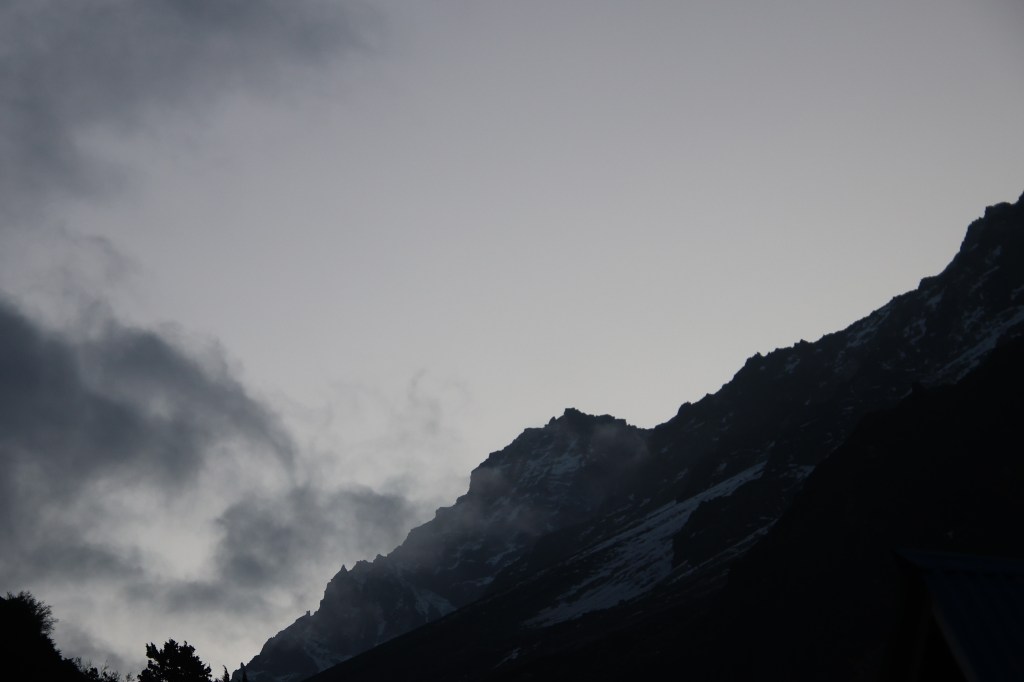
When I ventured out of the room in the wee hours to go to the washroom, I gave a quick glance to the sky. It was studded with stars. The dark silhouette of the surrounding mountains of Khambachhen was etched out clearly in that backdrop. When I returned to my bed to complete my remaining quota of sleep, my mind was peaceful. The weather seemed to have changed for better. Just as they say, big teams peak in their performance in later stages of a competition, the weather started to clear up when it mattered the most. The warm blanket caressed me but time flew and the alarm went off. It was half an hour earlier than the usual time. Darkness was starting to fade away. The sky was devoid of clouds. A few stars still twinkled. The snow peaks started becoming clearer.
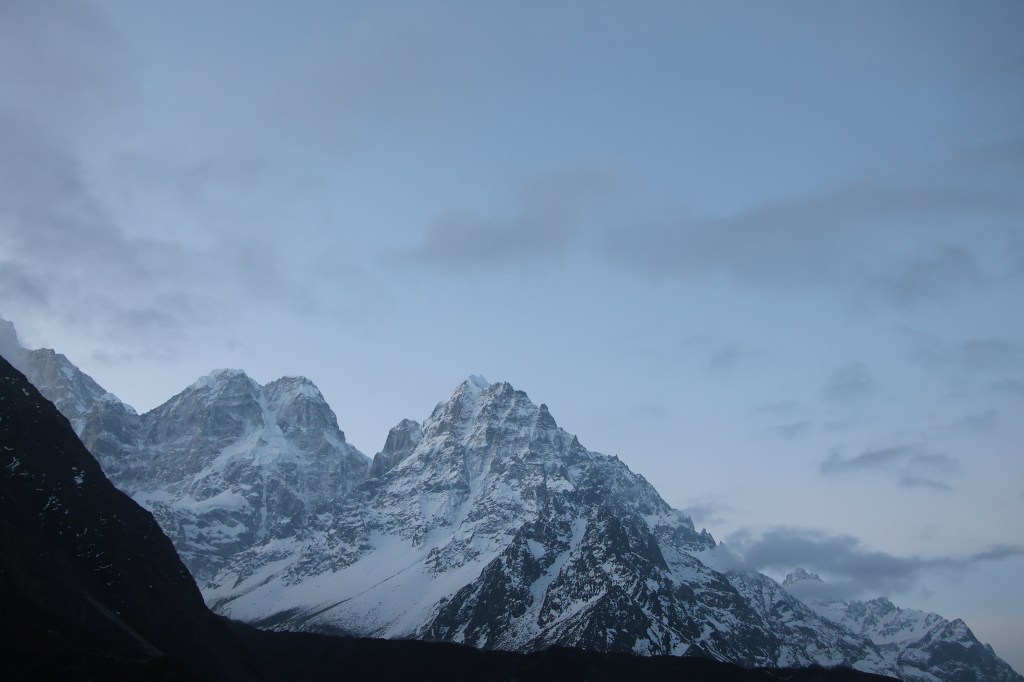
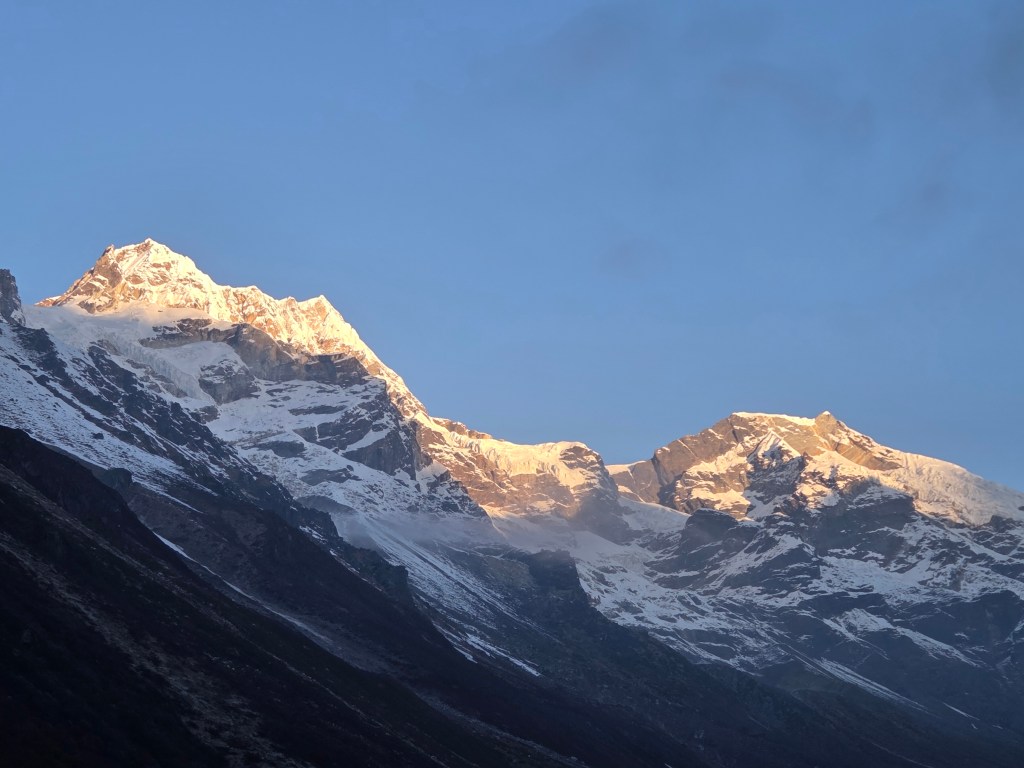
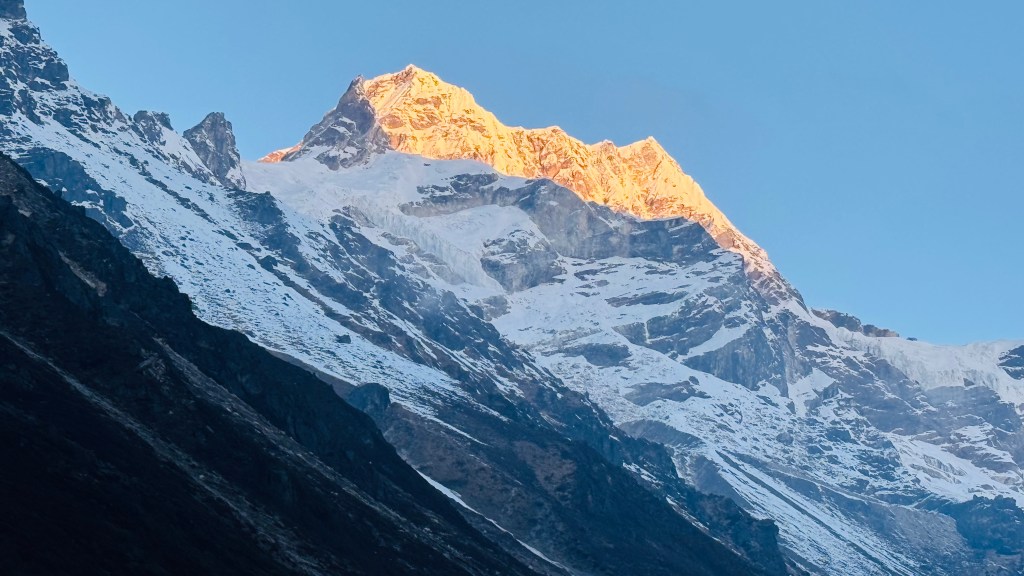
The twin peaks of Sharfu Li and Tanga started to acquire a tinge of gold. The atmosphere was chilling. It proved painful for the fingers to operate the camera, but our experience in the Himalayas told us that the scenes of a colorful drama were about to unfold. Hence, the pain was worth withstanding. The shower of gold started to acquire larger space. The rays of the sun slipped along the icy slopes to trickle down and ultimately the twin peaks wore the crown of gold.
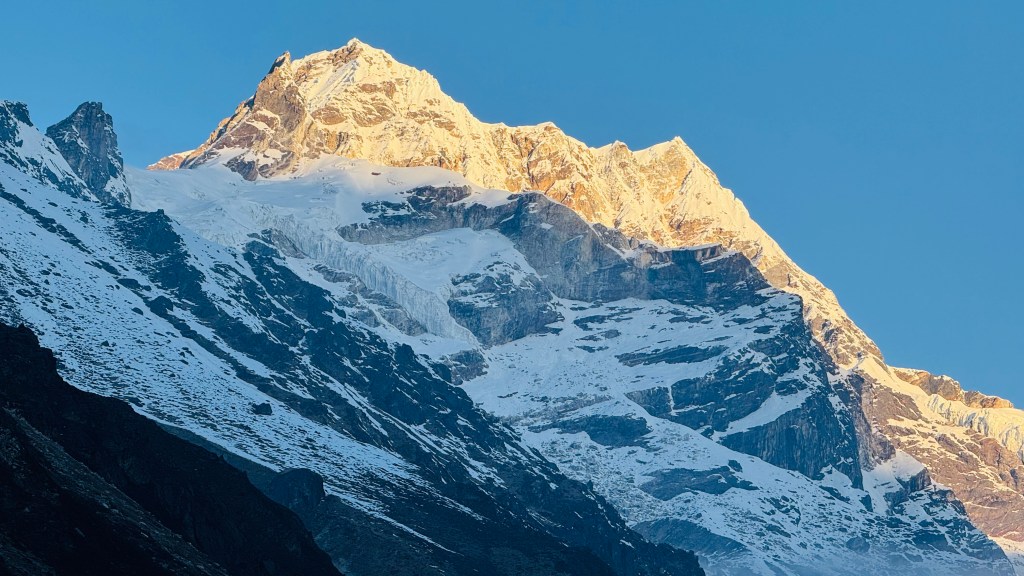
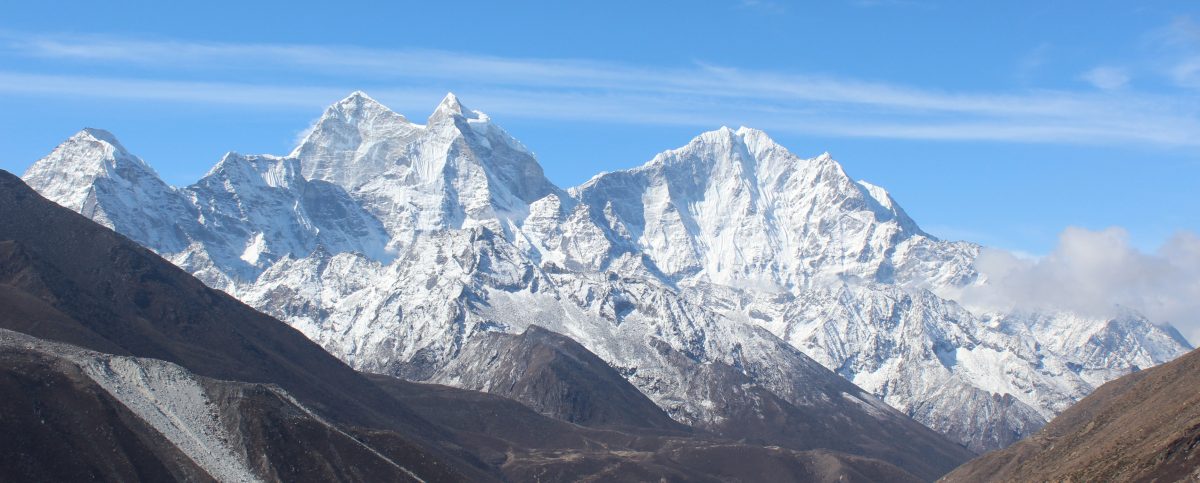
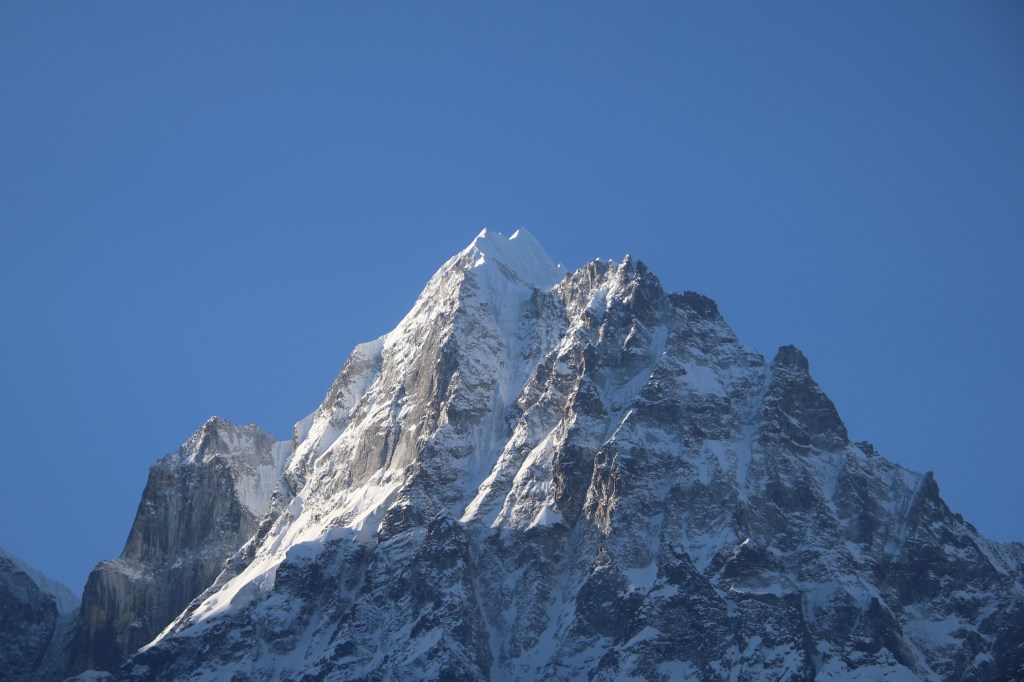
On the other side, there were the peaks of Khabur, Phole Sobithonje and the famous Mt Jannu. They didn’t have the fortune of bathing in gold, but they were making their presence felt. Jannu was only partially visible from the compound of the lodge. It was only a matter of time before Jannu would expose itself in its full glory. The day’s trail would lead us to its feet. We turned to our rooms and started getting ready.
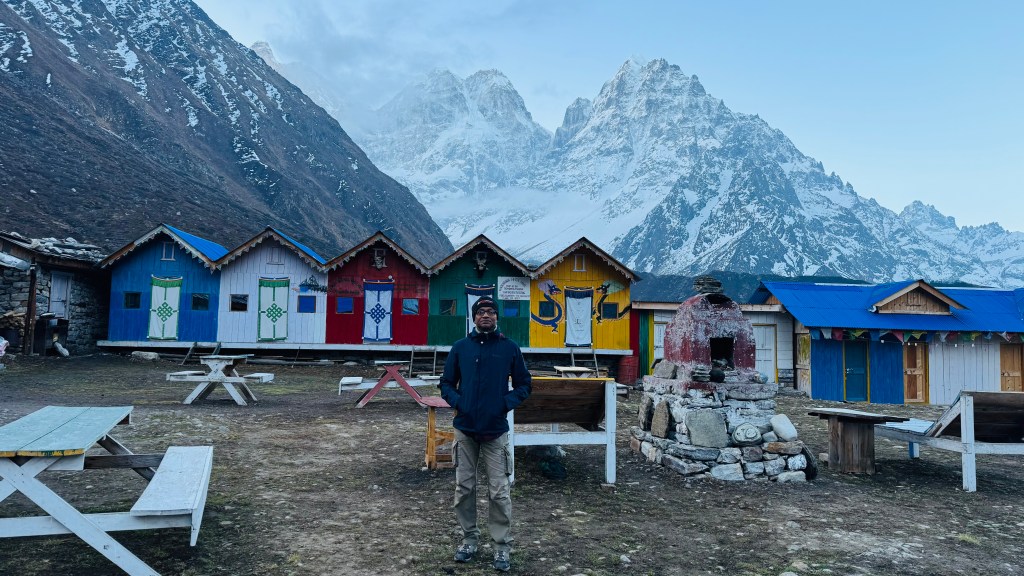
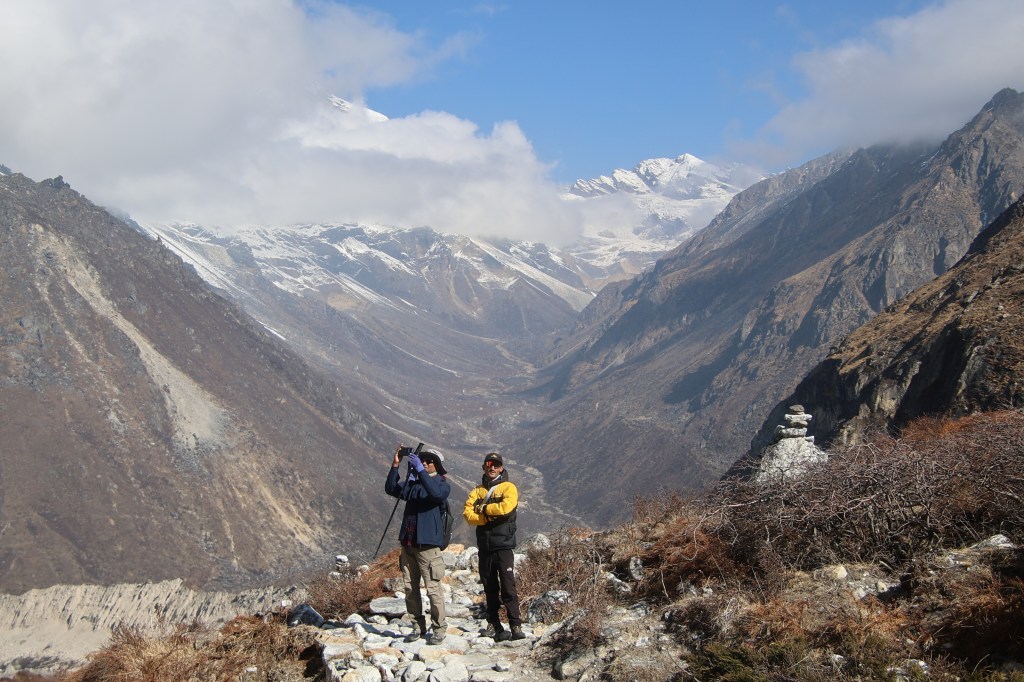
A quick peek at the dining space & kitchen revealed that lights were already on there. Shadows were pacing the closed windows. They buzzed with activities. We had our breakfast with chapatis and curry. To our dismay, the chapatis were not fully baked and their dough was thick & soft. I had to gulp them down with a few sips of water. It turned out that Nepalese were used to having chapatis like that. Nevertheless, we somehow managed and were ready to hit the trail. For the first time I put on my jacket and gloves. That gave some respite to the body, especially the fingers. The pain in the knuckles gradually subsided. But that relief was temporary as we had to remove our gloves frequently to capture nature’s glory. We retraced our track of yesterday to go towards the suspension bridge. As we moved along the track, Mt Jannu kept changing its angles and gradually appeared in its full glory. We crossed the bridge and reached the same junction. This time we turned left and followed the track which was well laid out by stacking the rocks and leveling them. It moved along gradually on an adulating terrain. Walking was easy but we could feel the terrain rising.
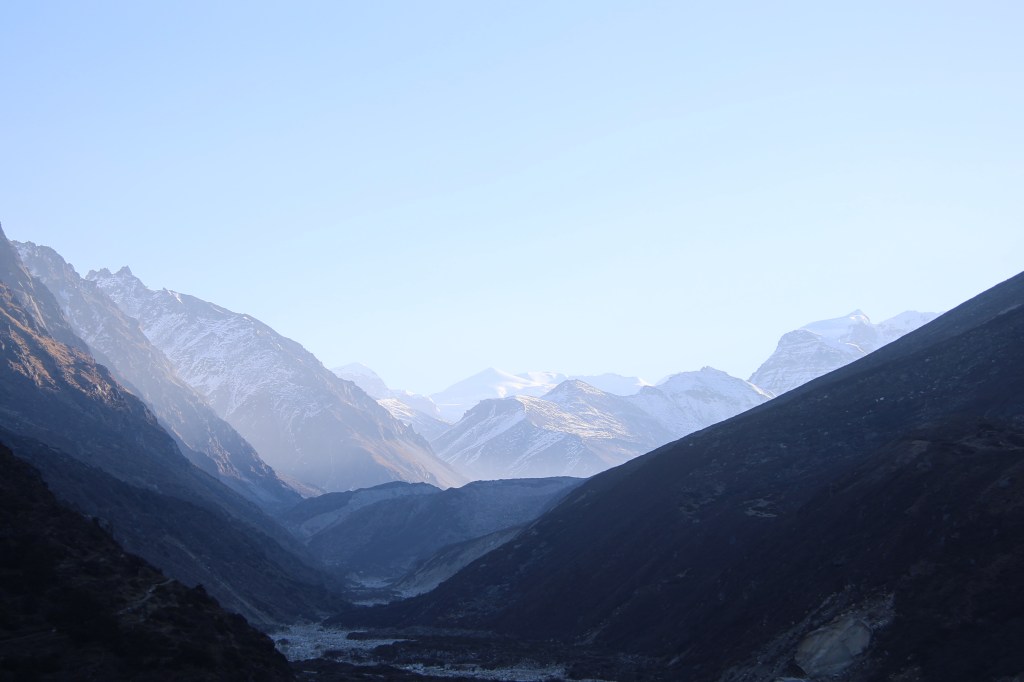
To be fair, the route had mercy on our knees. Because of the altitude our mouths kept getting dry and we continued popping lozenges into them. Limbu acquired the role of a guide as he was well acquainted with the terrain, being local. The initial section of trail was amidst shadows of the surrounding mountains. However, at the end of the stretch we could see a set of cairns which acted like a gate.
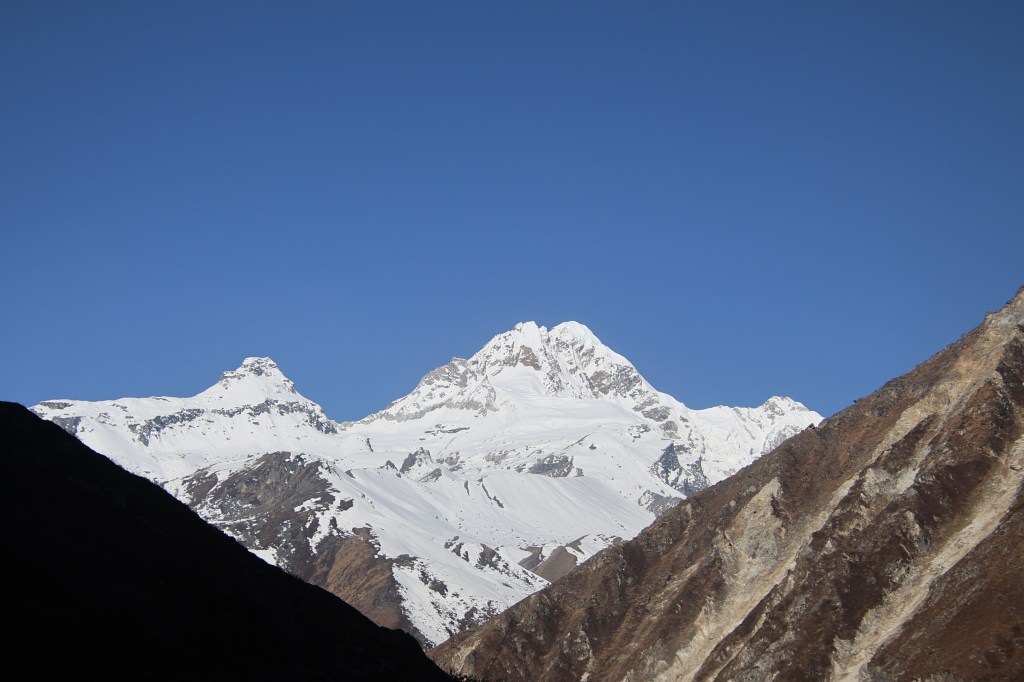
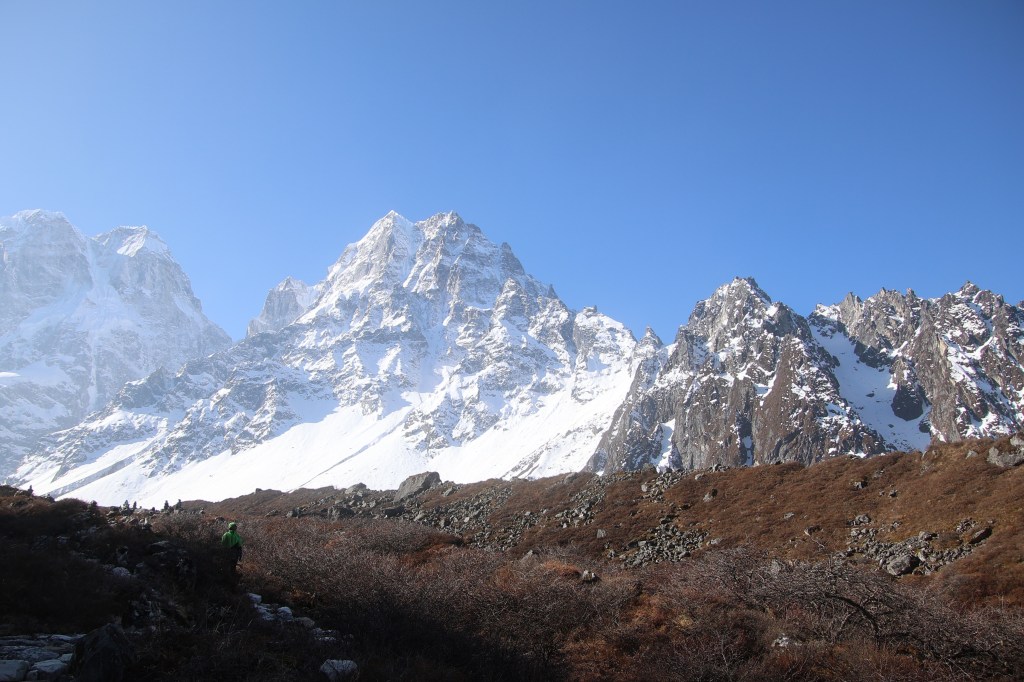
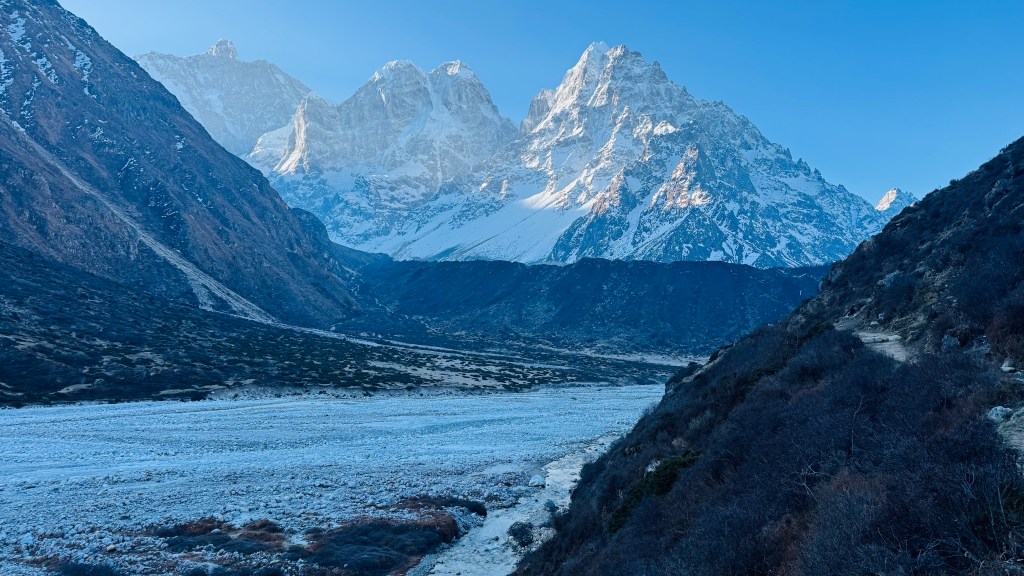
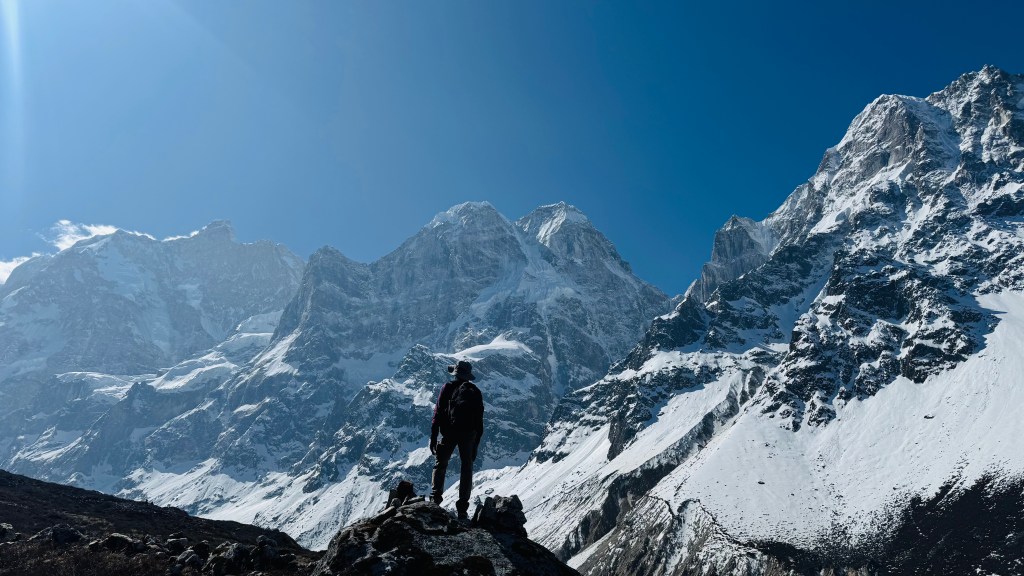
From thereon the trail took a turn to the left. That section was entirely lit up by the bright sunshine. We stopped for a while to sip some water. After crossing the cairns we entered into a wide valley and the track moved through its center. While there weren’t any trees, but bushes were scattered on both sides. To our right, the peaks of Khabur, Phole Sobithonje and Jannu rose above hills and were visible in their awe inspiring display.
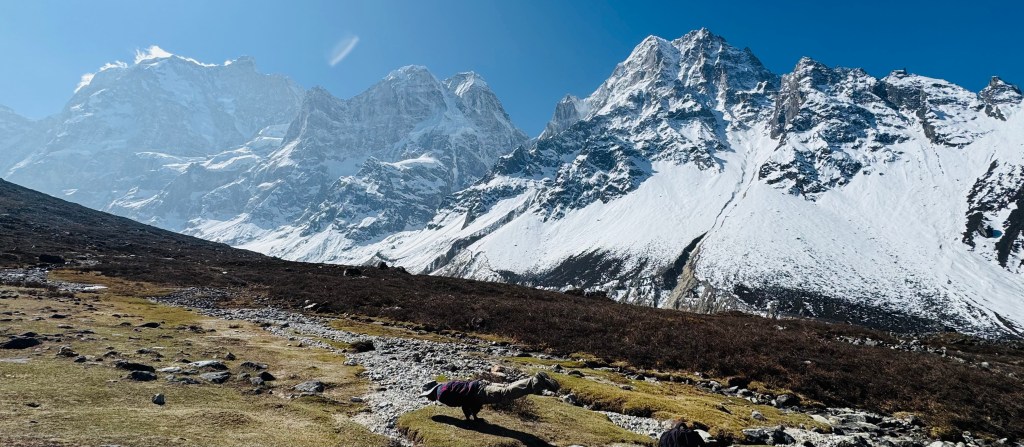
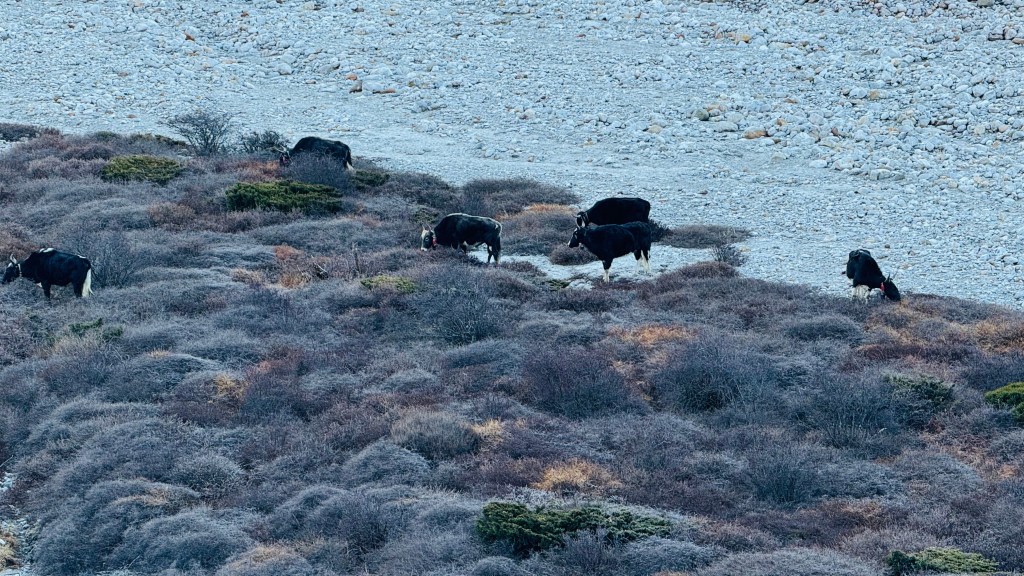
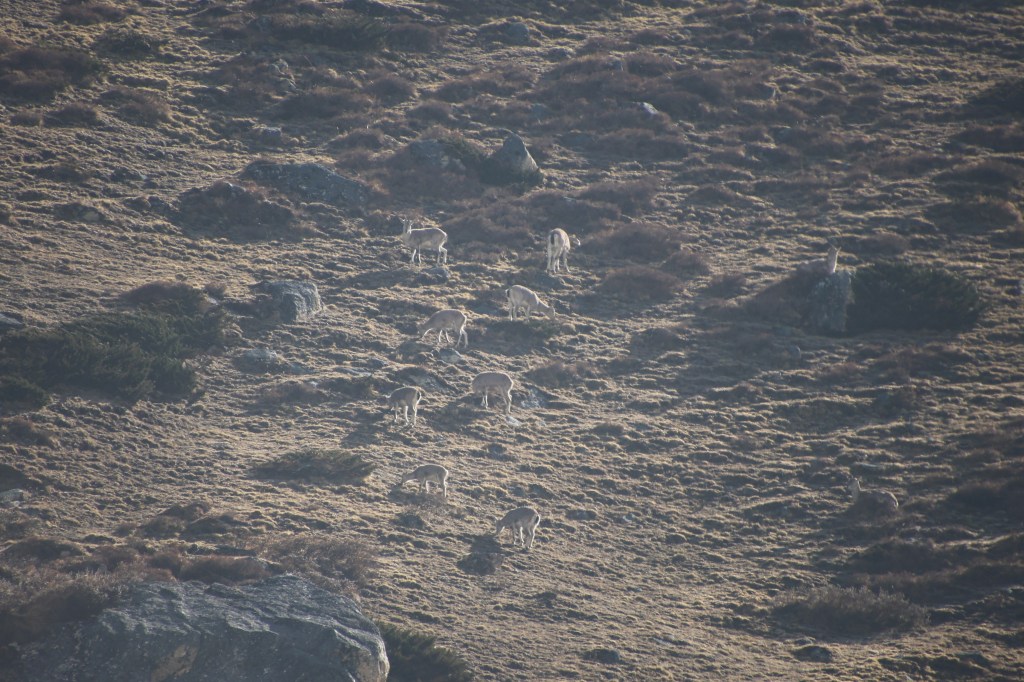
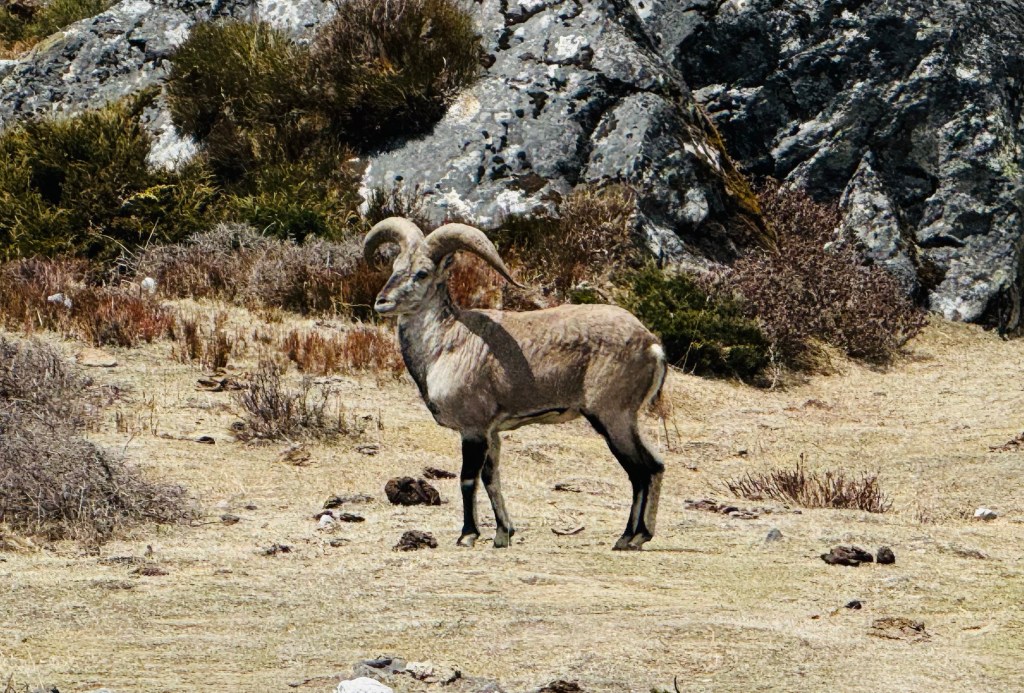
On the left side, the sloping hills displayed their repertoire of rocks. We kept moving. After sometime, something on these slopes caught our attention. We saw some objects moving. Some minor pebbles and stones came down from high above from where we saw the moving objects. A closer look revealed a flock of Himalayan blue sheep. Some also refer to them as mountain goats. They were grazing in the higher areas. I wondered what was there to graze in the stack of rocks. There wasn’t much vegetation up there. Looking at them through the zoom lenses revealed the details of the terrain on which they were roaming. These animals are swift to move along narrow rocky trails by moving from one rock to another by jumping along or tiptoeing. We’ve seen them in different parts of Nepal. At times, they send down streams of pebbles or rocks by their movements, causing problems for travelers treading the narrow paths below them. Males have thick, curly horns decorating their heads. It was a large group.
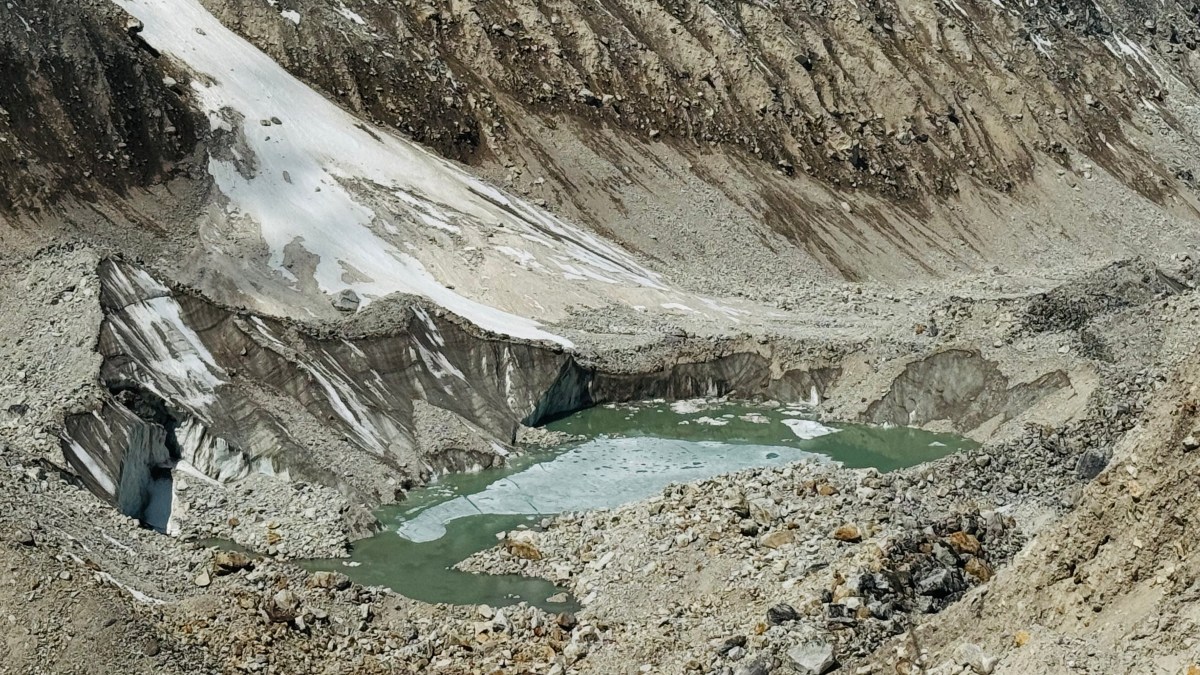
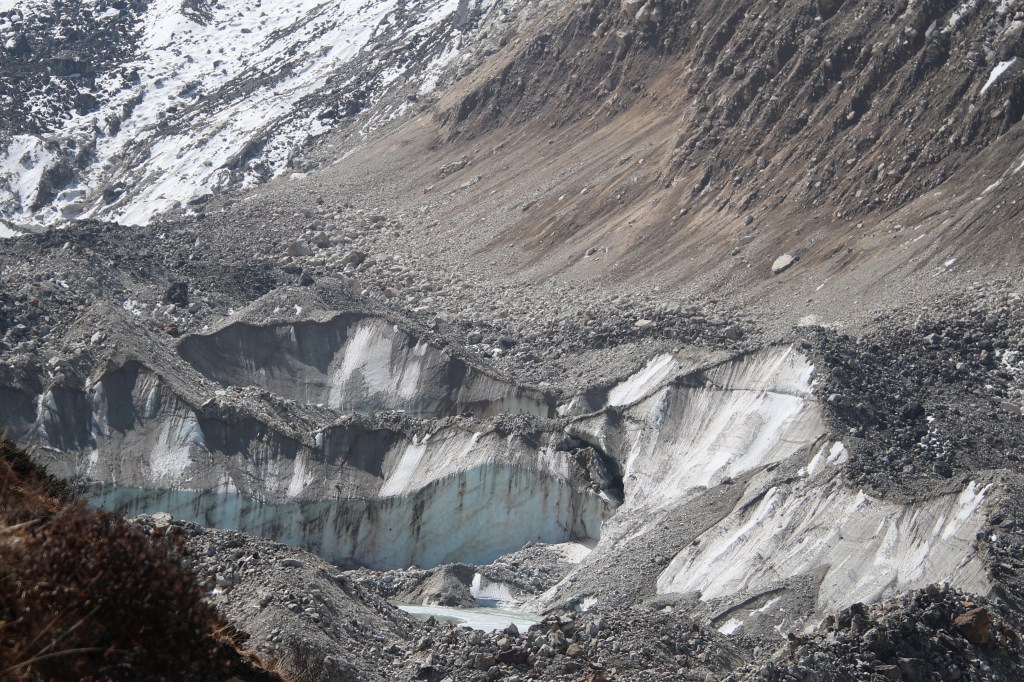
We continued on our trail. The entire path was shining bright since we were out of the shadows of the mountains. The ground was more or less flat and walking was easy. There was a gradual gain of elevation, but we couldn’t feel it on our knees. Though the ground was flat, but we could see its edge. The trail gradually moved towards the edge. Beyond it, there was an abrupt drop to the bed of a huge glacier. It was the first sight of a glacier on this trail. It brought back memories of our walk along the moraine of the Khumbu glacier on our way to Gorakhshep. The sight was similar. A huge river of ice camouflaged by rocks and debris. It was intespersed with small and large glacial pools that revealed the underlying ice blocks along their edges. We started walking along the edge of the glacier.
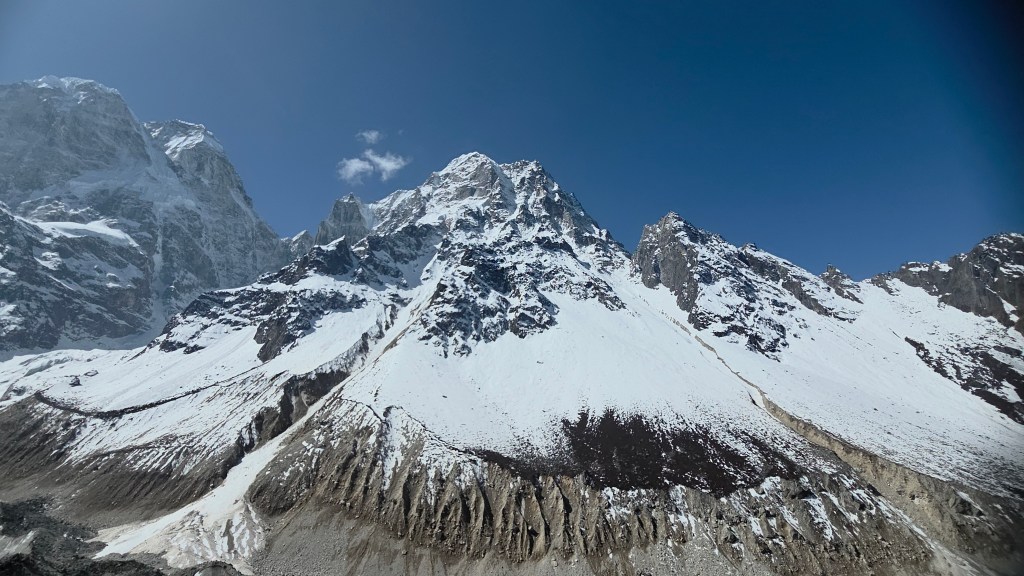
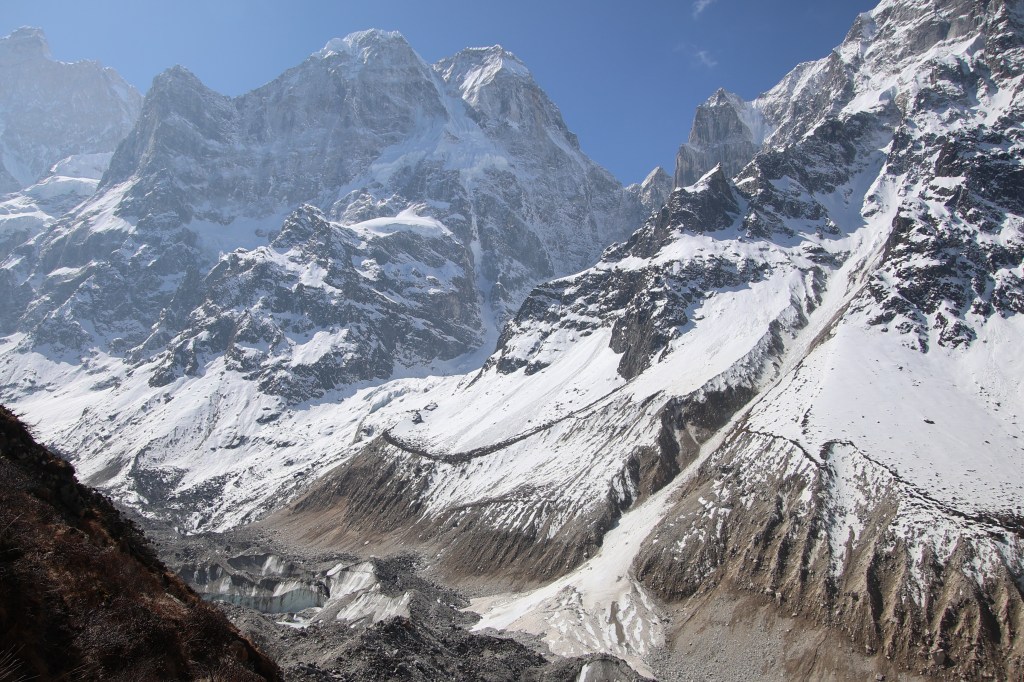
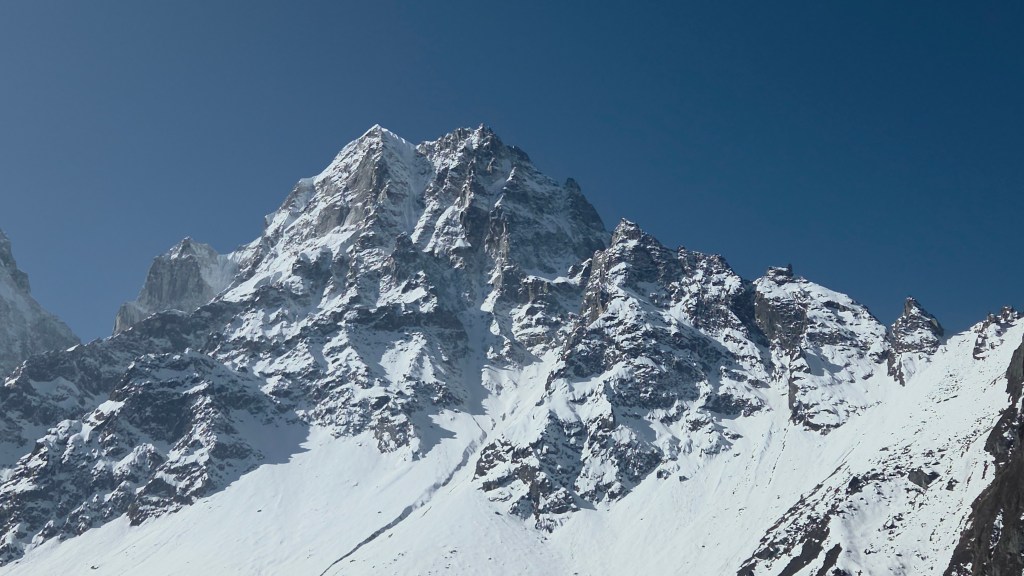
Suddenly, I heard a series of creaking sound. Was it an avalanche? I looked at the slopes of the mountains on the other side of the glacier but couldn’t see anything. The sound came again and I looked here and there along the glacier, along its slopes but couldn’t correlate the source. From thereon, that creaking and cracking sound accompanied us for the entire route till the base camp. It turned out that these were caused by the weight of ice, snow and rocks weighing down upon the glacier causing cracks and crevasses in its internal body. The place, which was otherwise marked with a pin drop silence, was filled with this surreal sound. I don’t recall hearing such sounds from the Khumbu glacier on our way to Gorakshep. The reason is simple. That route was much more crowded and the combined sound of so many travellers going towards Gorakshep/Everest Base Camp suppressed the sounds generated by the glacier. But we were the only visible travelers on this route, hence, the entire environment was available to us. Everest hogs the limelight because of its tag of the being the highest or should we say that it suffers because of it. There’s everything on that route except solitude. Kangchenjunga has so far been spared from that curse. Its region has the proper balance of trekking infrastructure and solitude (unlike Makalu , which just has the latter). The north face of Mt Jannu kept increasing in stature.
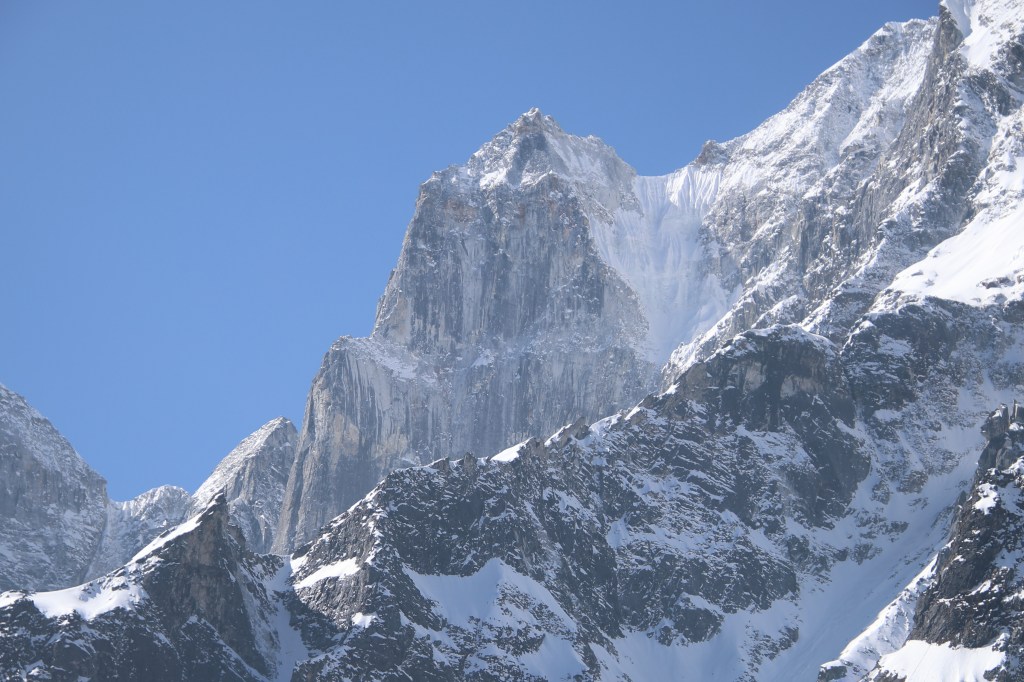
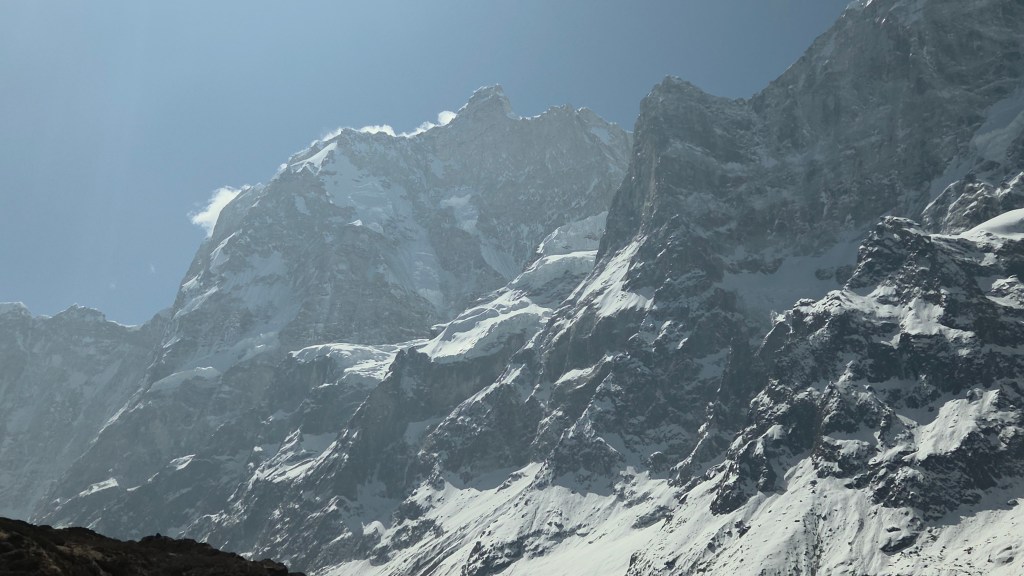
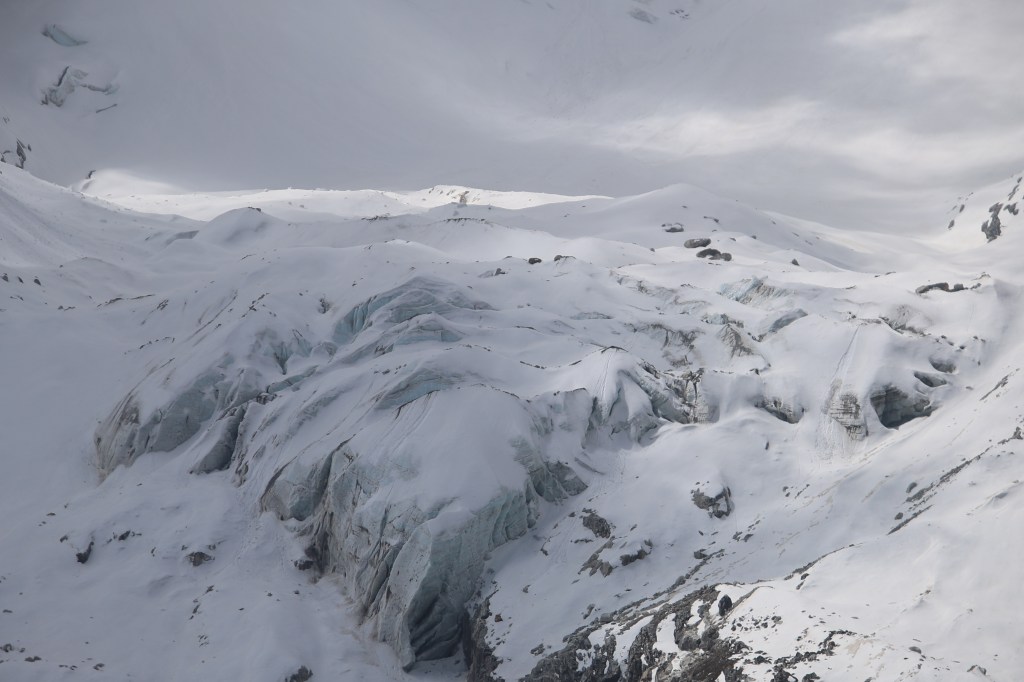
Its neighbors (most them reaching higher than 7000 m) also kept raising their heads. The flow of the glaciers along the slopes of these mountains became clearer. some of them came down along rough beds causing ice falls. Their cracks started revealing bluish or greenish colors. The sun was benevolent, clouds stayed clear off the mountain tops, except for a few puffs here and there. Earlier, we had to make our way though thorny bushes, but now even they disappeared from our tracks.
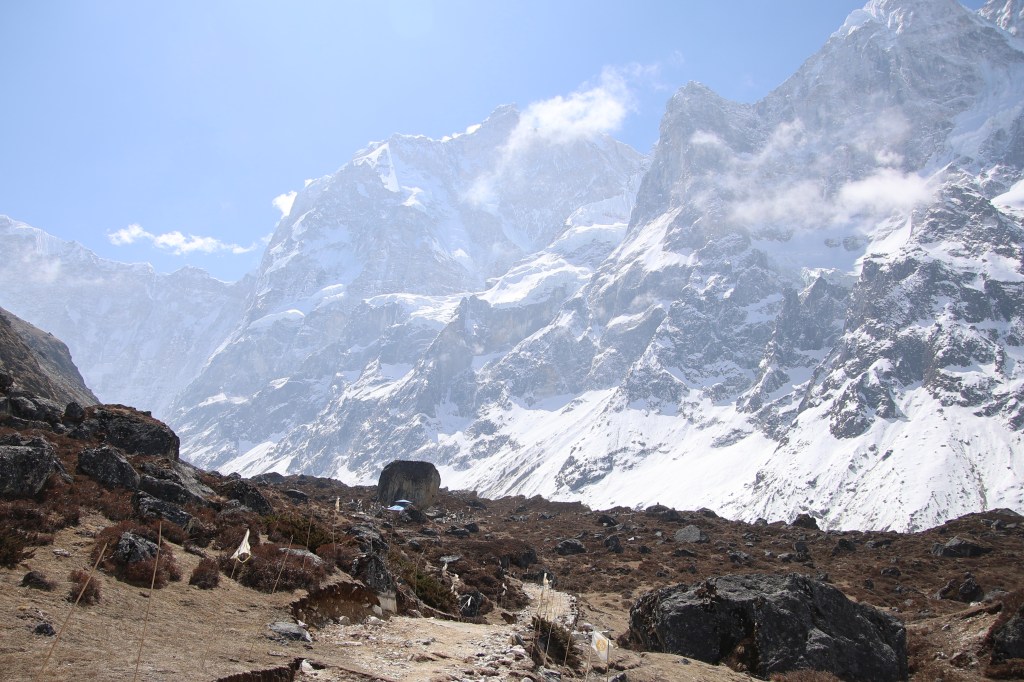
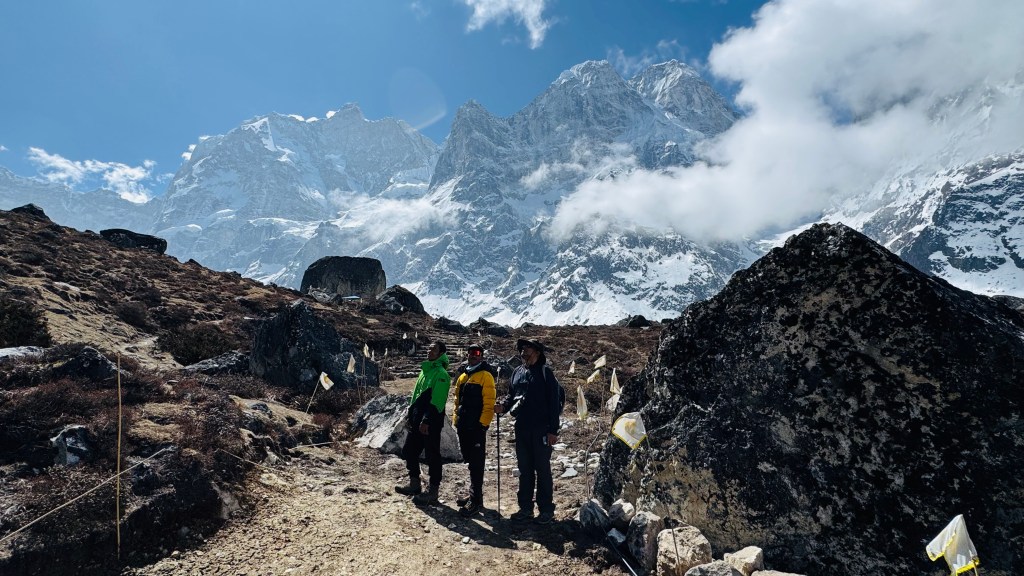
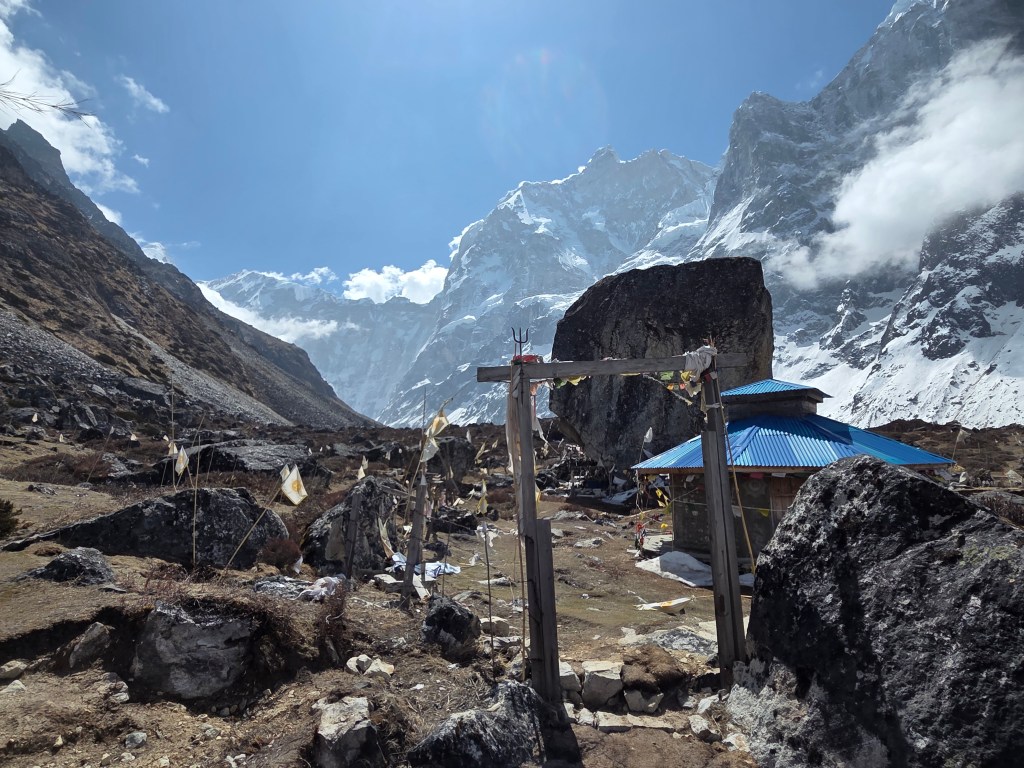
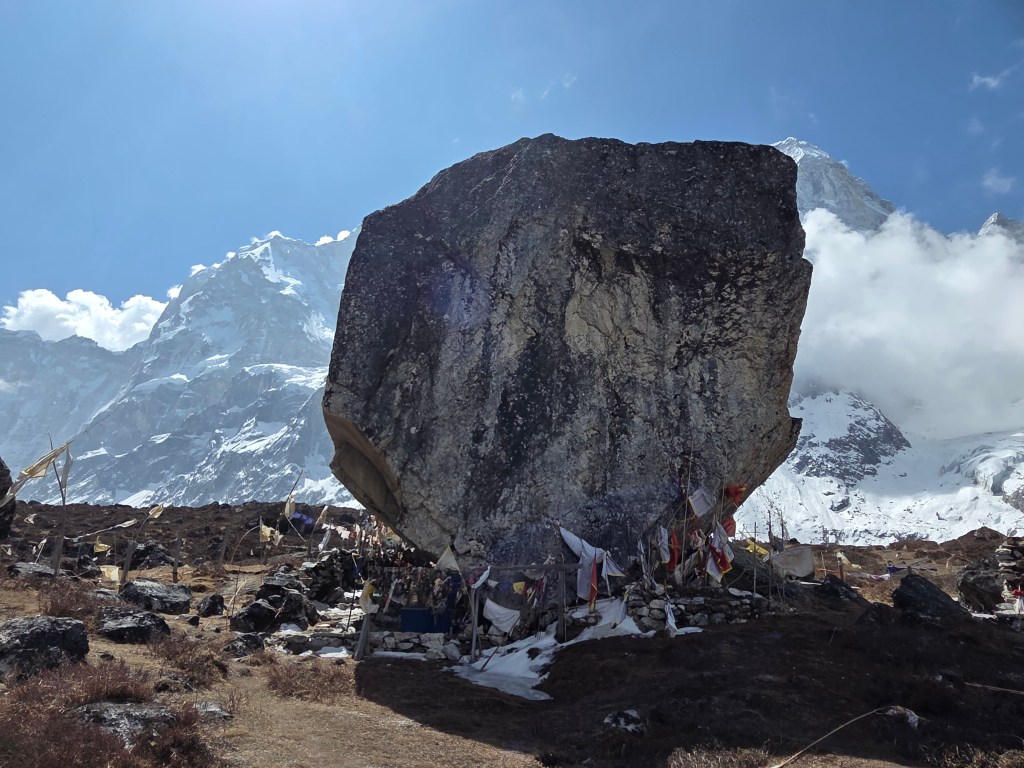
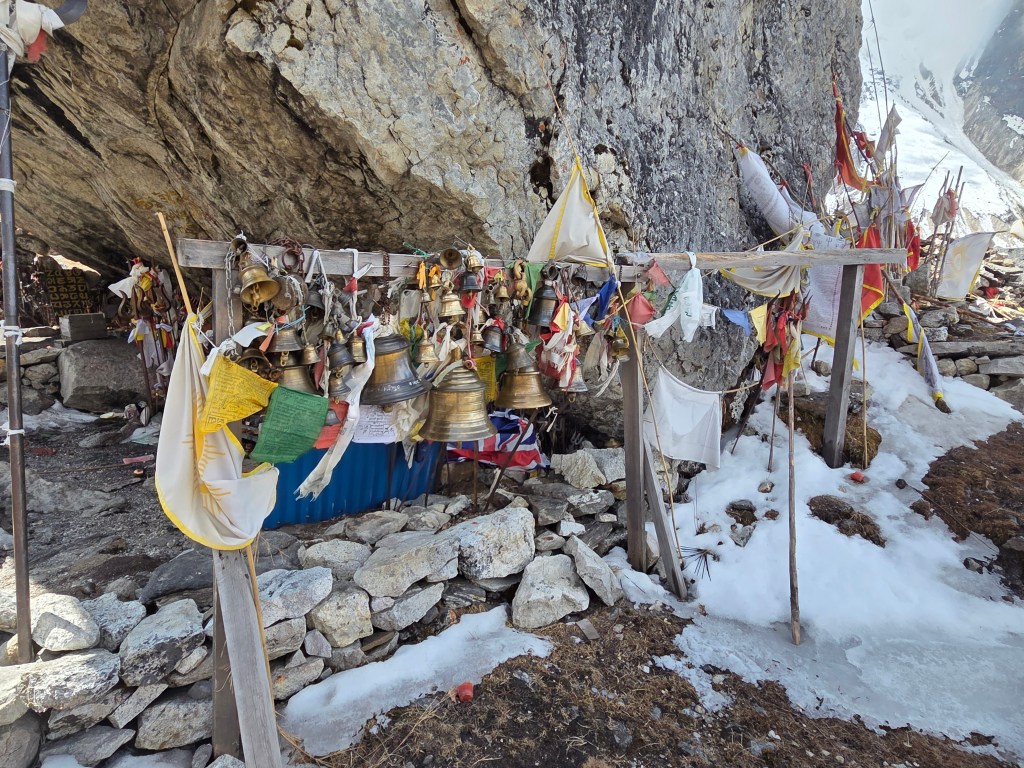
Limbu pointed towards a huge rock at some distance. That was our destination. It grew in stature as we moved towards it. When we finaly reached near it, it turned out to be as big as a house. Tibetan prayer flags dotted the place and the rock was covered with Tibetan mantras. The area around it was cordonned off by a wired boundary and one had to enter it through a gate (also decorated with prayer flags). We found ourselves standing at the center of an amphitheatre surrounded by Himalayan peaks, Mt Jannu being the most prominent.
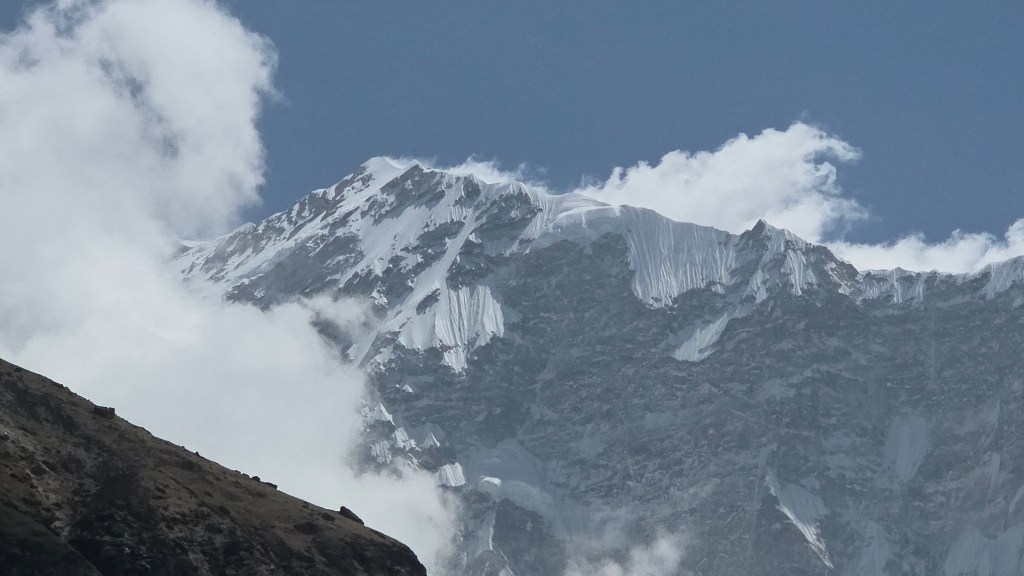
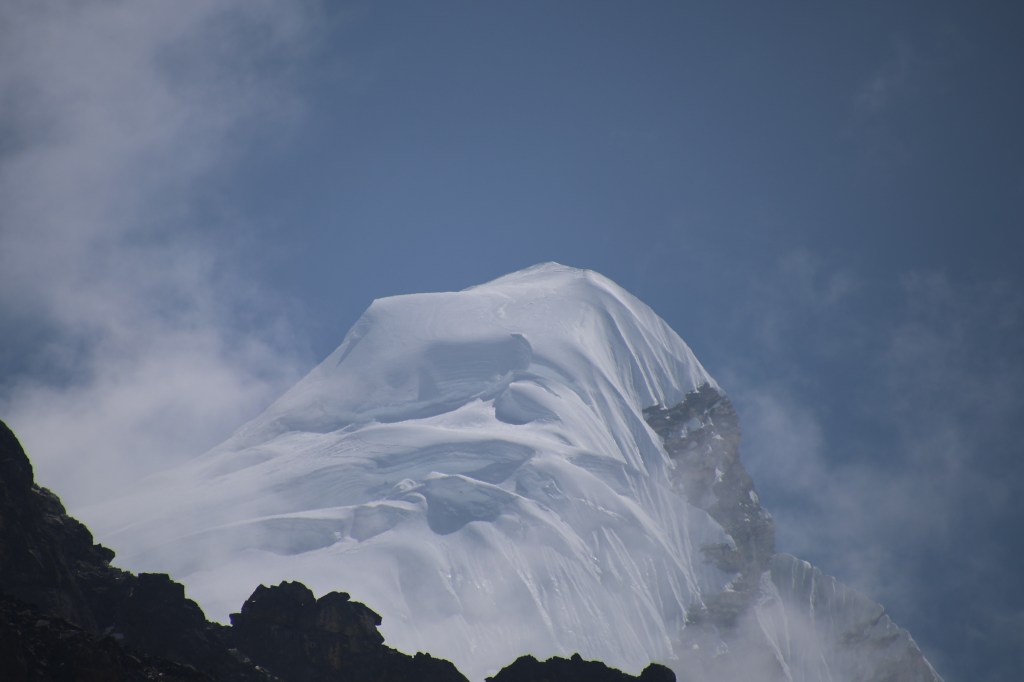
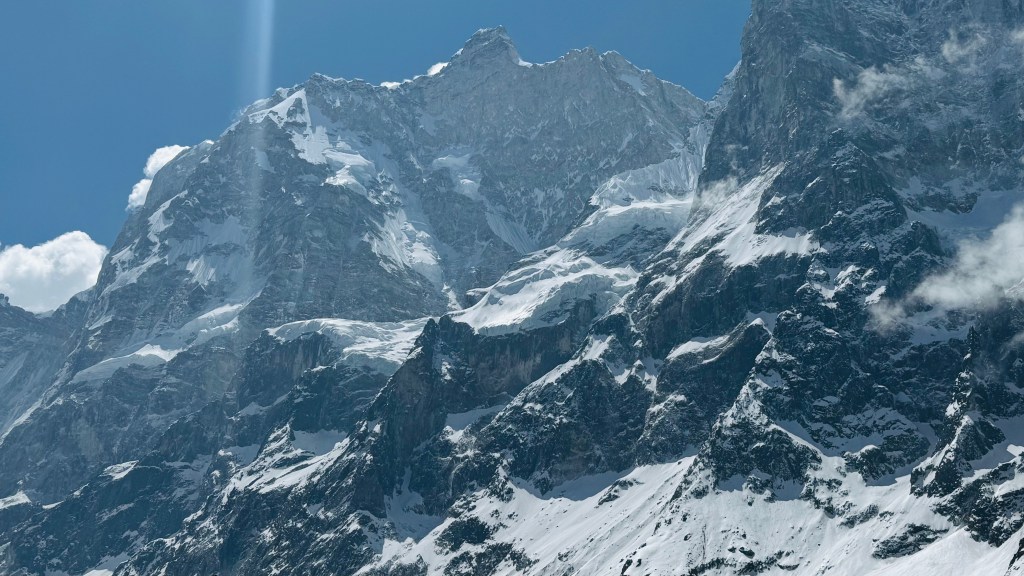
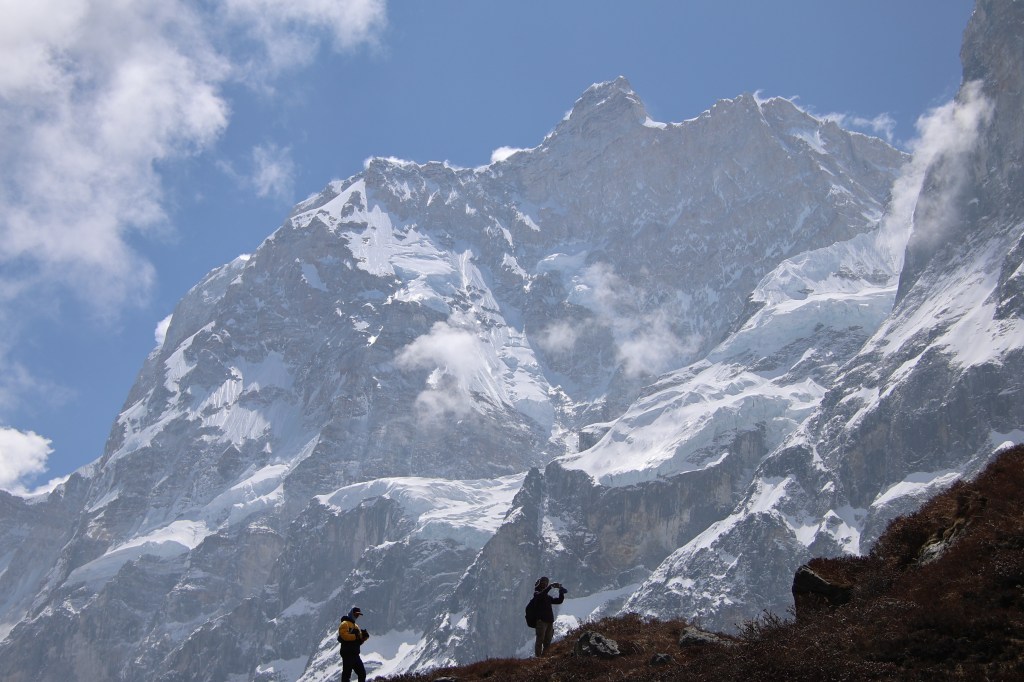
The illusion of a human head was even more apparent from this point. This place sees a lot of visitors during the month of October and November when people from villages near Ghunsa or even from lower valleys come for worshipping what they regard as a deity. There was also a small house with a tinned roof. It was devoid of inhabitants, but there were ample signs of regular use of it. We went beyond the place and up to the edge of the glacier. Looking down upon it, the steep drop of broken rocks went all the way to the glacial bed.
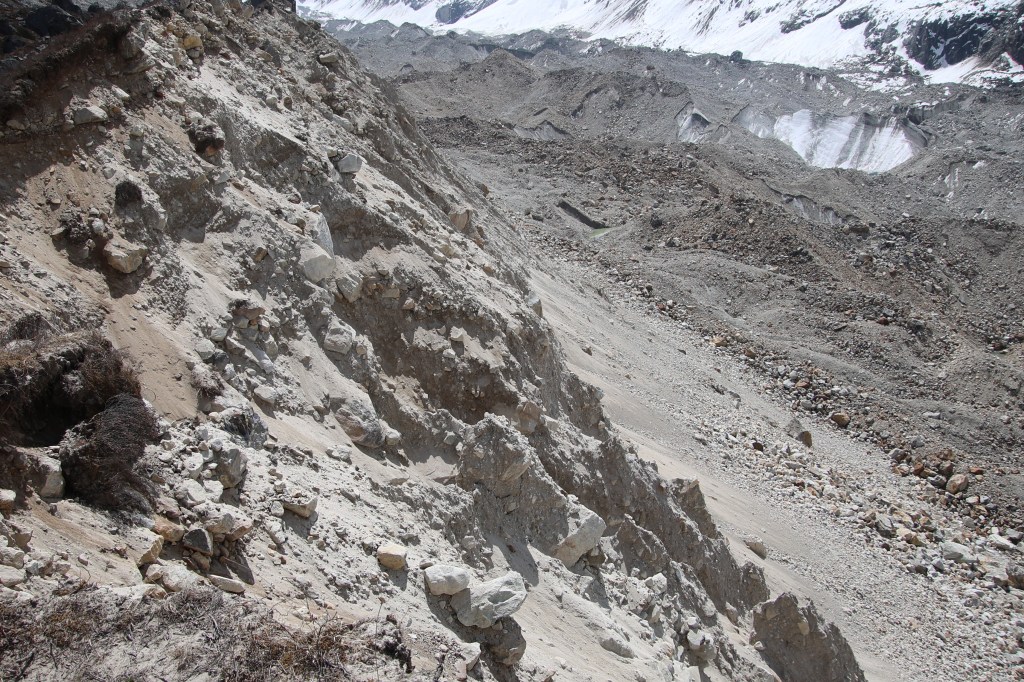
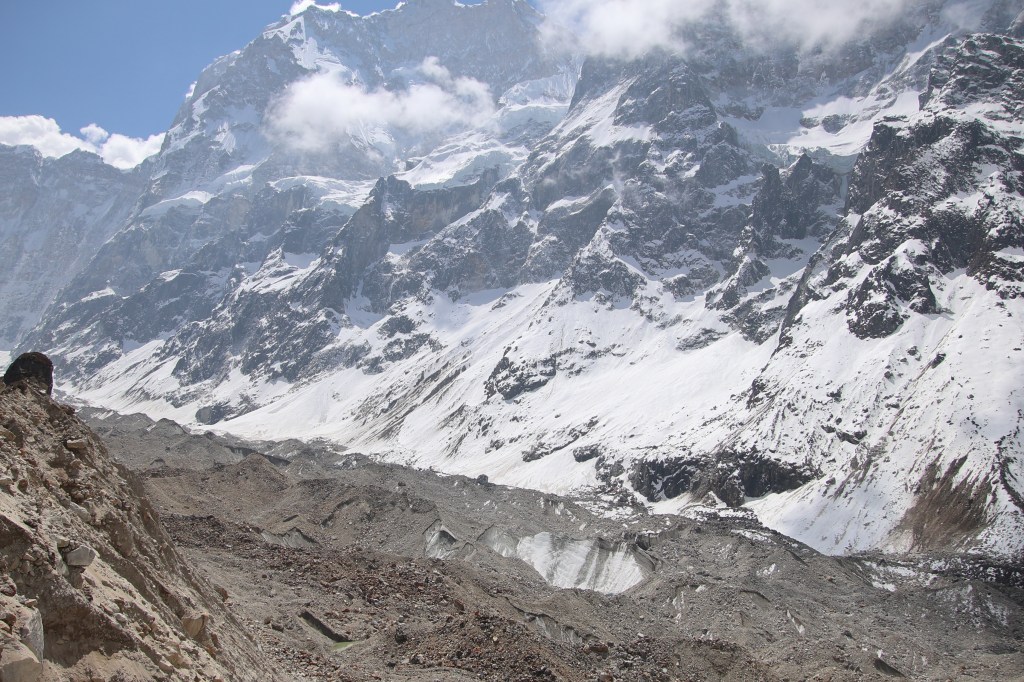
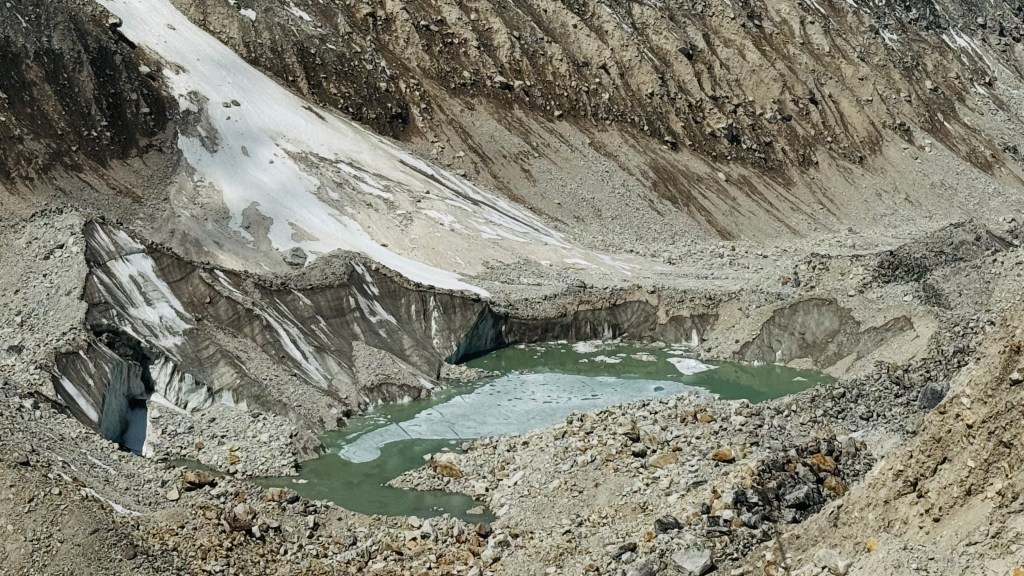
The entire bed was filled with cracks and crevasses. It bore a look of a stream of debris, dotted with rocks of different sizes. The only proof of presence of snow and ice were its innumerable crevasses that revealed the underlying ice formed over thousands of years of precipitation. Some cracks were wide enough to form small and large green pools of glacial water.
Jannu base camp
Our phones and cameras were busy capturing the snapshots and videos. We even posed with a banner of "Nepal Alternative Treks" against the backdrop of the surrounding mountains. It turned out to be an easy hike with heaps of rewards. Clouds started making their way towards the mountain tops. That told us, it was time for us to head back. We were satisfied to the brim. But nature had more surprises in store for us. The bright sunshine disappeared when we started going down. Walking was fast and easy. As we kept losing height, oxygen supply increased and we felt less thirsty than while going up. We descended fast and almost in no time, we reached the junction where the route merged with the main route towards Khambachhen.
En-route Khambachhen
Just when we were about to take a left turn towards the suspension bridge towards Khambachhen, a herd of mountain goats crossed the trail a few meters ahead of us. Dhananjoy was able to shoot a marvellous video of them sprinting along the path. One of the males even obliged to turn around to give a gorgeous pose for a still photograph.
We crossed over the Ghunsa river and started the gradual hike towards Khambachhen along the familiar trail. We were just in time for lunch. After lunch, I relaxed by lying down on the comfortable armchairs laid out in the lawn and kept watching Nupu and his associates, who toiled hard with their yaks to prepare the fields for potato farming. Limbu also led his hand. In these parts of the world, no one cares about the kind of work. They do whatever it takes to get things done without depending on others. Others (like Limbu) also lend their hand of help.
Khambachhen
The evening was more colorful as we met more groups coming up from Ghunsa. The French group of aged people, the group from the USA, all were present at the dining area. It was buzzing with conversations. The group from the USA was planning to go to Nupchu Pokhari (a distant lake) for their acclimatization. It was good to reunite with the French group. Instead of acclimatizing for the next day, their plan for the morrow was to proceed to Lhonak (just like us). They'd spend an extra day at Khambachhen on their way down. After dinner, when we were giving orders for breakfast, Dhananjoy brought up the topic of chapatis once again. He stressed that they should be roasted more to make them crispy. He had challenges explaining it to Nupu and his wife, but by observing his gestures, they guessed it and asked, "You want them to be Churum Churum (the Nepali word for crispy)?" We jumped at this suggestion, though it was subject to scrutiny for the next day. Our rest at Khambachhen was drawing to a close. We felt at home at this place, so I was a bit disappointed to leave, but the propect to get nearer to the basecamp was exciting.


2 thoughts on “Kangchenjunga north base camp – acclimatization, Jannu Himal base camp”