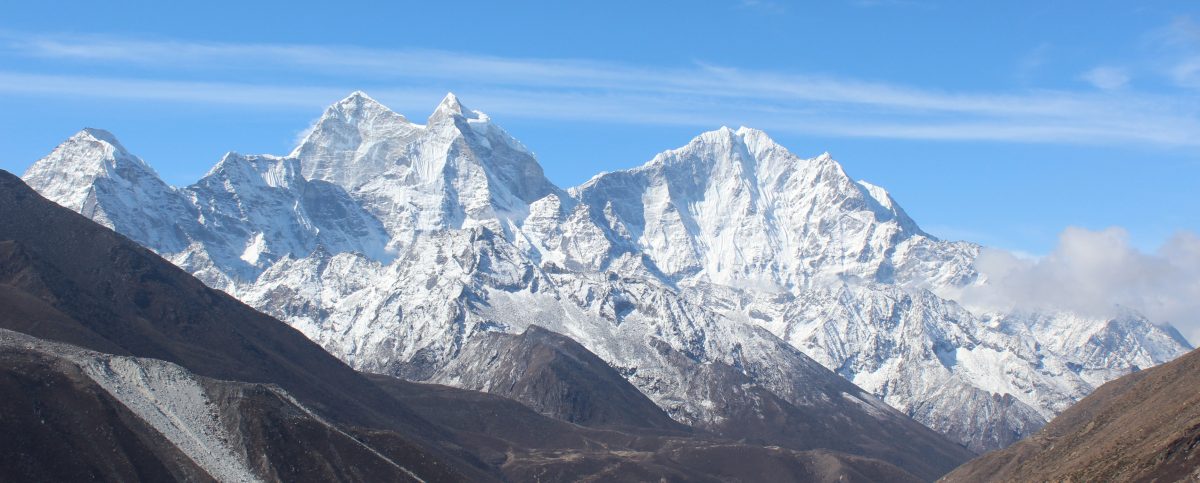

Drohmo Ri, 21st April, 2026
Based on experiences of Dhananjoy Dey and Dilal
The alarm went off which set the tent abuzz with activities. Considering the settings, sleep wasn’t that bad. The tent was reasonably comfortable under the conditions. The people of Nepal work so hard to make such things happen. Such arrangements are unheard of in other parts of the Himalayas. It didn’t take long for Dhananjoy And Dilal to get ready. Minimal stuff was to be carried (a bottle of water, the required warm wears and of course, the head lamp). As they ventured out of the tent, the sky was pitch dark, but studded with stars. Despite multiple layers of warm wear, the cold was biting. Members from other groupss also started coming out. Though few people were around (most of them went back to Lhonak on the previous afternoon and others were to reach much later in the morning), the place was alight with head lamps. Beams of torches moved around. Dhananjoy and Dilal cast a quick glance to the surrounding mountains. Their dark silhouettes were clearly visible. Beyond which, innumerable stars dotted the sky. They started moving towards the slopes behind the tea houses. Despite being from different groups, they kept together like a flock. At this stage, memberships don’t matter and everyone relies upon each other. It’s not a normal trail, even by the mountain standards. Drohmo Ri reaches almost to a height of 6000 m and there’s no proper trail, except for some traces left by earlier travelers. These signs (via cairns) get dismantled often because of falling rocks.. TTracks change on a seasonal (if not daily/weekly) basis. Starting at the wee hours reminded Dhananjoy of the Kalapathhar and the Roopkund hikes. On both occassions, height was lesser and there was an established trail. Fortunately, one of the guides from another group had been to Drohmo Ri on multiple occassions. He led the group. Soon after the tea houses, the trail started moving up and the incline changed drastically. Walking poles became necessary to have some grip. As they moved up, pebbles started coming into play and steps had to be careful. The air was already thin at the base camp and would get thinner with every inch gained. Travelers moved close to each other (maintaining just enough space to avoid tumbling upon the person lower down the order, in case of a slide) to keep company and help others, if needed. Sounds of breaths became louder with increasing altitude. The ground wasn’t just unstable, but was covered with frost. With gain of height, steepness increased. So did the size of the stones and their snow cover. One couldn’t call it frost anymore. After a hike of about 40 minutes, the sky started acquiring a brighter shade. They stopped and looklooked back. The Kangchenjunga and its colleagues also rose in height, but theyy apppearared neanearerr. At the base camp, they were awestruck visitors, but now the mountains seemed to extend their hands towards them. Early rays of sun started to remove the darkness from the Kangchenjunga massif. The twin summits of Kangchenjunga and its neighbor Yalung Kang, started to emerge out of darkness. The entire flow of the glacier from Kangchenjunga’s slopes started to reveal itself.

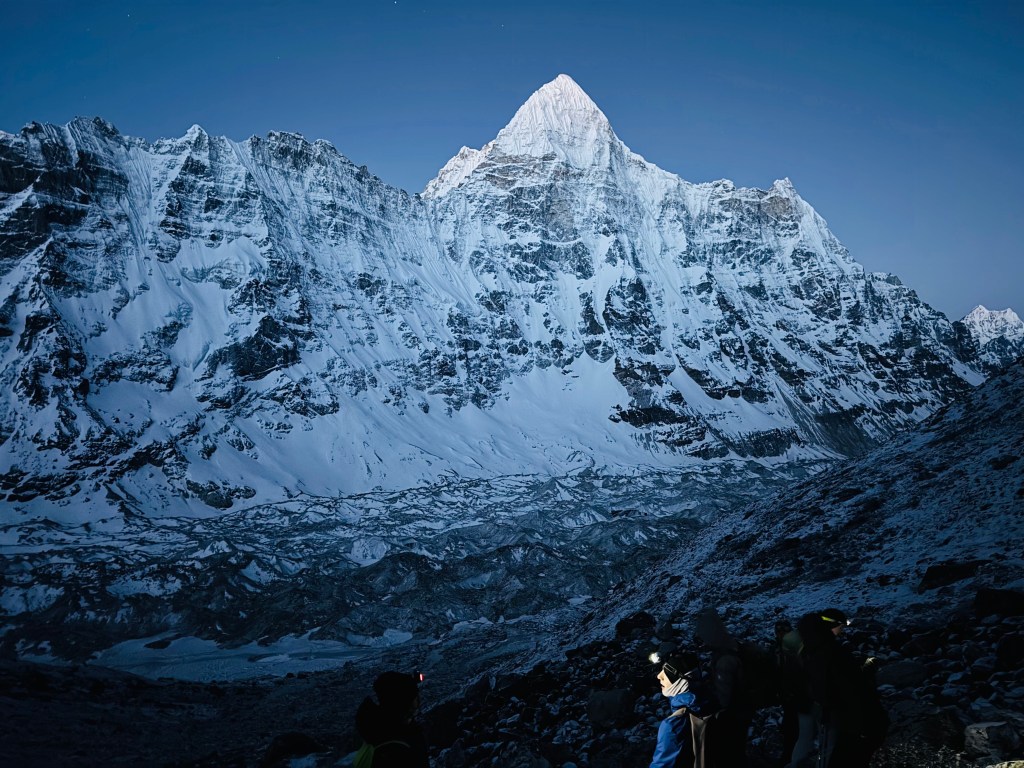
Small puffs of snow blew from the summits. The daylight wasn’t strong yyett to wipe off the stars from the canvas. The ground below will still dark. Mouths ran dry frequently and they had to take frequent sips from theirir bottles. The sun (still invisible) kept changing its angles and its rays started spreading in the valley. When they turned looklooked towards Lhonak, they could see the faint outline of the stream of ice of the Kangchenjunga glacier. Its uneven bed of rocks had greater shades of white as compared to its lower reaches at Lhonak. Its huge expanse was still hidden in darkness but the solar rays gradually started invading. Prior experience in the Himalayas told Dhananjoy that the drama of colors was about to unfold. The stage was set. But they couldn’t afford to stop as Drohmo Ri was still further ahead. The entire ascent and descent required at least 6 hours. By that scale, they still had 2 hours to reach the destination. Ideally, the target was to reach there just when the sun was about to rise. But the height, terrain and the cold was deterring. The size of the boulders increased. More often, they had to use their hands to get over them. After sometime, they had to do away with the walking poles as they needed the support of their limbs as well as hands to negotiate the terrain. The crust of snow over the rocks weren’t a factor yet but that would change soon with the rising sun. That was another reason for stoppingping, despite the appealing views. One would like to cover as much ground as possible to give a chance to reach the top. All said and done, there needs to be a hard turnaround time based on the calculated risk. Multiple factors went into that algorithm – the remaining distance, the incline of the slopes, the cover of ice on their surface and above all, the position of the sun. The last factor decides the risk of descent. As they say, ascent is only half of the story. The trick is to come back down safe. But they left all that to the experienced guide who’ve been there before. Despite the rush, they couldn’t ignore the canvas behind their backs where scenes were changing fast.
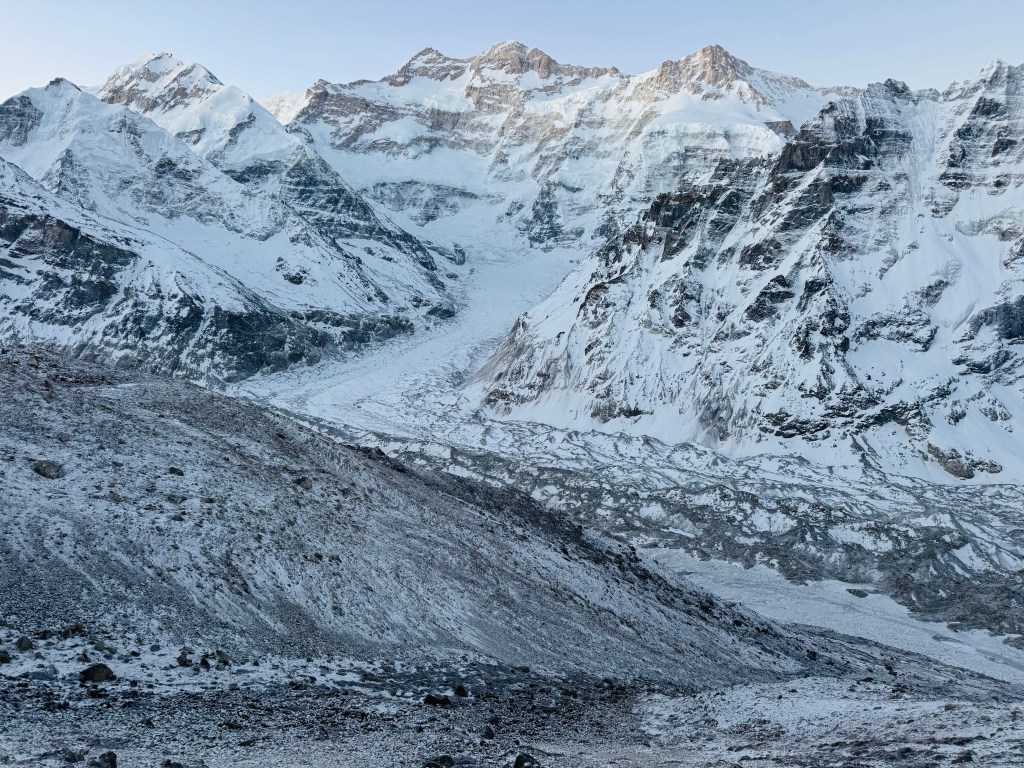
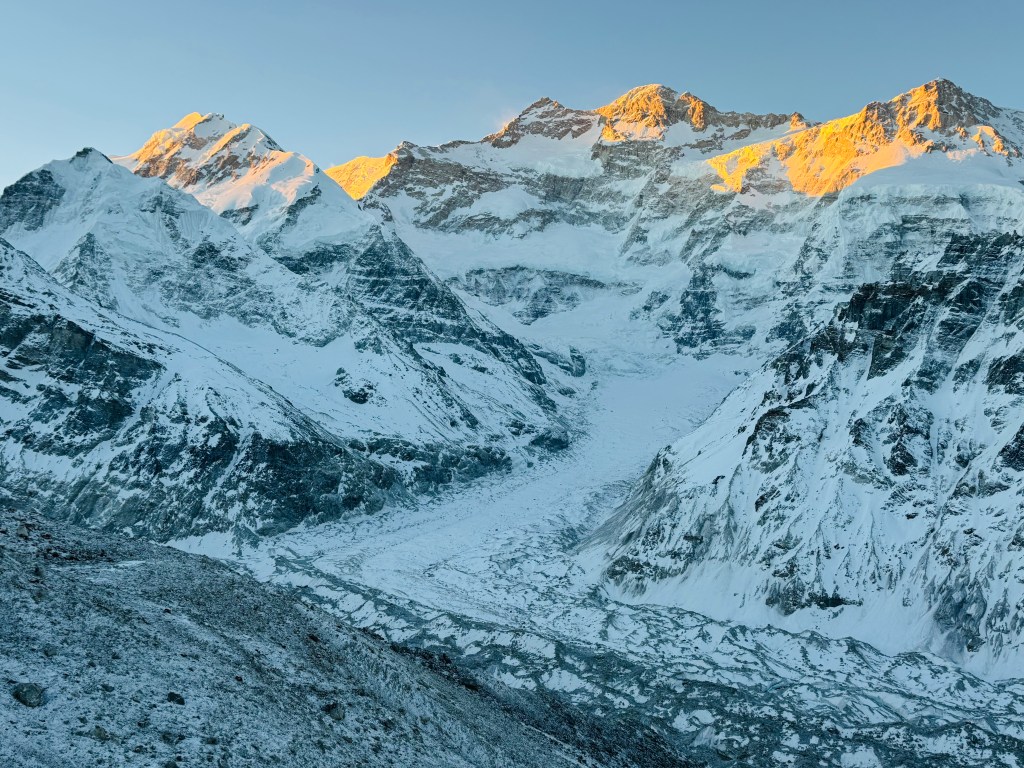
LookLooking back, they saw the entire valley was out of darkness. The full course of the Kangchenjunga glacier was now visible right from its inception from the slopes of the massif, all the way down where it followed a curved track to meet the main stream of ice. It was all monochrome. But that was about to change soon. The summit of Yalung Kang was the first to receive the touch of gold. It then started spreading to the neighbors. The main Kangchenjunga summit acquired a golden outline, but the color of flying plumes of snow from behind its summit indicated that it received its share of golden shower on that side which wasn’t visible from Pangpema.
En-route Drohmo Ri
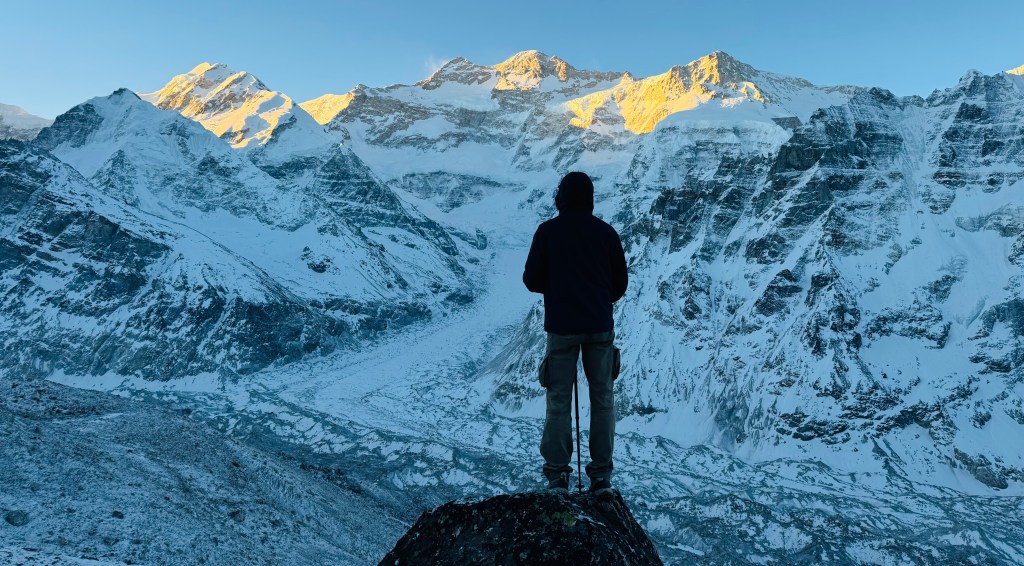
They kept plodding ahead, but it started setting on them that it was going to be a tough ask. Time wasn't the problem, terrain was. Even if one was fit enough to overcome the effects of altitude, but they kept thinking about the descent. The snow now covered almost the entire trail. It gave an uneasy levelness,, hiding the gaps bebetweenween the loosely stacked rocks. They'd have to descend over the same surface during a period, when the solar rays would ststart mert meltingting the snnow on w on the rockhe rocks, making them, making them. The crust of snow covering the surface would melt, making themhem ripe for slides. The incline made it more dangerous to arrest such slides during descent.
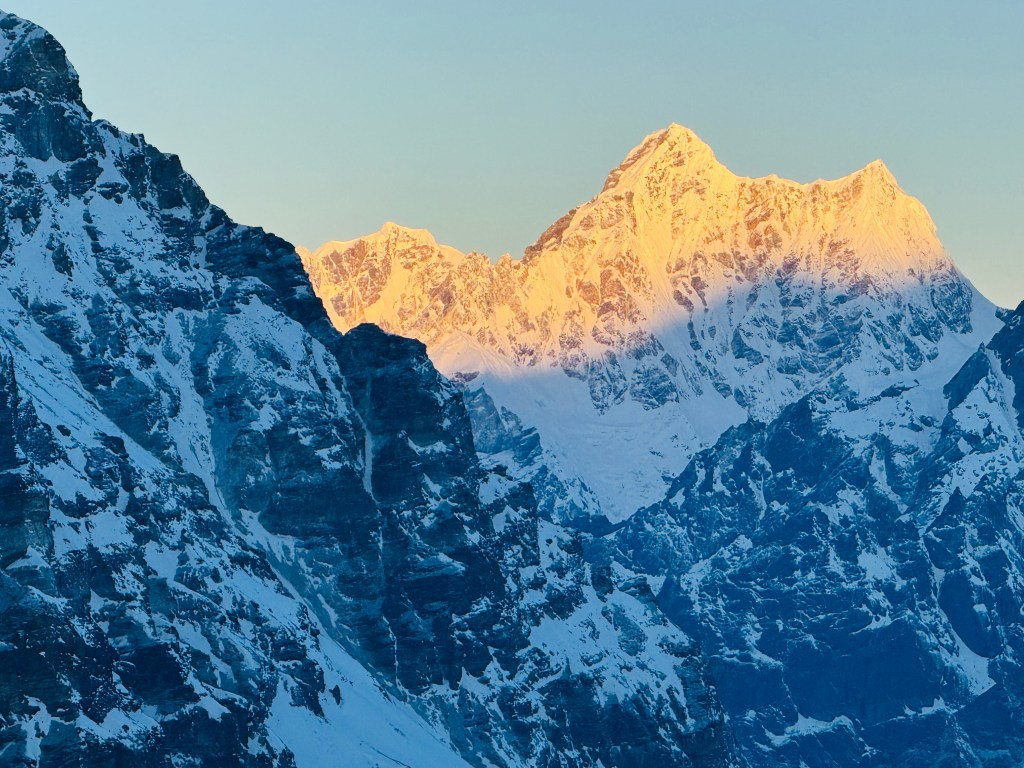
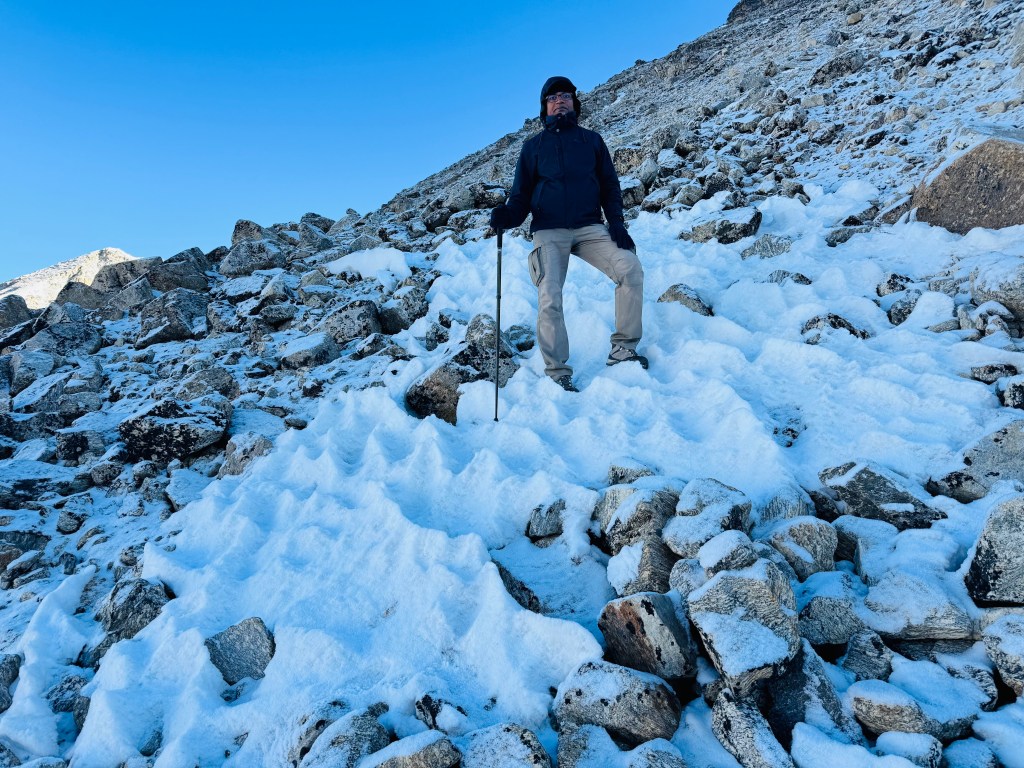

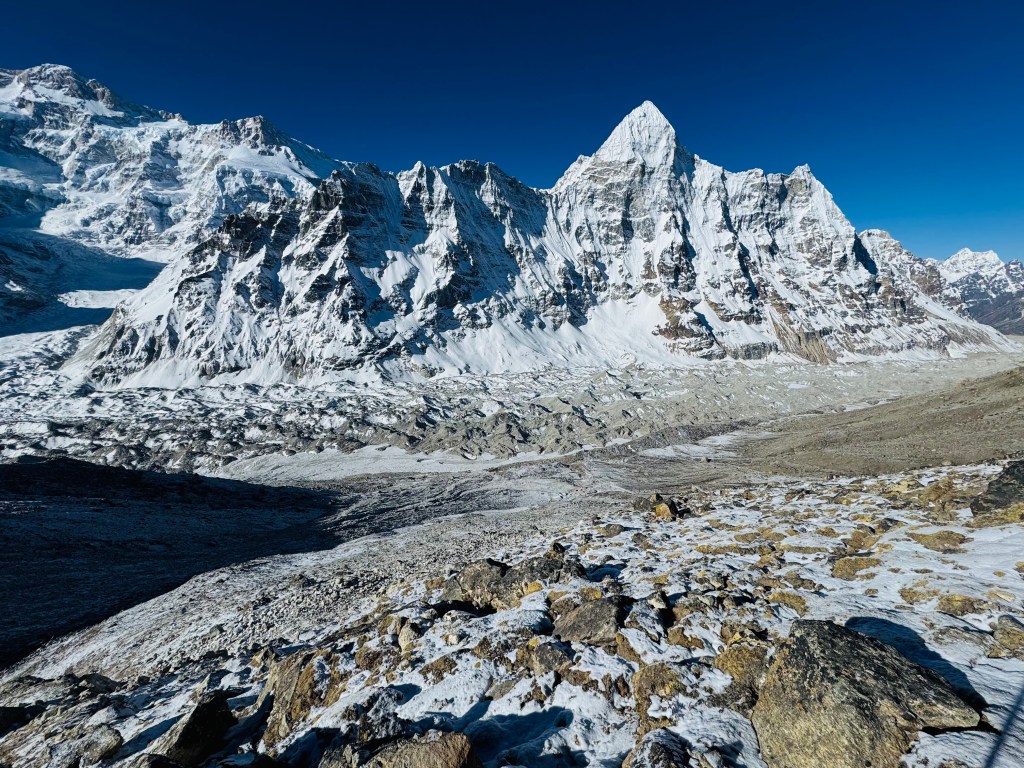
By now the sun was at its full display. The colors on the mountain slopes changed to dazzling silver. It had been 3 hours since they started. At about 7 AM, theyhey decided too tuturnn ararouundd as as the riskisk wasn''t worth taking taking. Dhananjoy usually doesn't budge so easily, but when it came from the mouth of the local expert, he had to heed. Though the actual top of Drohmo Ri remained beyond limits, but nature was generous enough to fill their laps with ample display of it's beauty. Just as they were about to descendd, Dhananjoy's gaze got fixed at a growing cloud of white coming down the slopes of Mt Kangchenjunga. An avalanche! It wasn't big, going by the standards at Kangchenjunga, but the mountain was kind enough to reveal itself in its all forms. Despite having to turn around, there was no reason to complain.
En-route Drohmo Ri
The descent was challenging enough because of its slope, uneavenness and the cover of snow. There were a few slides on their way down, but fortunately, arrested within limits. Apart from the wetness caused by the ice, there wasn't any other cause of concern. The incline eased with descent and with careful steps they made it down to the base camp by 8 AM. They reached the limits that were permissible under the circumstances.
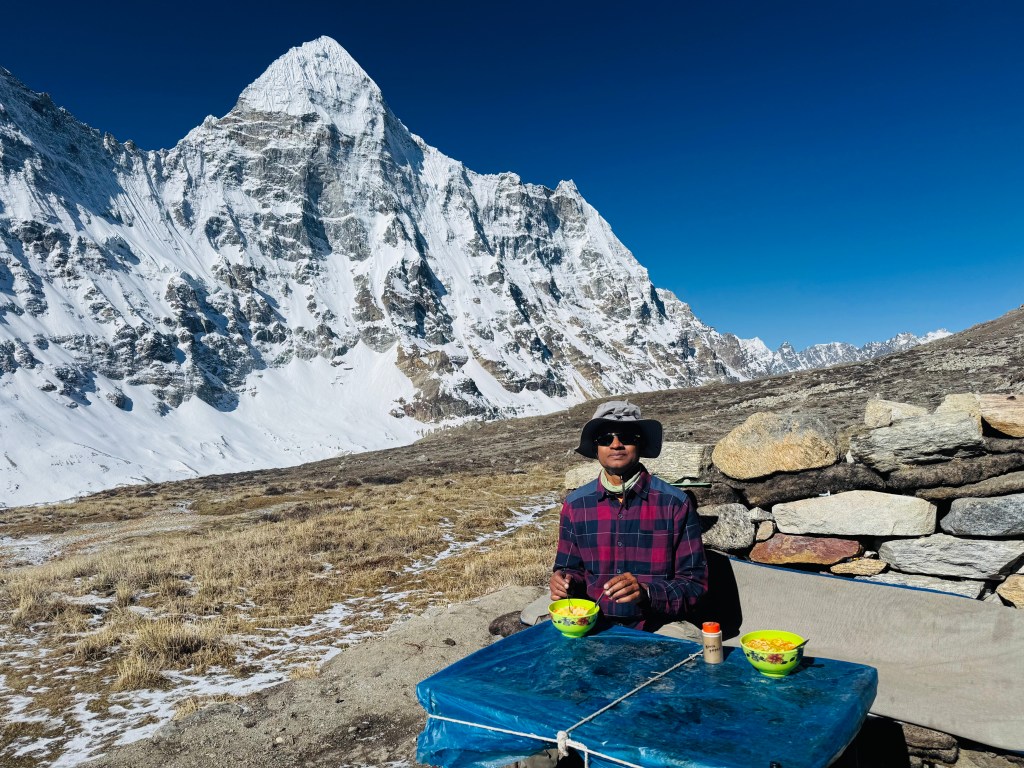
After breakfast, it was time to bid goodbye to the Pangpema base camp. For one last time, Dhananjoy cast a glance at the Kangchenjunga massif as it was about to disappear from sight. They turned their attention and headed towards Lhonak.


Lhonak, 21st April, 2026
I had better sleep on the previous night. Some of it may have had to do with getting adjusted to the altitude, but the rest of it was about the prospect of having a full day's rest at Lhonak. There was no hurry to get up early as there was nowhere to go (or so I thought). The alarm went off, but I kept lying on my bed, enjoying the warmth of the blanket. But after sometime, looking at the sunlight through my window, I felt it was criminal to lie down while the sun played the painter on the mountain tops. I came out to the lawn and quite expectedly, the colors started unfolding on the canvas.


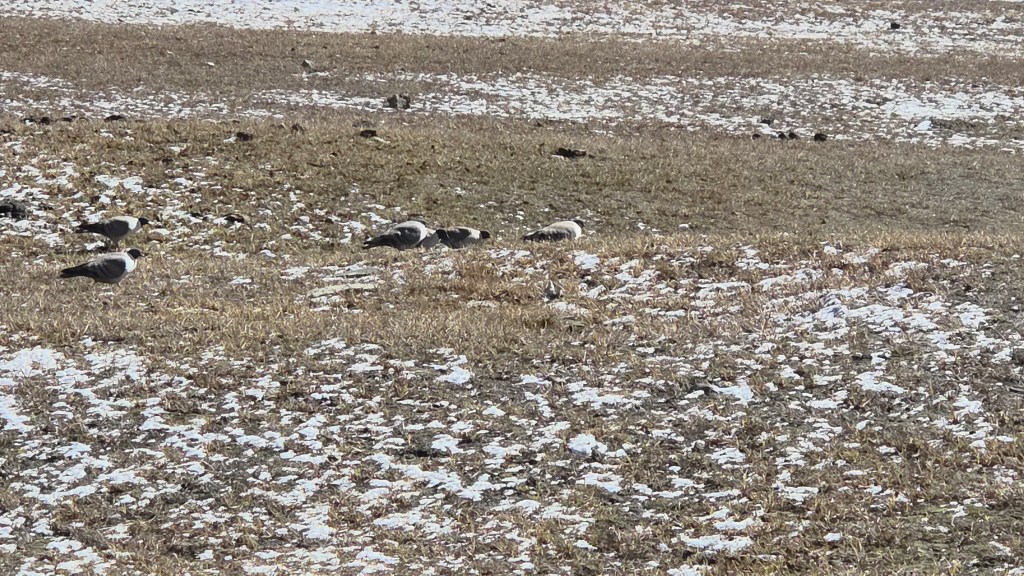

As the day before, there was frost on the ground, but the lawn was bathing in sunshine. I had my breakfast and chose to lie down on the benches spread out in the lawn. Carole was out there too. She would be leaving for Khambachhen in the morning. She had been interviewing people at different locations on this route about the changing climate and its effect on their lives. She had interviewed Nupu's brother at Ghunsa. She was now planning to interview the current lodge owner and had plans to interview Nupu at Khambachhen. The owner, who was roaming around in the lawn, holding the little hands of his small kid, trying to make him learn to walk. The kid would creep on the frost, try to rise up taking support of the chairs, walk on his feet for some steps, tumble down, only to rise up again to repeat the same cycle. It was a treat to watch while his father kept vigil.
Lhonak
Carole asked me to record her interview. I had to walk up to the edge of the glacier, where she had the conversation in its backdrop. She wanted to show the big lake. According to the owner, that lake had multiplied in size over the years at an alarming rate. It was supposedly at a risk of bursting and if that happens, it would wash out places all the way till Taplejung! During construction of lodges or repairs, they have seen layers of permafrost beneath the ground. It shows signs of cracking. Which means that the ground on which the tea houses stood, could also be slipping away, literally, moving under their feet! The officials of the Kangchenjunga conservation area visit their site regularly to collect taxes (for being allowed to run lodges on the land owned by the Conservation office), but such funds are not being used for sustenance of the environment. Carole did a heart wrenching commentry, while I assisted with the video. She was pleased with my effort and we hoped that the video, when circulated, would raise the right ripples. After sometime, Carole strapped up her backpack and headed for Khambachhen. I spent the rest of the morning, lying down on the armchair, enjoying the sun. Time passed lazily. I didn't expect Dhananjoy and Dilal to return before 14.00, or possibly later. To my surprise, they turned up at 11.30 and immediately declared about a change of plan. "With the entire afternoon at our disposal, what's the point of staying at Lhonak? Let's get down to Khambachhen instead and enjoy our stay there!" I had no problem since I had a full day of rest since my return yesterday. It was a welcome suggestion, but I asked for confirmation of his health, to which Dhananjoy replied affirmatively. After rising at 4 AM, completing a hike for about 4 hours, then another trail down to Lhonak for another 2.5 hours, he was still ready to venture further down for 2.5 hours! I packed my bag and after lunch, we hit the trail. Clouds covered the mountains by that time. Under overcast conditions, we walked down to the bridge over the Lhonak river and started hiking through the landslide area. Winds were blowing, we crossed the area, casting regular glances towards the upper slopes. At the familiar bend where we saw the Kangchenjunga glacier for the first time on our way up, we turned around. We walked through the plateau of Ramdang and started descending the landslide area. Familiarity to the trail and prospect of reaching Khambachhen removed my anxiety and I descended carefully but steadily to reach the banks of the roaring Ghunsa. The narrow line of steps along its banks didn't seem scary (just that we had to keep looking up the slopes at regular intervals). After crossing the warning sign-board, we started hiking up towards Khambachhen. It started drizzling and we had to put on our rain covers. Just as we covered our bodies, the drizzle stopped. As we neared Khambachhen, we saw yaks grazing along the mountain slopes. Some were up on the slopes, some down, while others roamed freely on the trail itself, munching the leaves. As I neared, they were courteous enough to make way for me by either moving up or down the slopes.
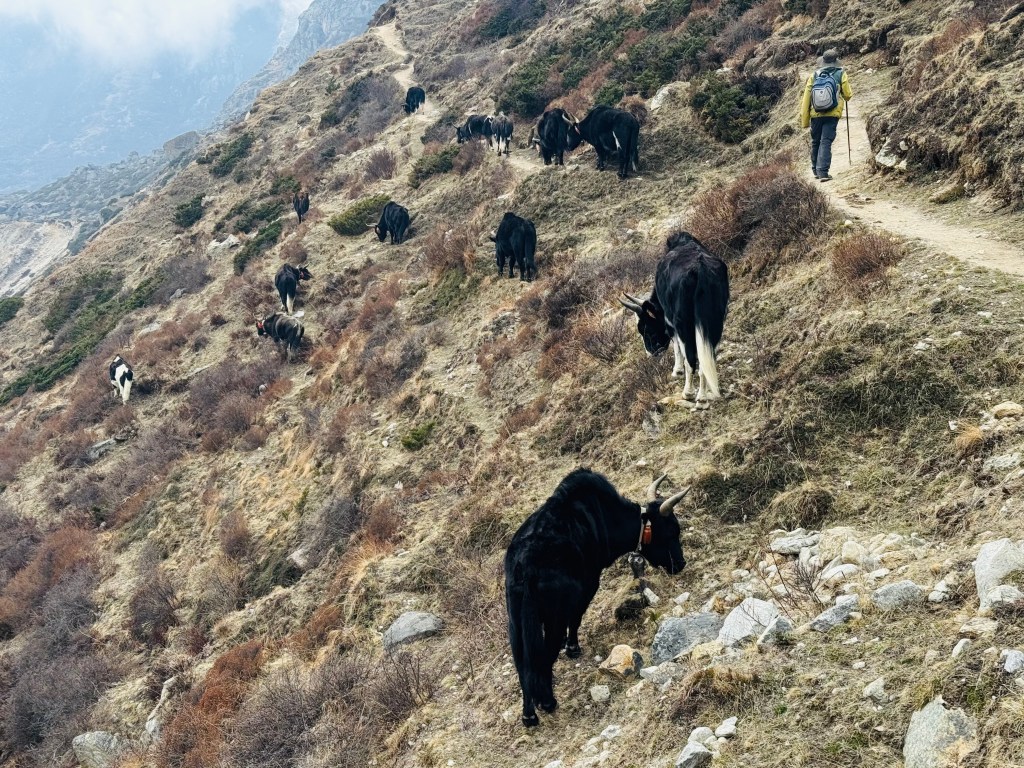
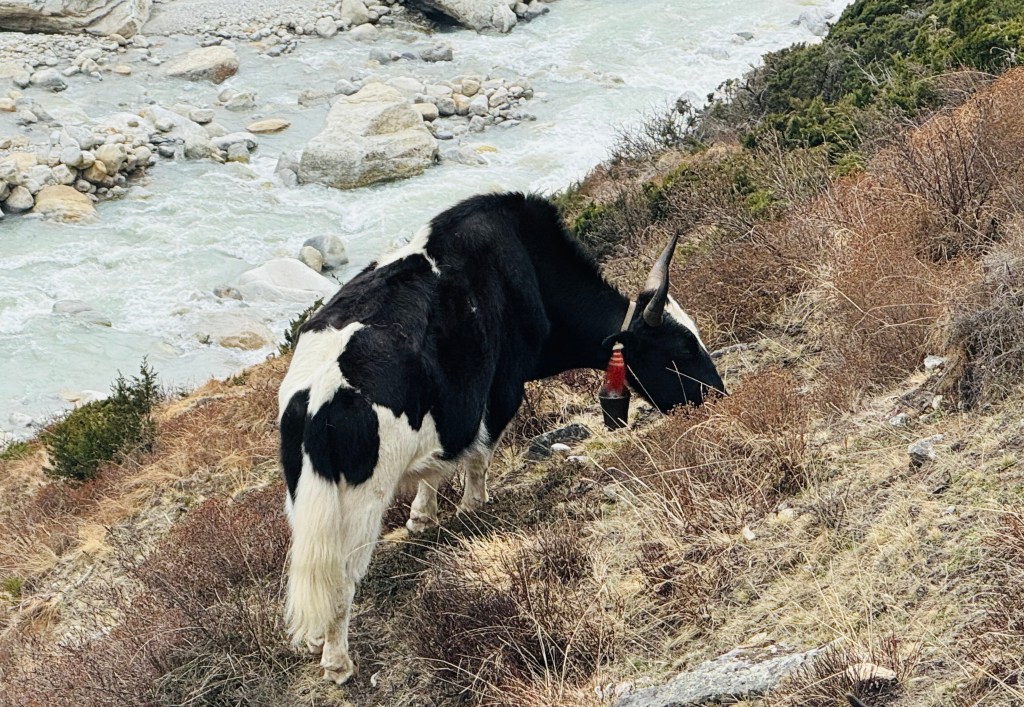
We kept walking along the trail and reached the familiar bend towards Khambachhen. The sight of the tea houses, the flowing stream and the trail on the other side were all familiar and gave a sense of security and relaxation. Nupu alloted the room to the right of the one he gave us on our way up. After changing, we went to the dining room. Meeting the French group was pleasing. Suddenly, someone attracted our attention towards the lawn. The clouds started clearing and amidst their dark background, the fading sunlight fell on the summits of Mt Jannu, Mt Khabur, Mt Phole Sobithonje. The golden summits floated amidst the dense and dark clouds.

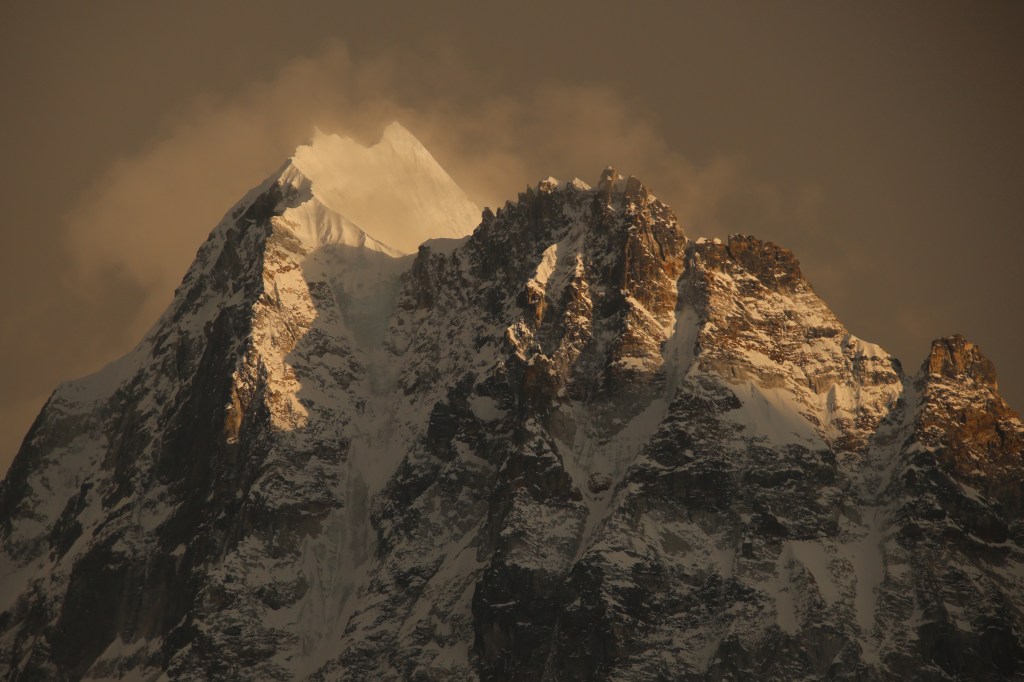
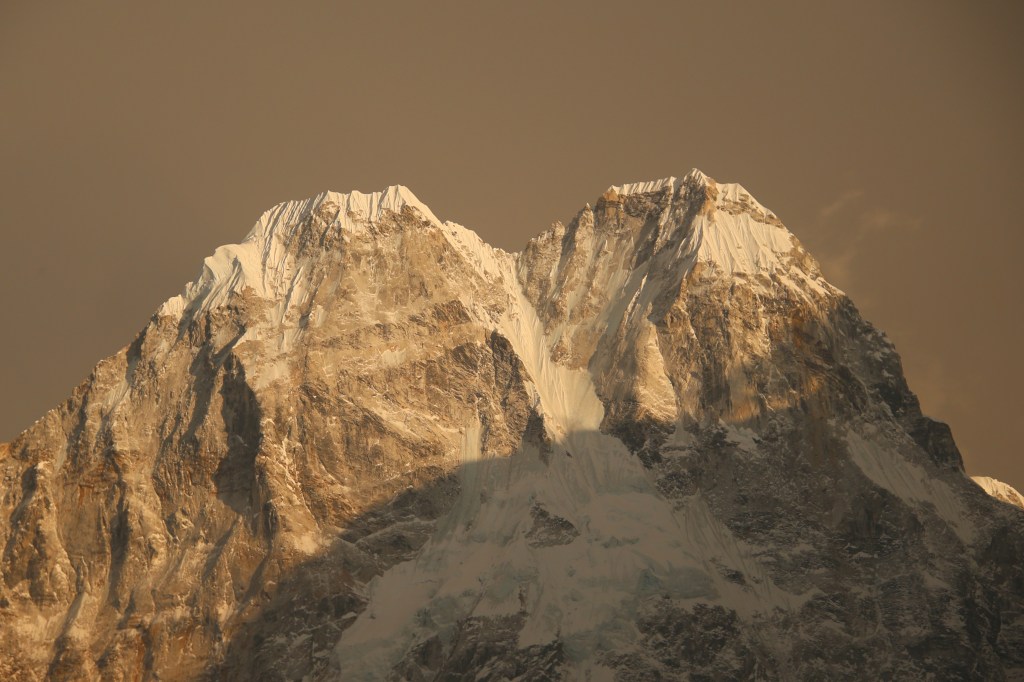


Khambachhen
The window of colors lasted for just a few minutes and then the entire area was covered with mist. We went inside the dining space and enjoyed the rest of the evening. Since it was on our way down, beer was permissible. Dilal didn't complain, probably because he was made a party to it. Didi (Nupu's wife) obliged us with a bowl of complementary popcorn. After a dinner with pizza, we slid under the blankets. Our plans for the next day was to skip Ghunsa and get down to Gyabla. The prospects of staying at the comfortable Singhi Namjong hotel once again, made us excited.


One thought on “Kangchenjunga north base camp – the zenith”