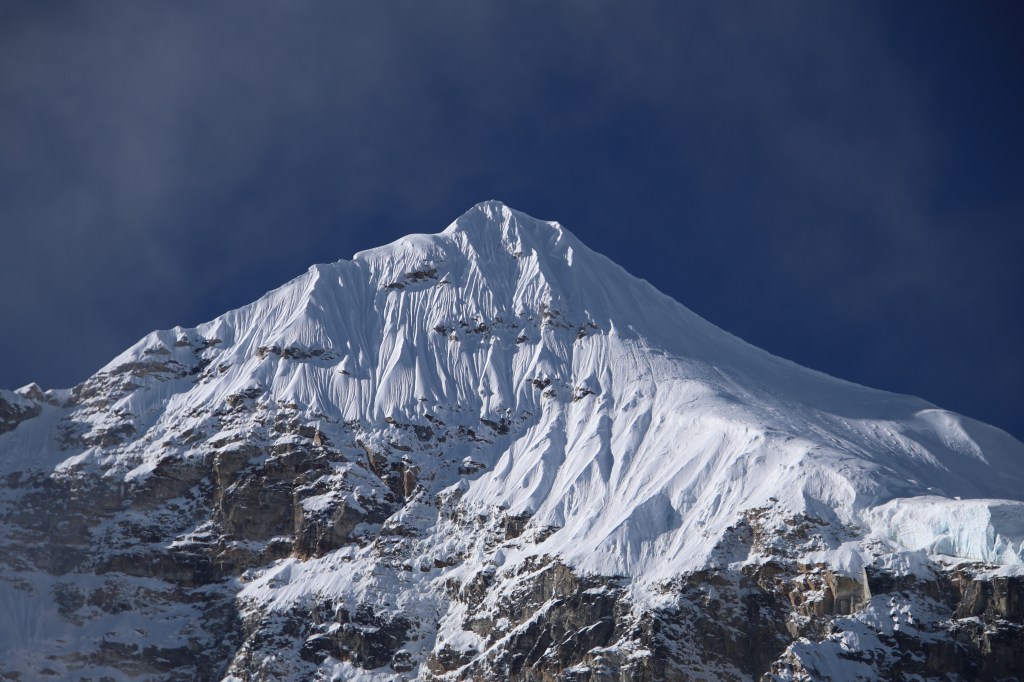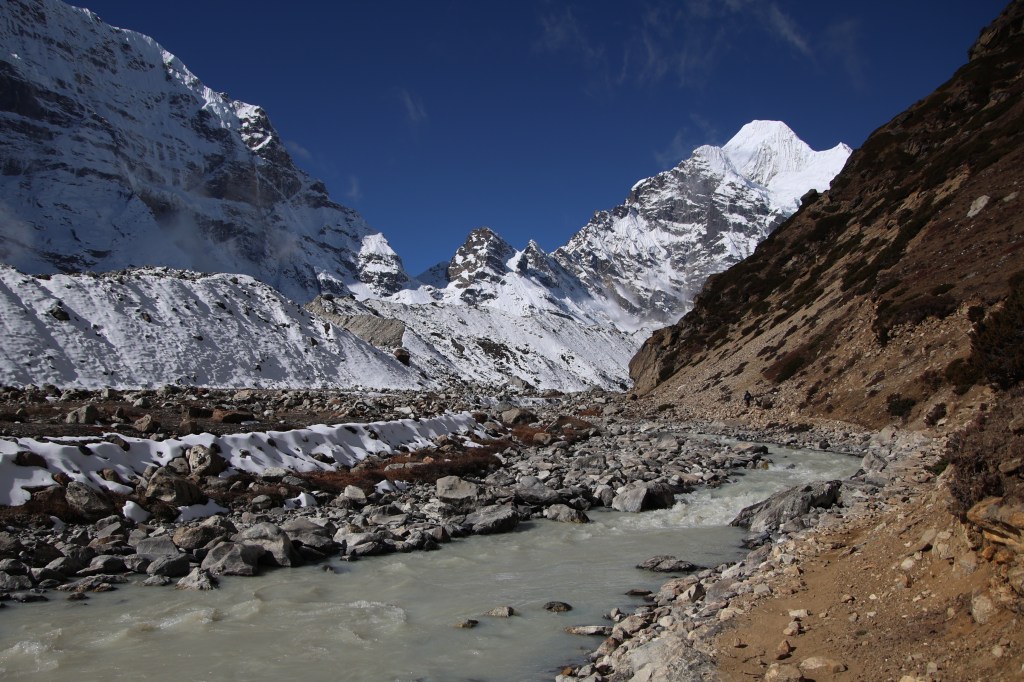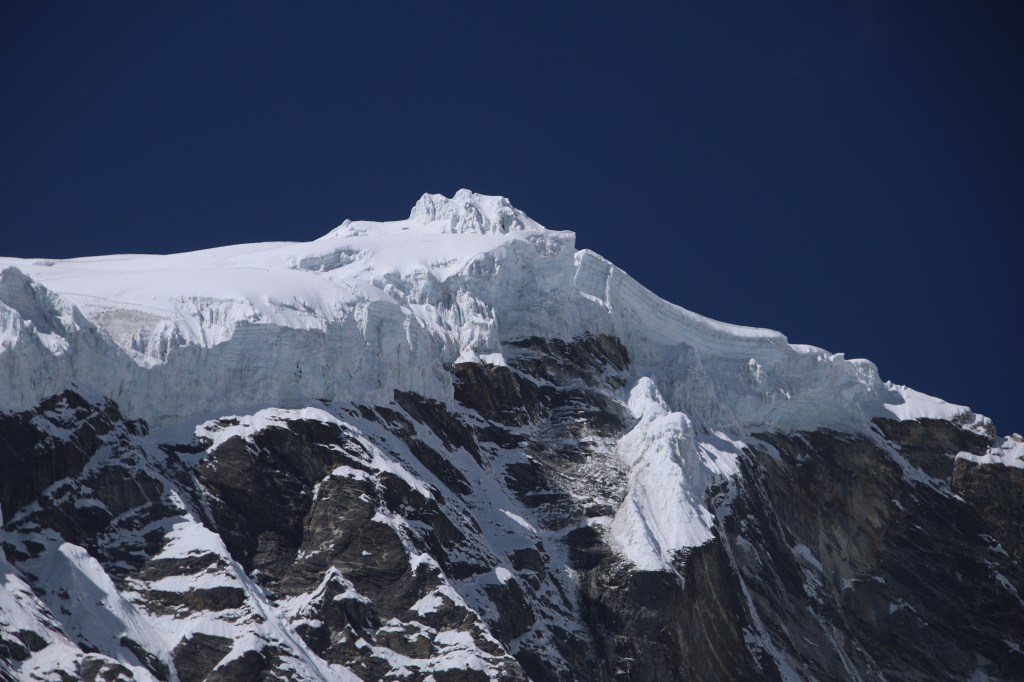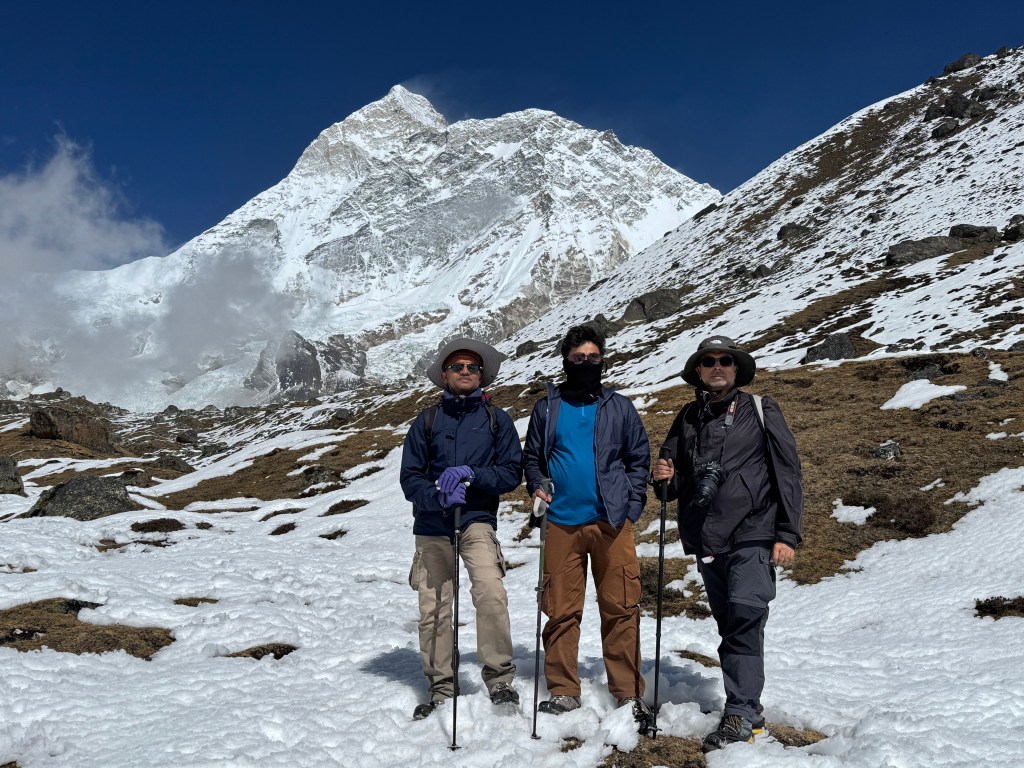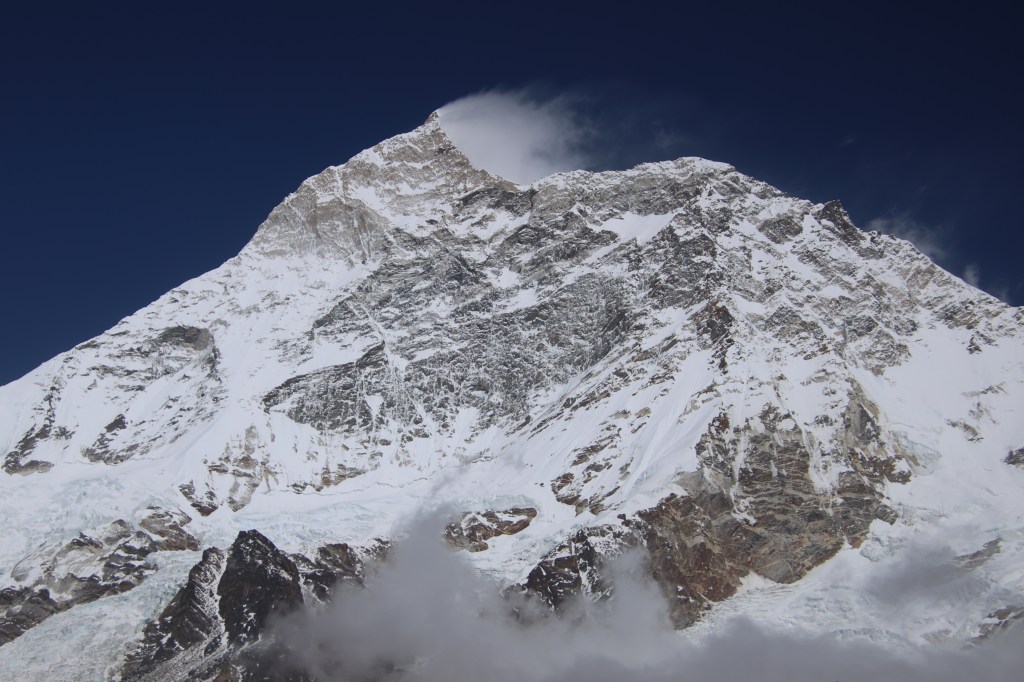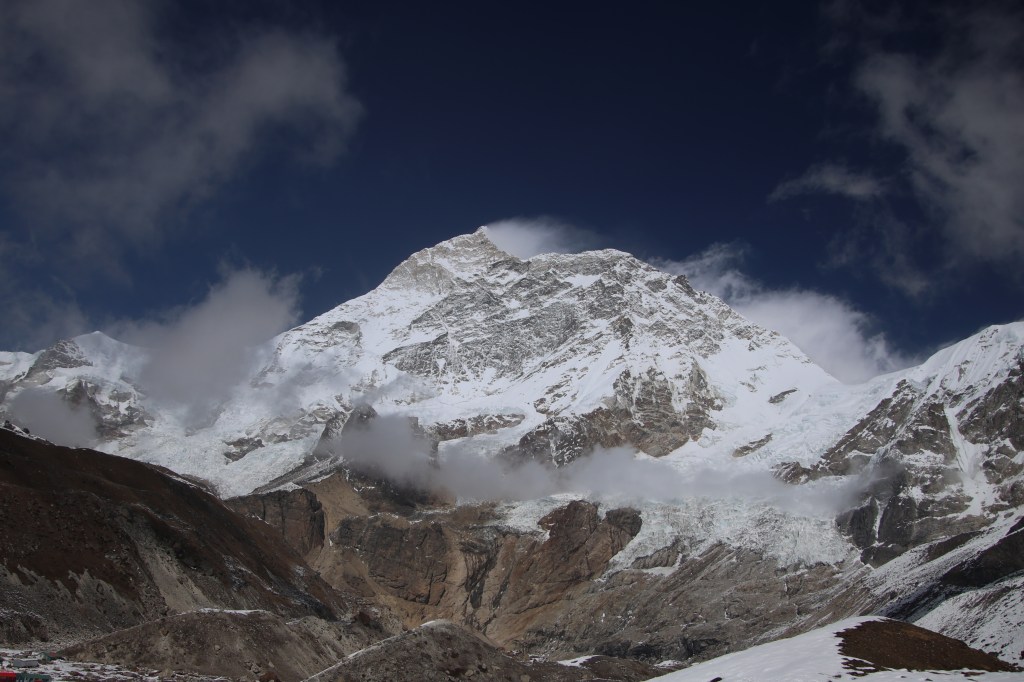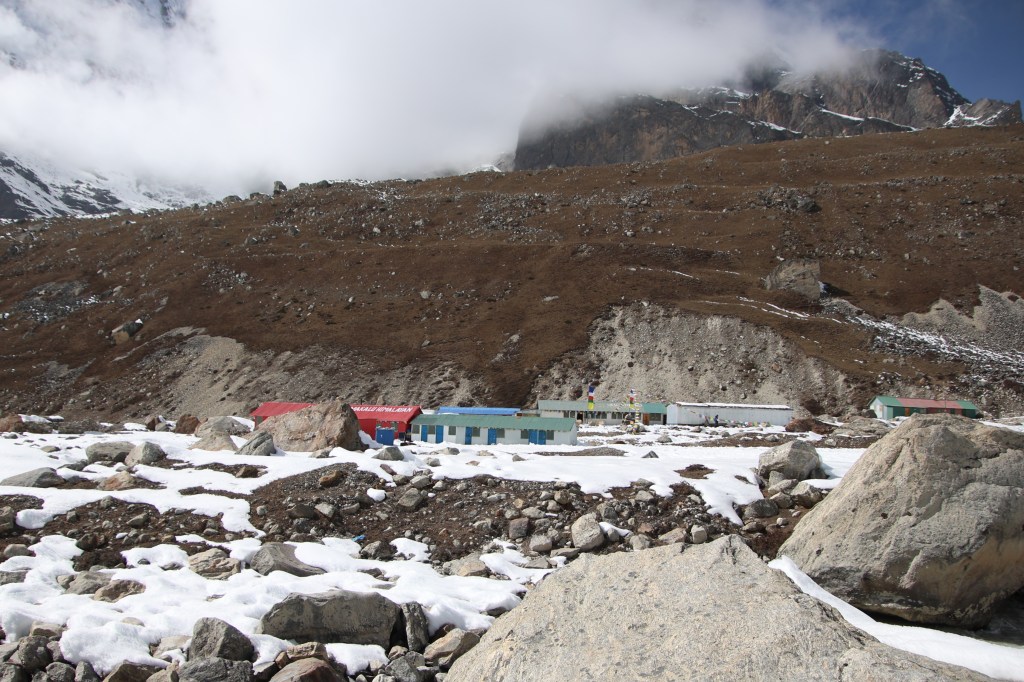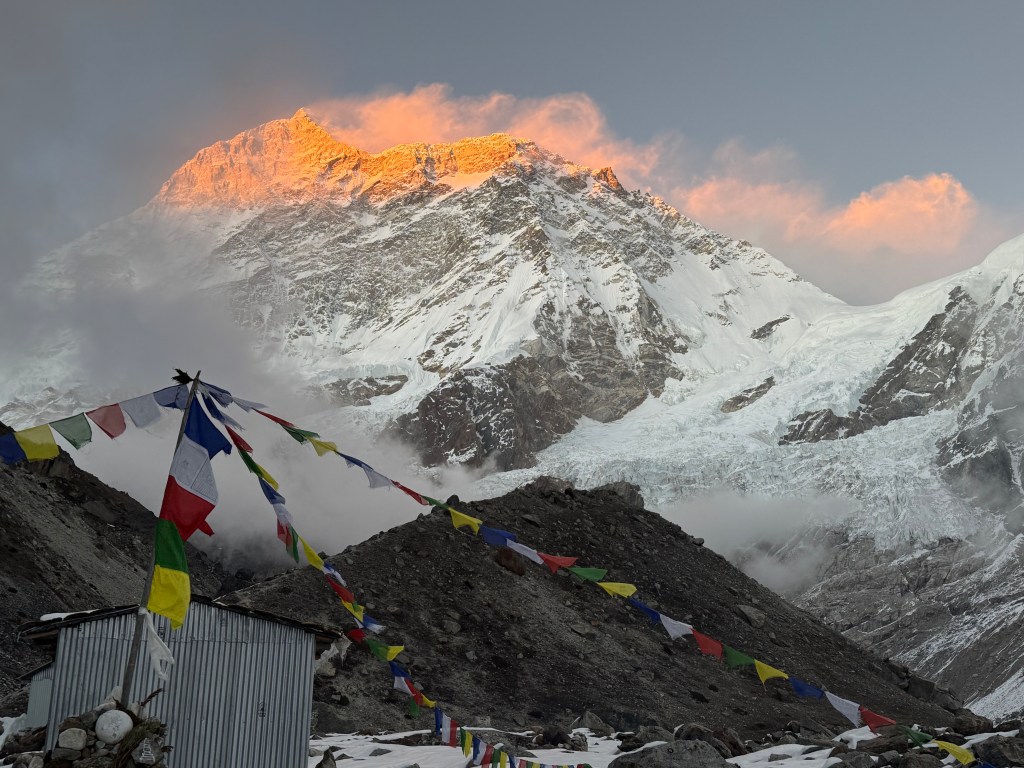
The Barun valley – the spirits of the Shipton La

Phemathang

27th October

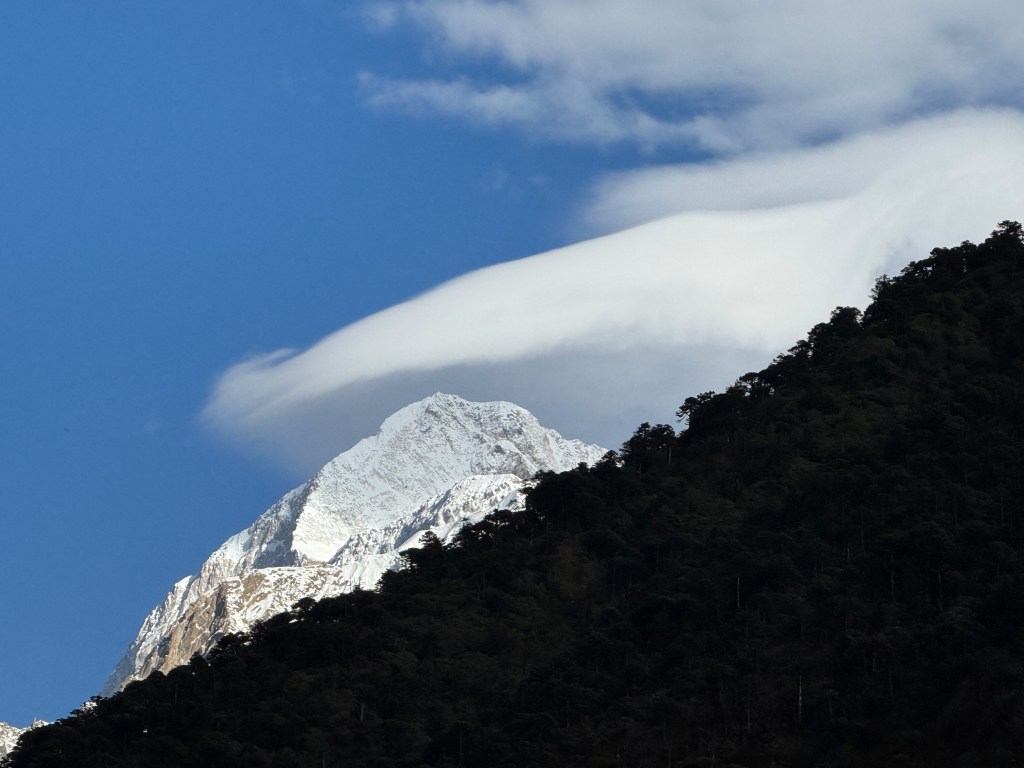
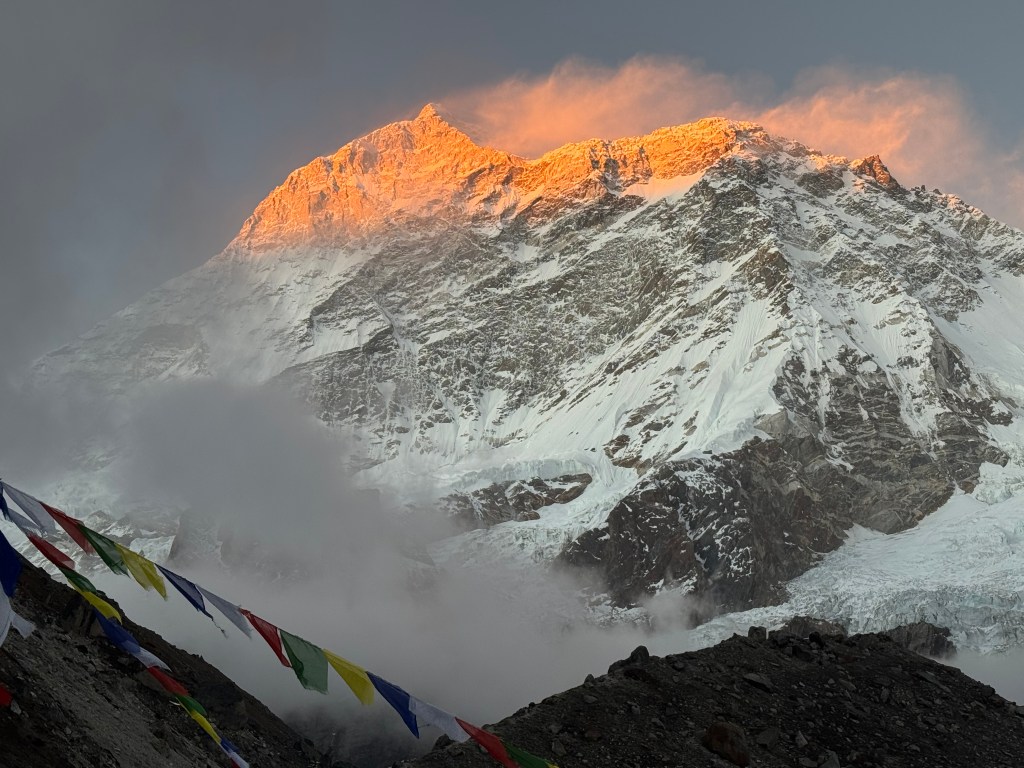
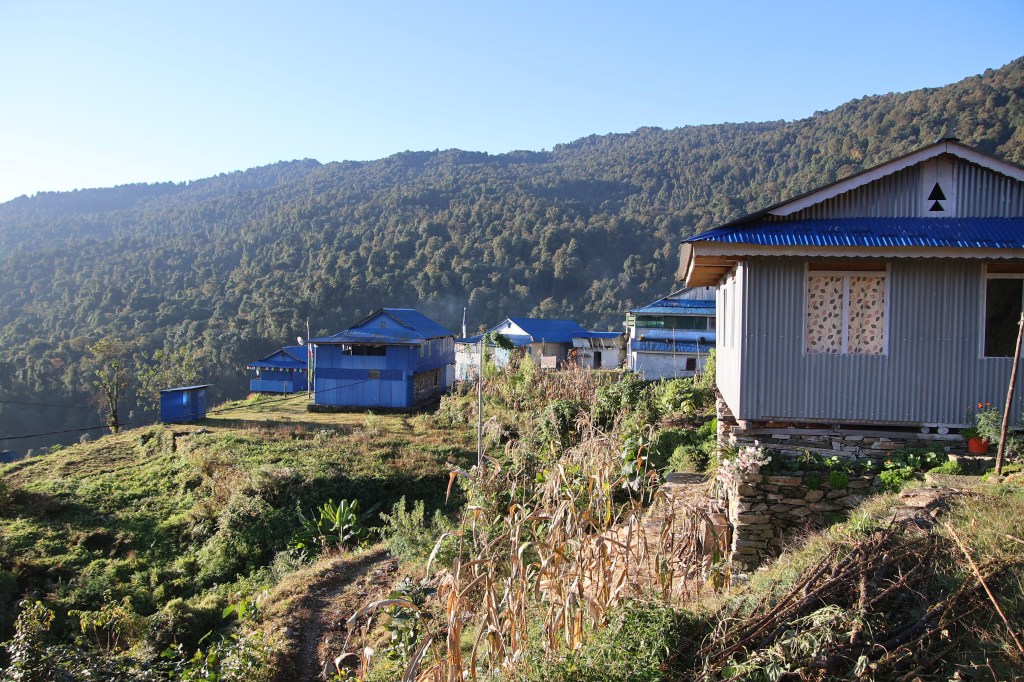
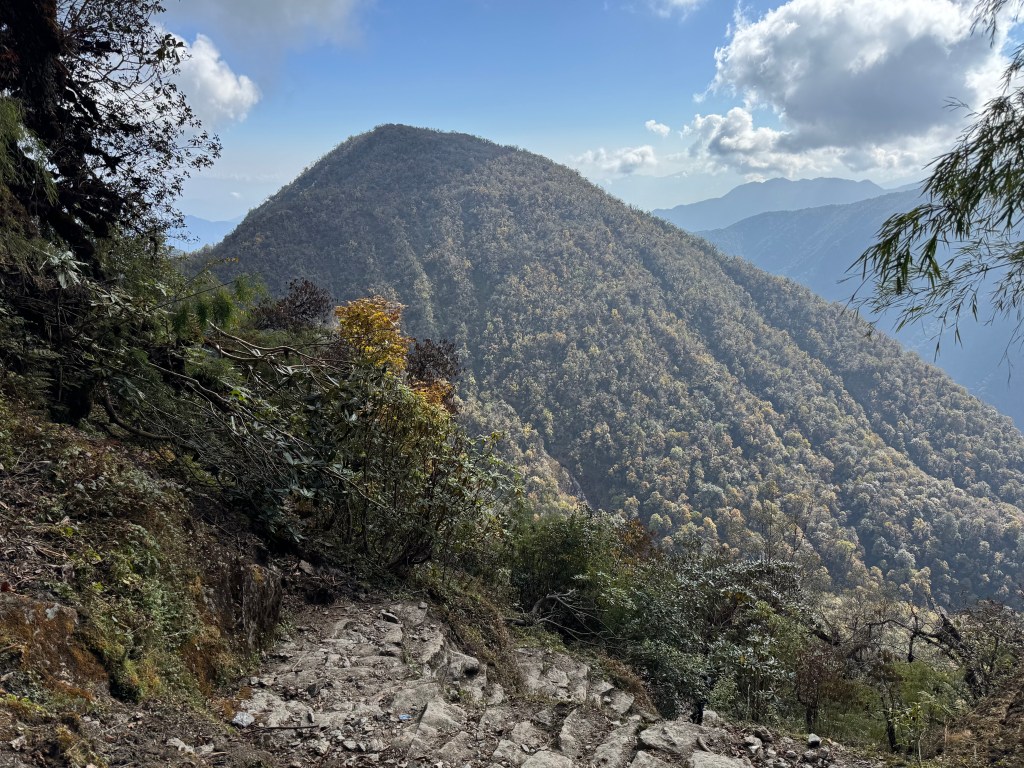
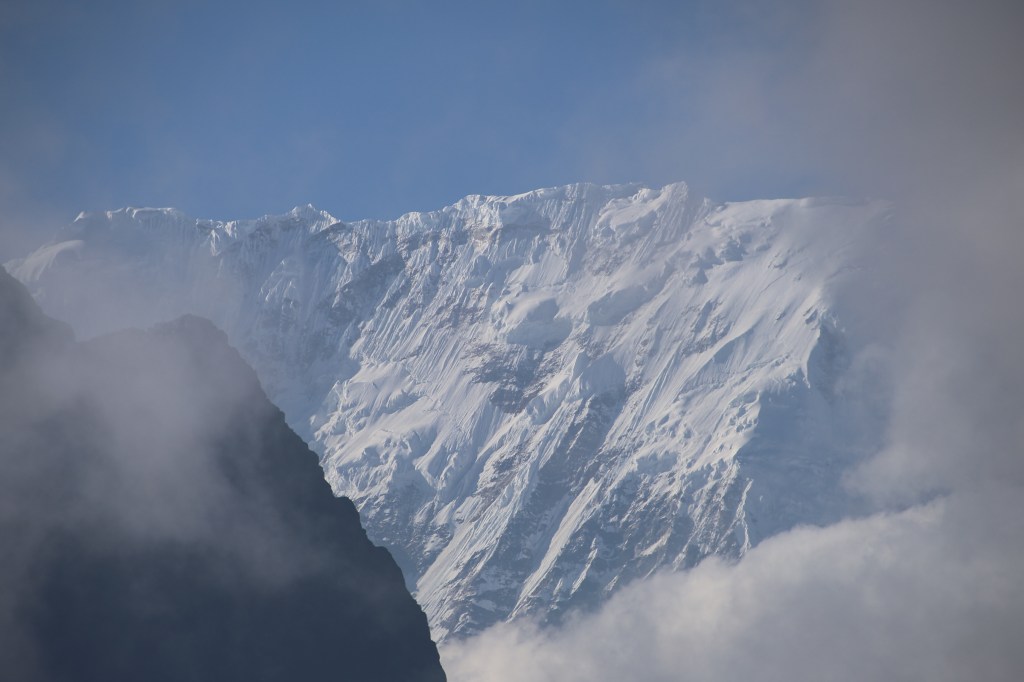
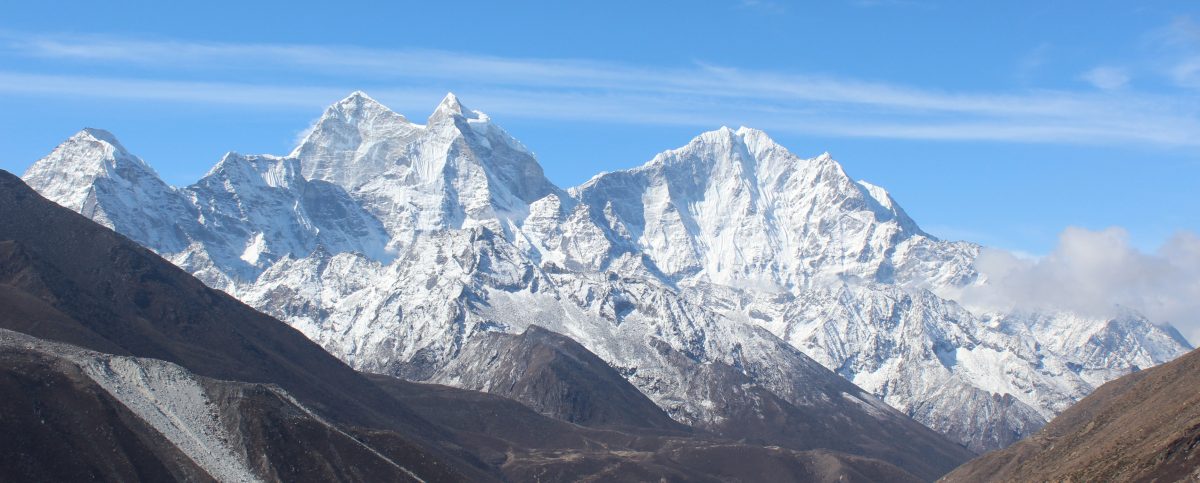
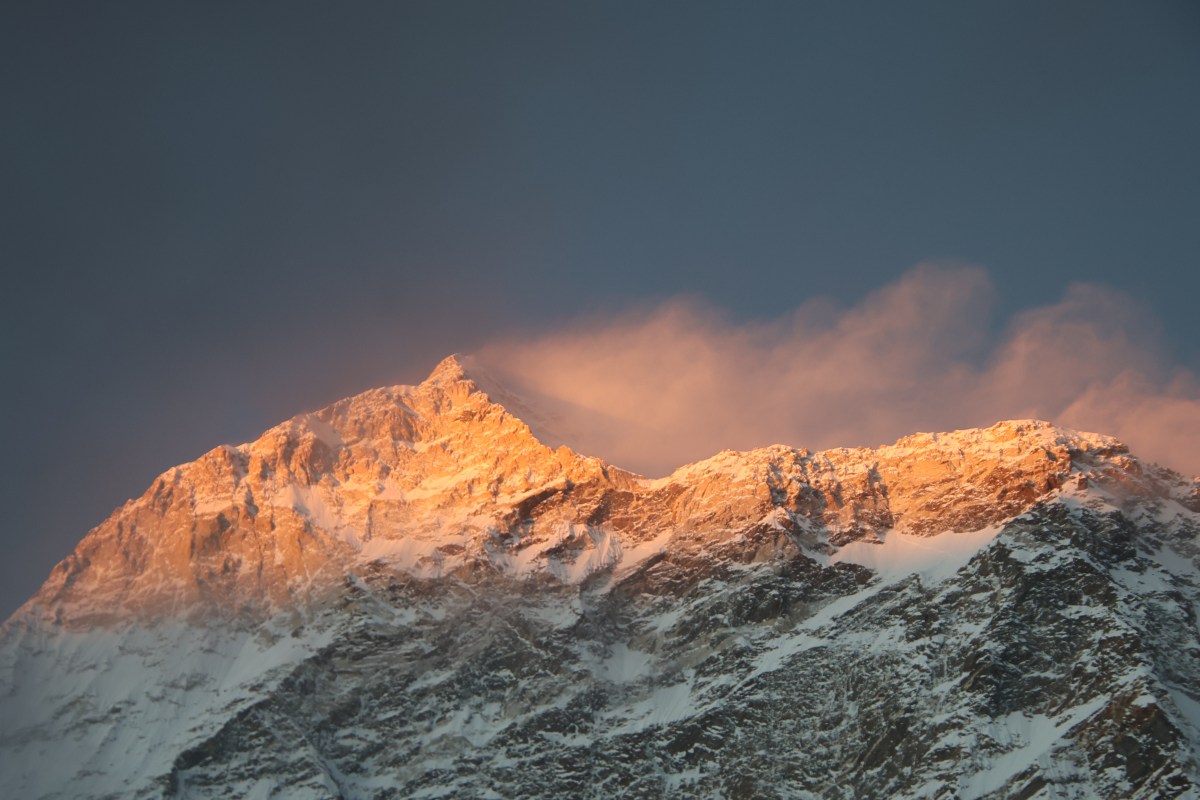
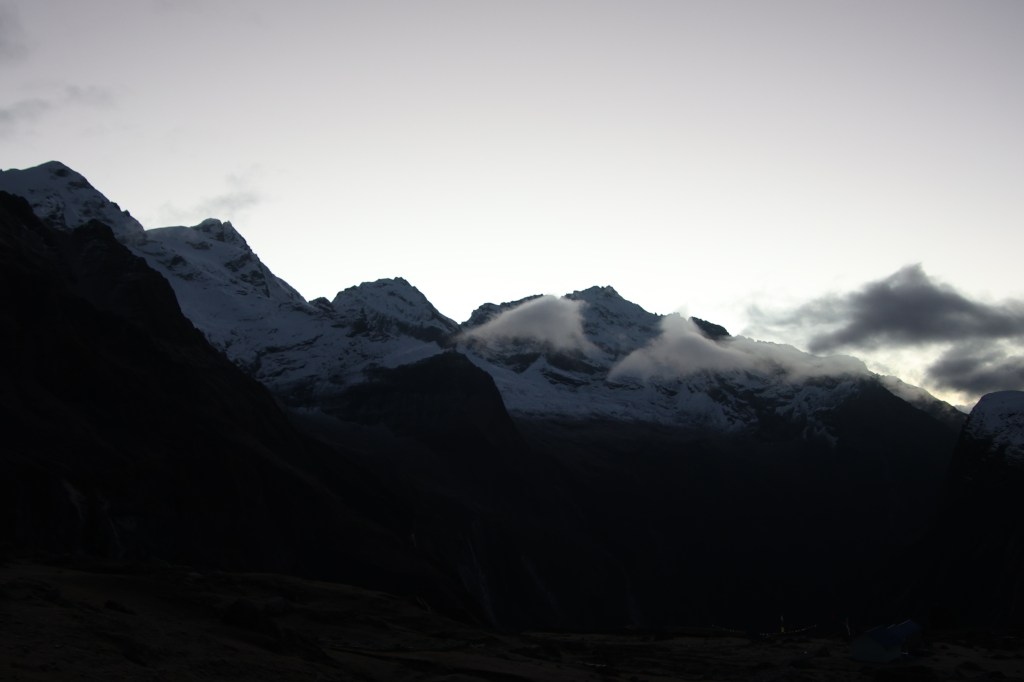
As planned earlier, Manoj went off for Dobato at 7 AM with the hopes of reserving our stay. He was equipped with enough money and a packed breakfast. Quite assured about his success, we had our breakfast. For a change, we sat in the kitchen. Though it was smoky, the warmth was enjoyable. By & large the sky was clear, but clouds weren’t that far. The distant mountains played hide & seek with them. But that didn’t deny us the colors of sunrise. Phemathang has its own charm. Being situated within the gorge, it’s nestled between the high mountain walls that guards the flowing Barun river. The sounds of the violent torrent keep ringing in your years. They’re amplified by the mountain walls that close in from both sides. The valley opens up with a V-shaped sky on the northern horizon. The roof of the Makalu massif peeps above the hills. This is the last time one can see it in the Barun valley. It’s next appearance is at the Shipton La, provided the clouds stay clear. Thereafter, it makes it’s final appearance at the Khongma La. Beyond that, the trail moves down below the tree line. The stretch between Phemathang and Dobato goes through the deep ravines of the Barun river’s gorge. Consequently, the distant mountains stay out of view.
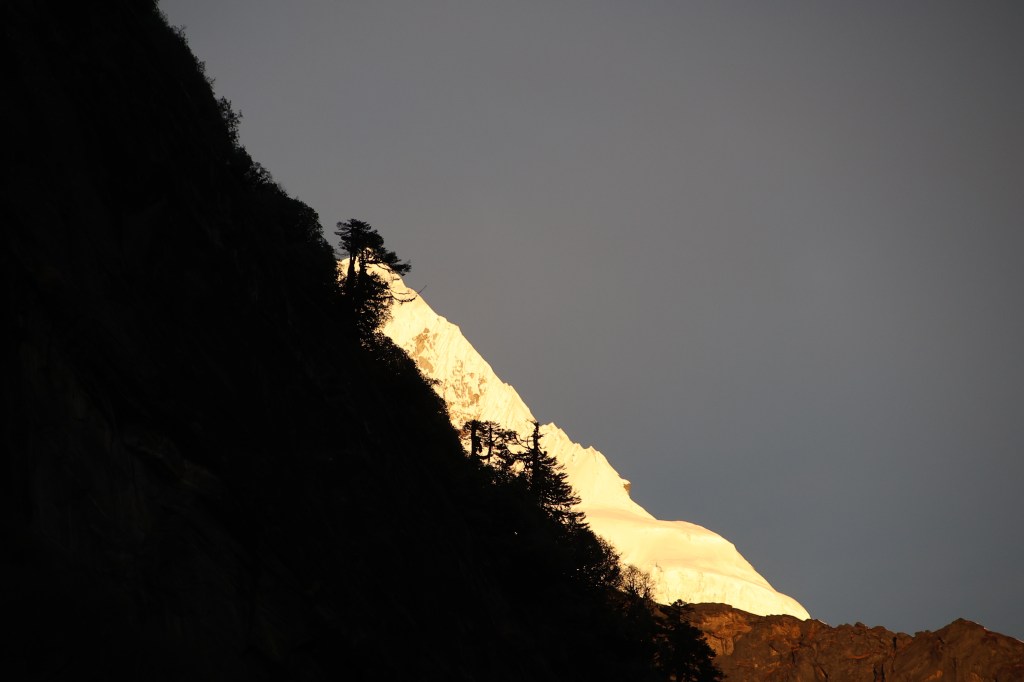
Phemathang
Phemathang, picture courtesy, Dhananjoy De

After a brief view of the sunrise, we exited Phemathang. This was the first time we were seeing the surrounding valley in bright sunshine. On our way up, we entered Phemathang amid darkness. At that time, relief was the predominant emotion. After spending days above the snowline, the sight of the lush green forests was refreshing for our eyes. Unlike other trails, one has to rise above the tree line again to cross the four passes to reach Khongma. Depending on how you look at this aspect, it can be a double bonanza or unnecessary hardship. We enjoyed crossing the passes and passing by the two “Pokharis” between them. But that trail was slated for the next day (or so we thought). After exiting the gates of Phemathang, the trail moved amid green vegetation. These remote Sherpa villages have decorated gates at both ends. We knew this won’t last long as the large stretch of landslides would soon takeover. They gave us a tough time on our way up. I was preparing myself for these extended sections of debris. The ferocious torrent of the Barun river kept moving in leaps and bounds forming massive rapids and waterfalls.
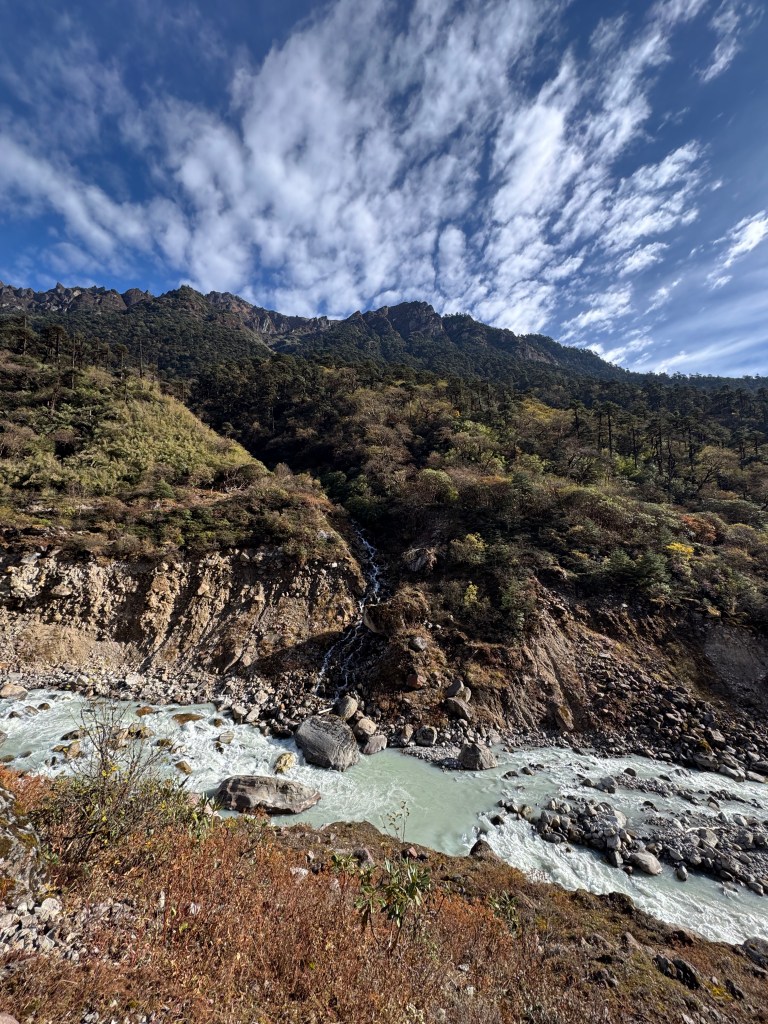
The Barun river, picture courtesy, Dhananjoy De

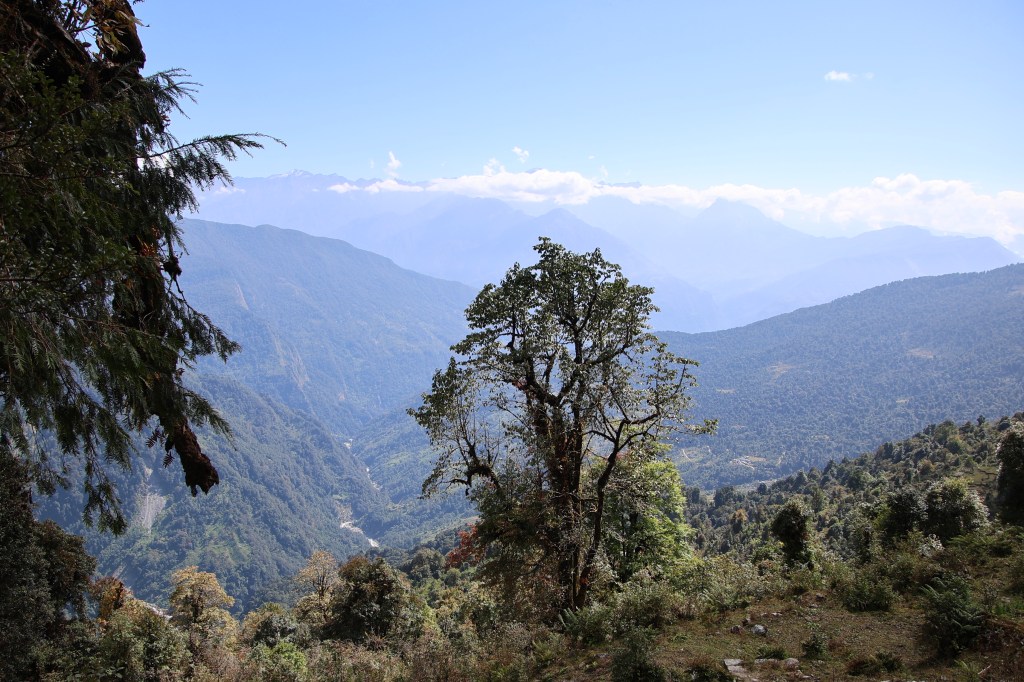
We made our way through the labyrinth of boulders along the banks. Giving a careful look, one can make sense of a desired way through the abyss. Sometimes by tracking foot marks and other times by common sense. Depending on the challenges thrown at us, we had two options. We either circumvented the obstacles by taking a longer route. Or, we shortened them by tiptoeing. One has to be careful in these areas as some of the boulders can give in under body weight. That’s where guides & porters come into play. But this time around, panic didn’t set in. Firstly, it was in broad daylight & secondly, we now knew the trail & the destination. Today’s walk wasn’t supposed to last beyond 4 hours. While crossing the landslide zones, we kept looking up along the slopes at regular intervals. There are no reasons to think that these streams of boulders have frozen in time and space. Nevertheless, we carefully negotiated them to reach the base from where the hike was to start for Dobato. It was the same set of stairs amid dense forests that moved constantly up through multiple switchbacks. On the earlier occasion, we traversed these amid hovering darkness & accumulating moisture. At that time, caution was the watchword. On this occasion, in bright sunlight, “tiring” was the predominant emotion.
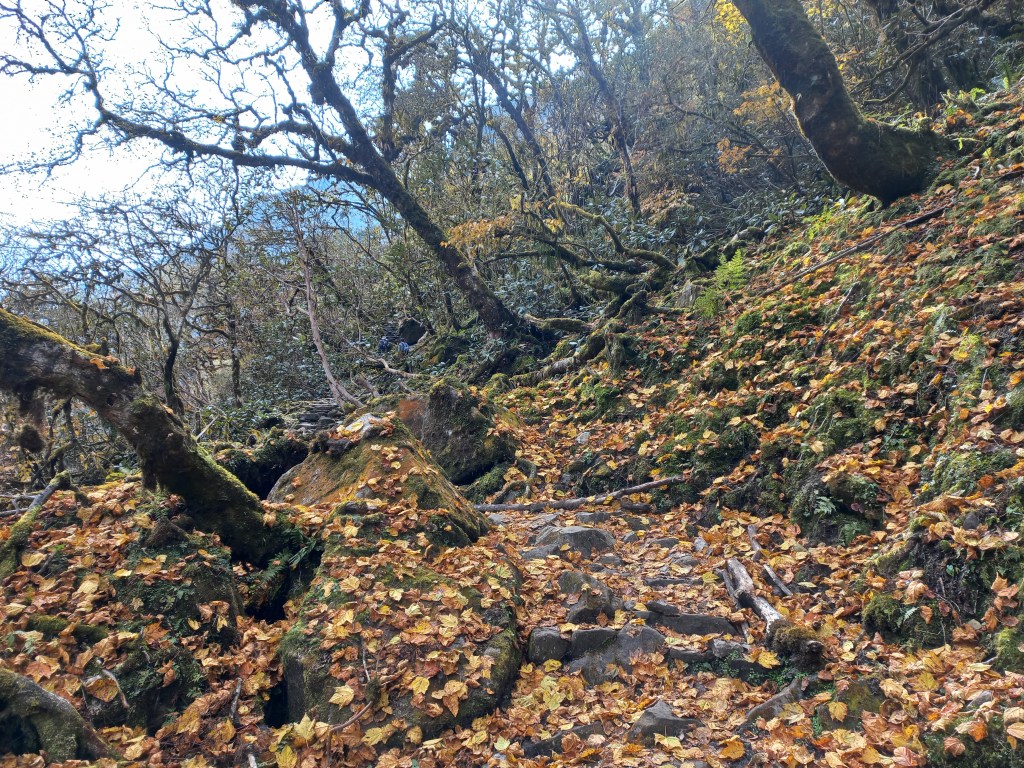
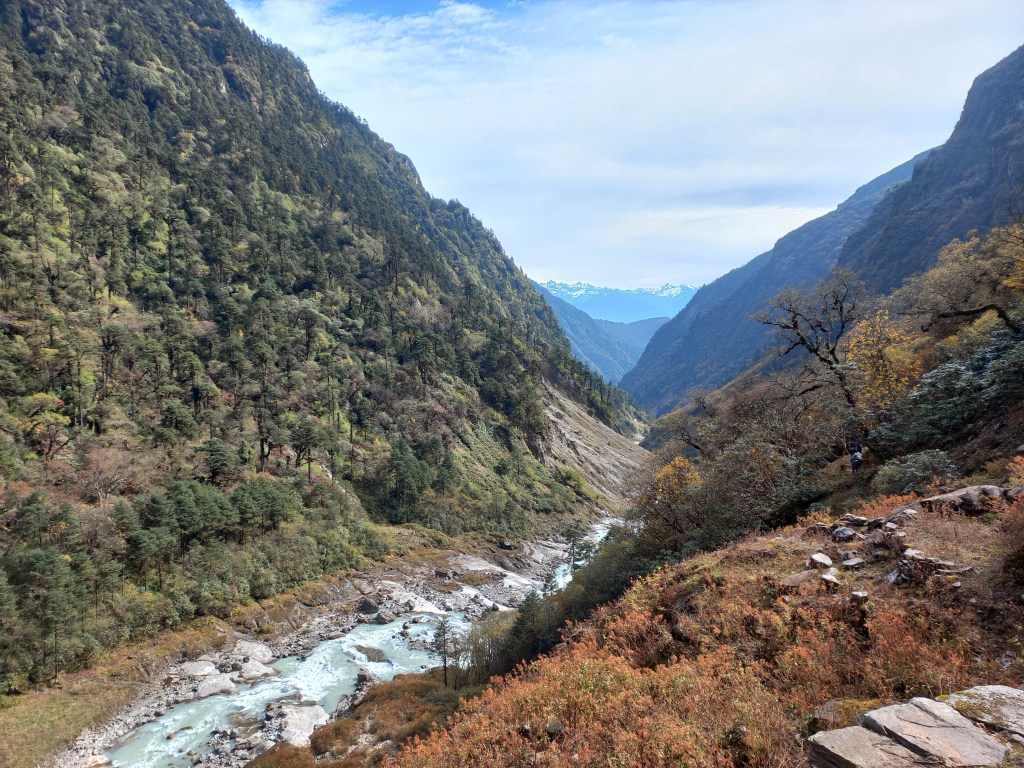
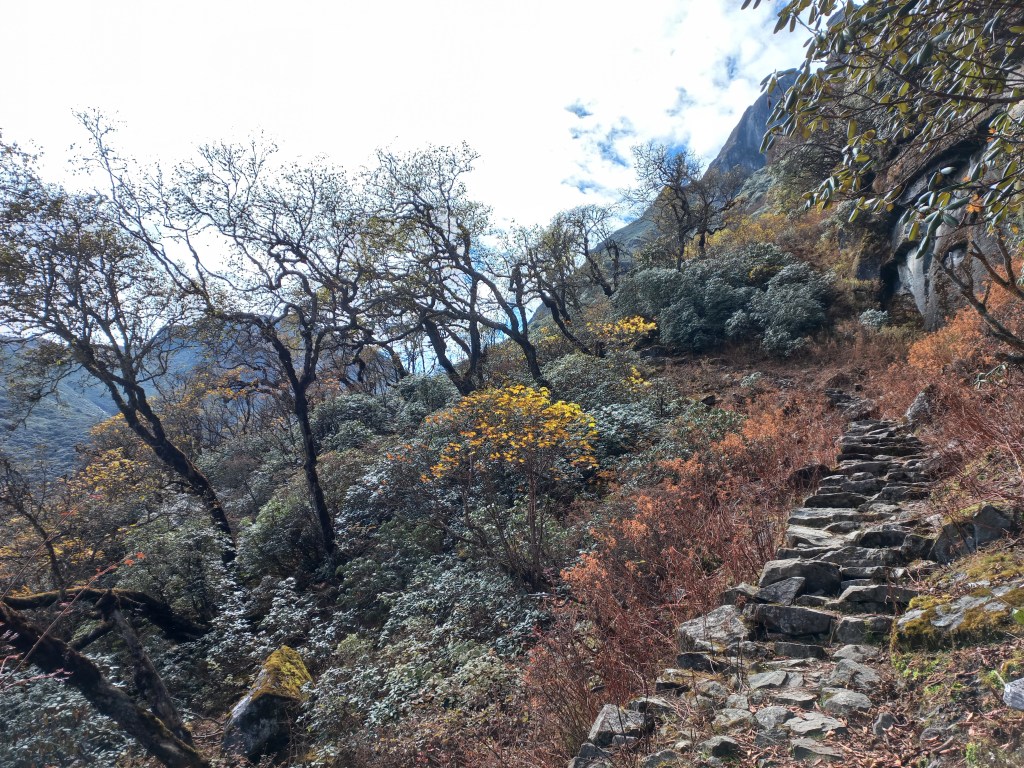
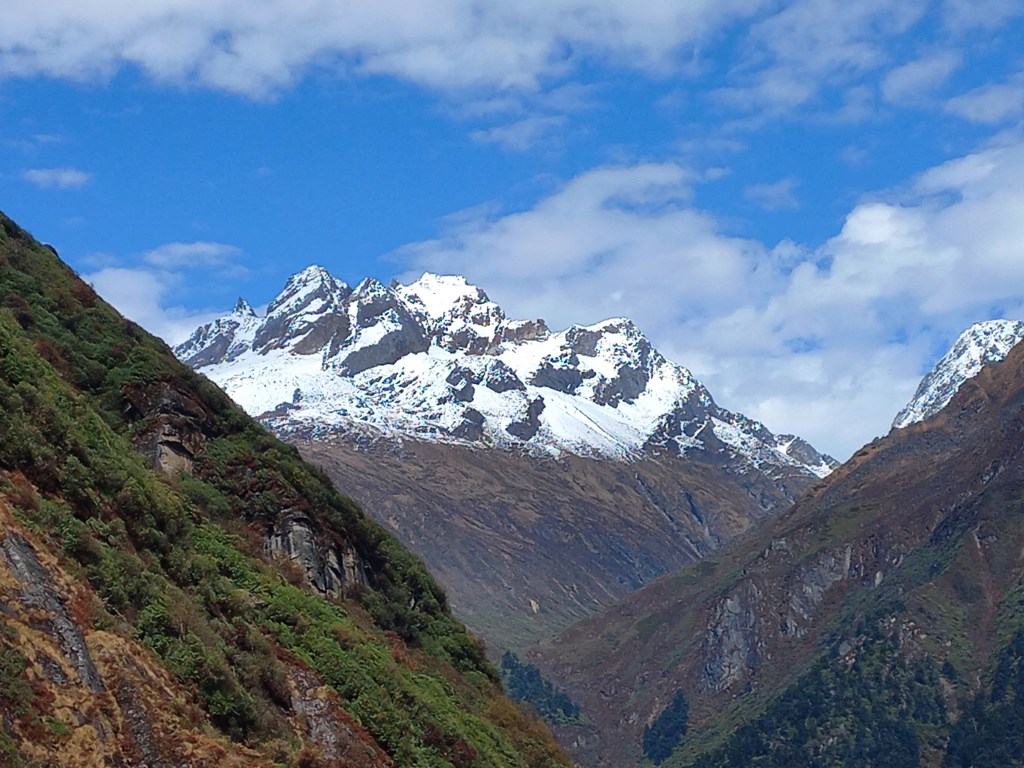
En-route Dobato

At this junction, we bade adieu to the Barun river. It continued its journey down into the valley. There, it meets the Arun river.  After giving a look at the ensuing staircases, we embarked on the hike. The usual tactics of setting small milestones did help with the cause. We used phrases like, “The next set of 10.” Or, “Till the next switchback.” Even, “Till the place where Dhananjoy is resting.” There were many expressions like these. For sometime, I noticed that Raju was lagging behind. It’s normal for him to walk behind the last person. He usually brings up the rear. That typically doesn’t leave a gap of many steps. I was the slowest, but Raju was keeping at least a couple of switchbacks behind me. He stopped often and that wasn’t normal.
En-route Dobato

At that time, I thought he was taking it easy because the trail wasn’t supposed to last long. It was only later in the day, I realized the impact. Nevertheless, we continued our hike through the forest. On our way up, we saw some construction going on. By the looks, it appeared to be a tea house in the making. In another few years, this route is likely to get traction and Dobato may not be a bottleneck anymore. The slopes started to gentle out. After a few more switchbacks, we could see the roofs of the tea house at Dobato from a distance. Checking on a passer-by, it was revealed that our stay at Dobato could not be confirmed. Manoj &  Raju’s efforts went in vain. We entered the lodge premises with this depressing news. I tried to find out if sleeping at the dormitory was an option. That too, was exhausted. That leaves out the dining place or the kitchen. Apparently, none was available. We tried to think about the impact of this. There’s a remote chance to stay at one of the lodges at Shipton La. Their conditions weren’t very encouraging. We’d have to sleep at 4200 m at the top of a mountain pass. It can be paralyzing in the cold amid the winds that sweep that place in the evening. But there was no choice. Even grabbing that choice required us to ask the lodge owner at Dobato. We requested him to inform one of the two lodges at Shipton La via walkie talkie. With that sorted, we looked at the positive aspects of this development. That would advance us by at least 2.5 hours for the next day’s trail. Reaching Danda Kharka would be easier. We may not have the comforts of Dobato, but it was just for a night. At that time, the bargain seemed to be in our favor, but nature had other plans and so did the “spirits” at the Shipton La. Once staying options were sorted, we ordered lunch and relaxed in the sunshine. There was enough time to reach Shipton La and the trail, though tiring after lunch, was not difficult.
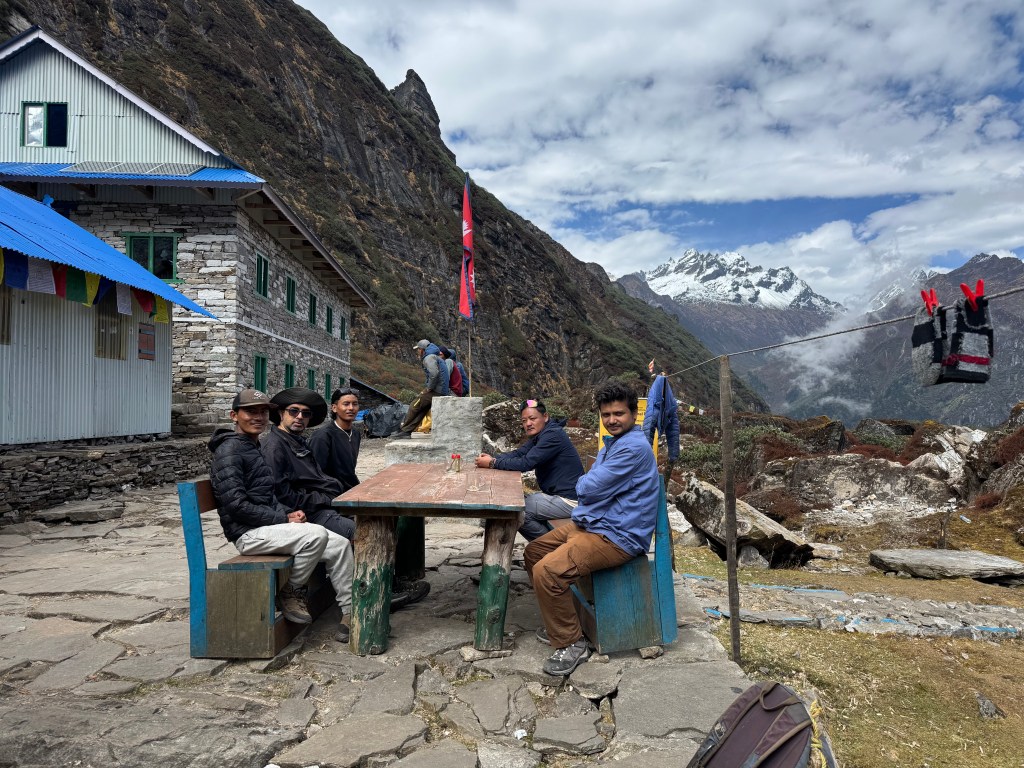
Dobato, picture courtesy, Dhananjoy De

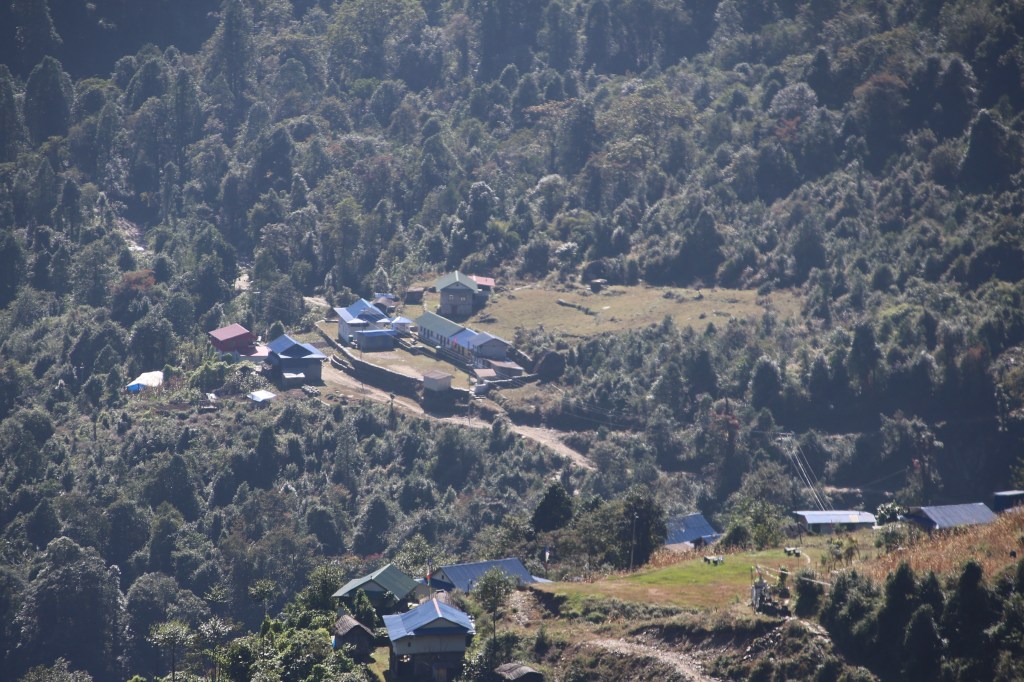
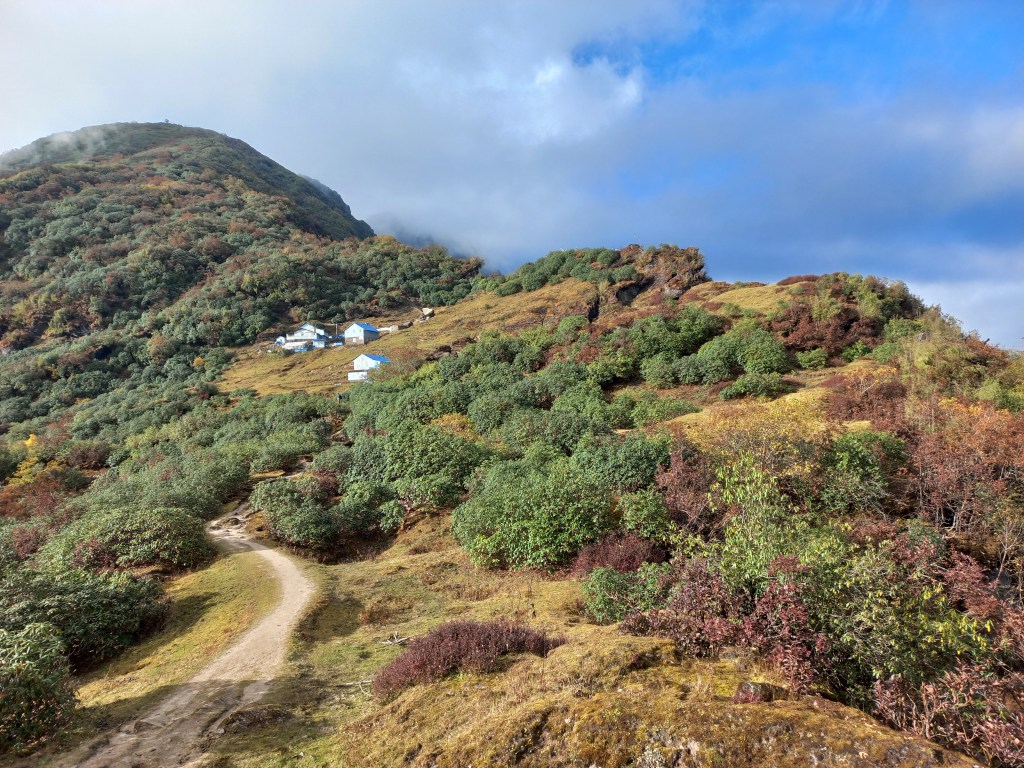
After a comfortable lunch at Dobato, we resumed our hike. The trail moved up gradually amid rhododendron forests. After a certain point, we got a wonderful areal view of the Dobato tea house amid the forests. Though it didn’t offer us sleep, but that didn’t resist us from enjoying the view of the sole tea house. A guide from another team informed us that certain lodges at Tashigaon have connections with this tea house. Staying there could have ensured a stay here. It was apparent that despite the claims, our place of stay at Tashigaon didn’t have that privilege. A lesson learnt too late.
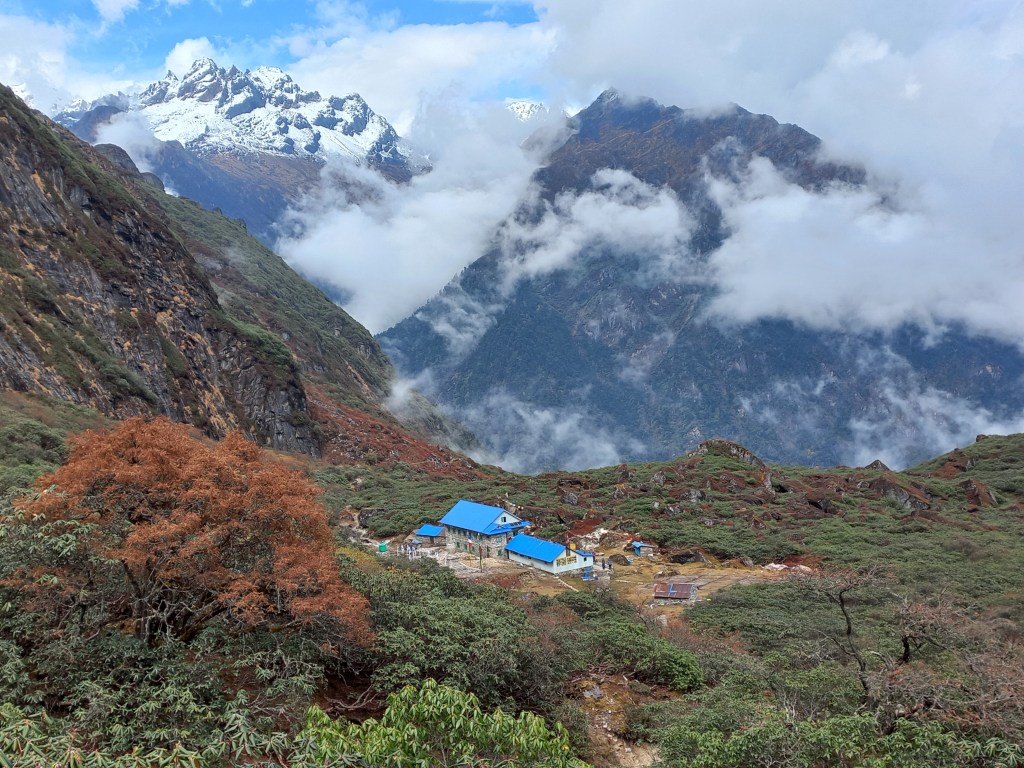
Dobato

But little did we know at that time that this would prove as a blessing, given the weather conditions for the next day. The trail moved gradually up towards the Ke Ke La, the first of the four passes between Dobato & Khongma. It all seemed familiar and we reached the pass. The stupas and chortens greeted us amid the gloomy weather (by that time, the clouds started dominating). During both the ways, we reached the passes at a time where no views were possible. Wasting no time, we started our descent. The stair cases went all the way down through red & brown slopes to the banks of the Thulo Pokhari. We went down the stairs. We kept an eye on the dark waters of the lake. It kept growing in stature with every step down. Gentle winds created ripples on its surface. In no time, we were walking by the sides of it. It felt like a homecoming as we traversed the same route in the opposite direction.
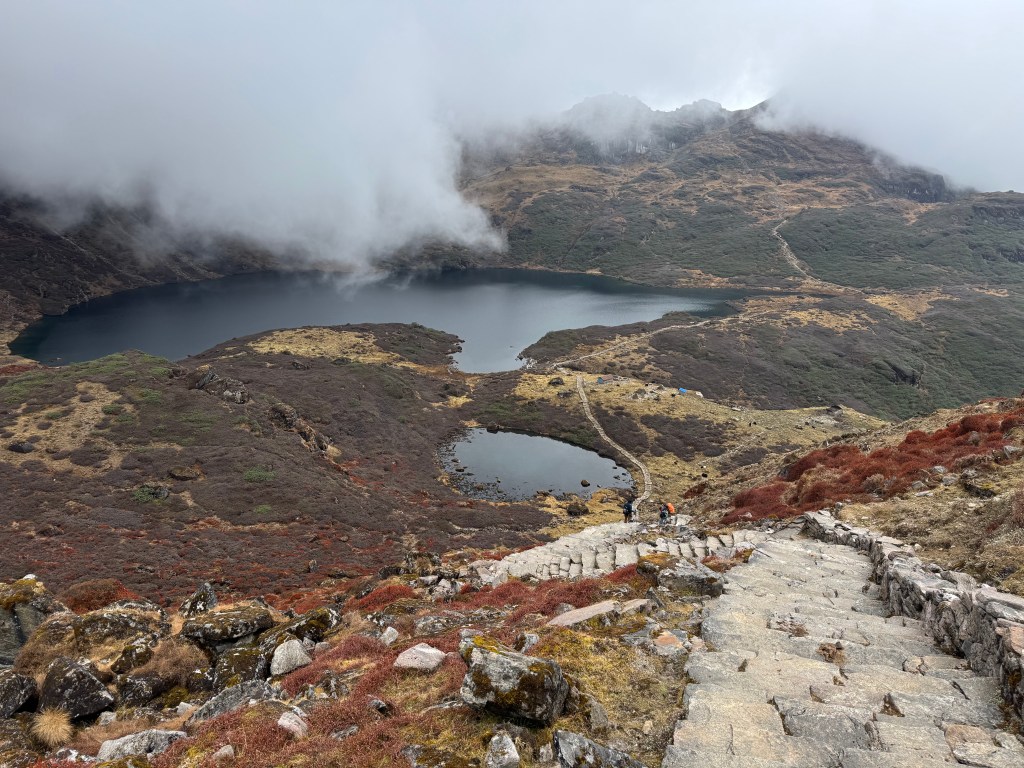
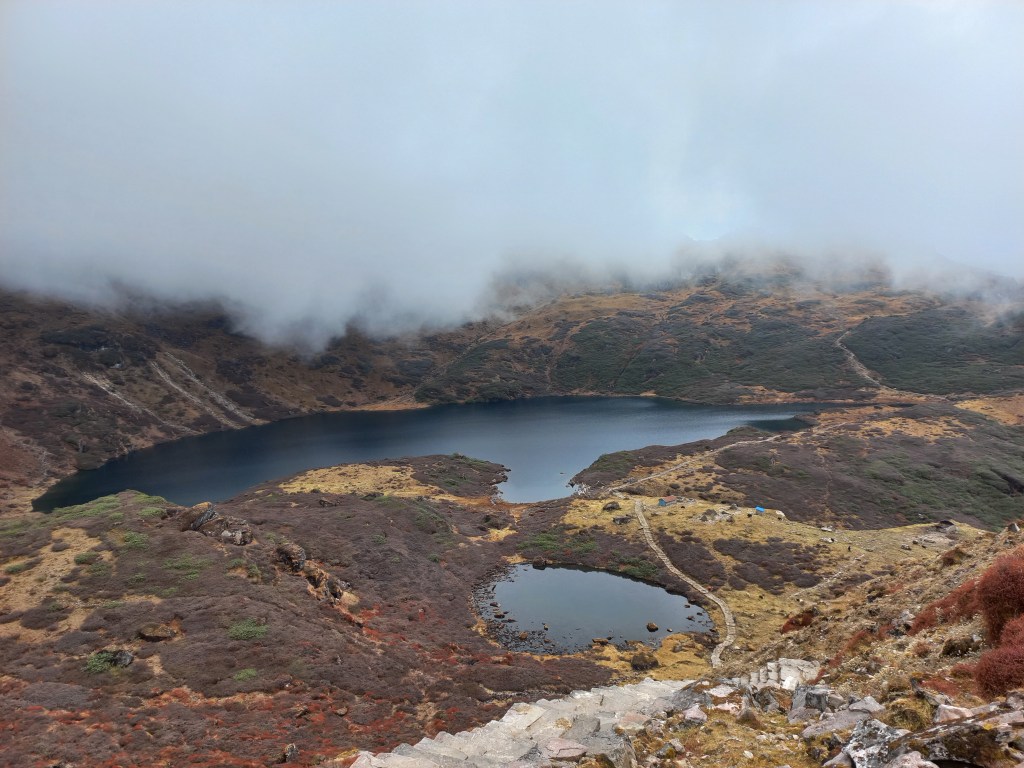
Thulo Pokhari
En-route Shipton La, picture courtesy, Dhananjoy De

After sometime, the hike resumed for the Shipton La & switchbacks reappeared. But on this side, they were less frequent and gentler. With every step upwards, the pass kept revealing itself and finally we reached the stupas at its top. Our lodge was just below the top. When we entered it’s premises, dense fog & clouds engulfed outside. We were allocated a single room. Later on, after ensuring that no other traveler was expected, another adjacent room was allocated. We took turns to change to our home-wears and settled at the small dining space. The kitchen was located at the end of the same space. The burning wood served both purposes. To prepare the dinner as well as offer warmth. We hung our trekking wears around it with hopes of drying them up. We felt comfortable, now that we were under cover and had a shelter for the day. After sipping steaming tea, we spent time by playing cards and conversing with the family that owned the lodge. They were from Seduwa. They keep stocking this lodge with resources brought from that village, at least 2-3 days of walk from this place, by our standards. After dinner we settled into the rooms. The blankets were fluffy & warm. Raju & the porters slept in a room in the upper floor. Everything went quiet and we hoped for some sleep. Just then, we heard Raju talking with the porters and there were sounds of many steps above our roof. It seemed Raju was pacing the floors, talking to the porters in Nepali. We couldn’t understand much. After sometime, Raju came knocking at our door. Dhananjoy came in too. Raju was feeling heaviness in his chest and couldn’t sleep. He felt someone was pressing against his chest causing nightmares for him. I correlated this with his slow hike towards Dobato. That pointed towards high altitude sickness. Raju had regular addiction to cigarettes and alcohol. Despite warnings, he had been consuming both throughout the trek. Regardless of what science says, Raju thought it was down to the spirits who were playing foul with him. Otherwise why would he get nightmares? Reasoning was difficult and Raju was determined to go down to lower altitudes immediately. That also is the scientific remedy under such circumstances. What’s triggered by lack of oxygen can only be remedied by increasing it’s supply. The only way to achieve that is to go down. But at this hour? It was 23.45. Raju suggested taking along Anil to go down to Khongma. He handed over some money to repay the debt at the lodge, brought out his warm wears and started off for Khongma at the dead of the night. Anil followed him. When we saw them off, it had started snowing.

While going back under the blanket, different thoughts plagued my mind. On one hand, I was irritated with Raju. Being a guide, he should have been more responsible. At these altitudes, one needs to control their cravings. With Anil, he had taken along the most experienced of the porters. That left us with Manoj, the younger of the two porters. He now has to guide us down the tracks from Shipton La all the way through to Khongma and beyond. Looking at the weather, chances were high that we will have to traverse through snow filled tracks. Another part of my mind said that this could happen to anyone. It’s good that he decided to go down instead of putting his life at risk. Sleep eluded me for most of the night. While tossing over to a side, I felt the bed to be wet. The torchlight revealed that an entire section of it was covered with grains of snow. It must have been from my cap which accumulated some snow while we were seeing off Raju. But the extent of snow kept increasing. That’s when I realized that the room had some gaps between its walls and the roof. Snow kept pouring in through them. Fortunately it was localized and I shrinked myself towards the center. The rest of the night elapsed without any further drama. We were sleeping at 4210 m.
Phemathang

The Barun valley – Makalu base camp

Langmale Phemathang

25th October

There were different reports about the expected amount of snow en-route base camp. So far the route has been devoid of snow. But on this last leg, it’d be surprising if Makalu didn’t throw up some challenge. After all its the fifth highest mountain in the world. I recalled the videos of the base camp. I have seen them multiple times over the years and hoped to reach there someday. Today would give us that opportunity. I yearned to reach that final little wooden bridge. It lay over the frozen stream of the Barun river. Beyond that, the lodges of the base camp welcomes the travelers. Unlike the Everest base camp, where one can’t get to see the summit, Makalu is visible from its base camp in full glory. It’s areal distance from the base camp is even lesser than that of Mt Annapurna from its southern base camp. I suspected that Langmale would offer a panoramic view of the peaks. Clouds deprived us yesterday. But the moment I entered the lawn at the early hours of dawn, I could see the sky littered with stars. The dark silhouette of the surrounding mountains corroborated my understanding. Mt Makalu isn’t visible from here but others dominated the sky. There was a trail that gradually moved up from the lawn towards another set of rooms. The trail circumvented around them, went beyond and disappeared in the darkness. That’s the trail towards Makalu base camp. Despite enough warm wear the cold was biting. We kept our vigil on the dark edges of the surrounding peaks. We watched on as the drama of colors was about to play out.

Langmale

It started with a soft light gradually diluting the darkness. The silhouette became more prominent. Beyond the point where the trail to base camp disappeared into oblivion, rose Mt Chamlang dominating the horizon. Moving anticlockwise from there, there was Mt Nepo, Mt Sersong and other Himalayan peaks, still dark in their appearance. Winds dashed our faces but we persevered.

Langmale

Mt Chamlang absorbed the first brush of gold. Mt Nepo wasn’t far behind either. Nature’s paintbrush worked wonders in the canvas of the mountains. Their slopes, glaciers and ice falls struck gold. The canvas changed colors by the minute. Gold gradually faded out giving way to a silver blaze. The mountains basked in their full morning glory amid clear skies. Small fluffy clouds floated along their edges. All of the mountain summits were wrapped in white scarves. These were plumes of snow particles sent out into the sky by gales of strong winds dashing at their summits.

Langmale
Langmale
Mt Chamlang East, Langmale
Langmale, picture courtesy, Dhananjoy De
Langmale

After breakfast, there were some group photographs taken. Then we started off for the base camp. The trail left the lodge and gradually moved up. Walking was easy. We stopped often as the mountains offered ample scope of photography as they kept changing angles with each step ahead. After reaching a height the trail moved down into a wide valley. Barun river reappeared and our trail went by its side.

En-route Makalu base camp
Barun river, en-route Makalu base camp, picture courtesy, Dhananjoy De

Its torrent was less violent in the valley. The streams started to freeze. They flowed amid frozen ice. The valley was barren and wide, strewn with boulders. The Barun river formed its outer rim. Beyond that, rose the mountains. The ground was almost flat during the first part of our journey. The glaciers along the mountains were getting clearer and so did the contours of their slopes. With every step ahead, the mountains drew nearer and increased in stature. The landscape was totally devoid of any vegetation. It was all about snow and rocks.

En-route Makalu base camp
En-route Makalu base camp, picture courtesy, Kunal Kishor

The rocks stood on top of another in a loosely stacked aggregation. It gave an impression that a moderate wind or any such similar trigger could roll them over at anytime. Everything seemed so temporary and transient. It could so happen that next year, these formations might get replaced by others. After about 1.5 hours, we reached an area surrounded by mountains. Their slopes were barren and broken. They were literally stripped to the bare.

En-route Makalu base camp

A signboard displayed the name of the place. It was called “Merek”. This is the name that was mentioned in our itinerary as a place of halt before reaching the base camp. However, we were informed at the very start of our trek that it was not suitable for a halt. This was due to the threats of impending landslides. Looking at the site, we realized that they were correct. The path went beside the stream of the Barun river at some places. It was now almost fully frozen with very thin streams of water flowing from melting snow.

En-route Makalu base camp

The valley started to turn to the right. That’s when Makalu appeared beyond the hills. The route started to move up and the trail went through a maze of boulders. We started to cross another landslide zone. Gradually, we started seeing rocks with their tops covered with snow. Small and medium sized patches of snow were scattered on our route. But we were still capable of circumventing them to move ahead. We had to find our way through them as there was no clear trail available. At some distance, we saw some green roofs – a tea house! There was a small lawn in front of it where other trekkers lay around leisurely. Some even sat on chairs sipping hot tea. We entered the lawn and removed our day packs to have some rest. The surrounding was magnificent. The tea house was right below Mt Sersong and that’s why the place also bore its name. We were sitting at the base of a bowl and its edges were formed by mighty mountain peaks all around. We felt so insignificant amid the huge surroundings. Lemon tea was ordered and we took the time to soak in what nature placed at our disposal. Shutters kept rolling but they couldn’t do justice. The sun was shining bright and the clouds stayed away. Some of the trekkers started to move out (the ones who reached earlier than us). I followed their trail as far as I could see. The valley narrowed from hereon and the trail moved steadily up. Base camp was another 2.5 hours away. The snow started covering larger tracts of the route. I had a feeling that I’d have to rely on micro-spikes very soon.

Sersong, picture courtesy, Kunal Kishor

We resumed our hike. Sersong was left behind and after sometime, it turned into a small dwelling. There wasn’t any clear trail but a network of paths moved in a general direction. Snow started to close in from both sides and after sometime, it wasn’t possible to circumvent it. So I sat on a dry section to put on the layer of micro-spikes onto my boots. It’s a web of sharp spikes woven into a cage made of hard rubber. One had to insert their boots into that cage and pull the rubber strap behind the heels. Once the cage fits in, a Velcro strap needs to be fastened to make it hold tight. The act took about 15 minutes. With micro-spikes now fastened, I didn’t have the headache to find out a trail devoid of snow. Instead of that, I’d rather step over them to get me acquainted. As I moved over the snow tracts, my boots made small dents.

En-route Makalu base camp
En-route Makalu base camp, picture courtesy, Dhananjoy De
En-route Makalu base camp

I saw similar dents made by others on the track and tried to keep my feet in them. It’s an act of literally filling in the shoes. It’s important to follow such foot marks, especially when the snow gets deep. They give an indication of hard ground. Snow can be treacherous and there are sections of soft, fresh snow which gives in easily. One could get knee-deep or even waist-deep in no time and it can be come difficult to negotiate the track. I retained this act of following into others’ steps right up to the base camp. Though the snow was getting deeper, the ground was still wide. There was enough space on both sides to give confidence. But that was to change soon. Mt Makalu emerged from the hiding. It was now visible in its full glory on the northern horizon in front of us.

Mt Makalu, En-route Makalu base camp

The trail now gradually moved towards the left edge. There was just enough space for a single person to move at a time. To our left, the slope went steeply down to the banks of the Barun river. To our right, the steepness was the same, but upwards. Our porters and guide Raju were leading the way. Anil moved in front of the group. Raju was behind or in front of me, depending on the incline and the support I needed. Manoj was guarding the rear. Thus, our small train navigated the steep slope. It was now completely filled with deep snow. We kept an eye out for the signs of the base camp. The entire landscape was dazzling white. The sunlight reflected from the surface and increased the glare. We couldn’t see anything on the LED displays of our cameras and mobile phones. It’s tempting to remove the glasses. We wanted a clearer view, but we were aware of its impact on our eyes. The views were mesmerizing. We had to rely on guesswork while training our lenses because the LED displays let us down. The entire massif of Mt Makalu dominated the northern horizon.

En-route Makalu base camp
Makalu base camp
En-route Makalu base camp

Other mountains were equally imposing and they kept closing in as we moved along the slope. We saw a patch of red in the distance amid vast swathes of snow deposits. Then there was another one, followed by a few other colors. They were the roofs of the tea houses at the base camp. With that in sight, we were ecstatic. That prompted a few more photographs with the distant base camp at the background. We now sensed the slope moving downwards. Descending is even trickier on such narrow snow filled slopes. I thanked the micro-spikes because of the grip they provided. More than physical, its the mental peace which they bring in. Carefully negotiating the track, we finally came down to level ground. The serpentine trail moved along the valley floor towards that coveted wooden bridge!

Makalu base camp, picture courtesy, Kunal Kishor

As I walked over and stood on the bridge, it gave a sense of coming to a “known” place. It was a unique feeling, given that we were visiting the place for the first time in our lives. The Barun river was flowing beneath it. It came down from the glaciers along the southern slopes of Mt Makalu, which stood right in front of us. Beyond the bridge, we took a few more steps on the accumulated snow. Then we entered the premises of the base camp. There were about 4-5 tea houses at the base camp.

Makalu base camp
En-route Makalu base camp

All of them were rectangular and were oriented north to south. Our room was right at the end. We took off our shoes. I retained the cage of micro-spikes on the boots. This was to save the effort of putting them on tomorrow. The entire compound was filled with heavy deposits of snow. They have been cleared in between to make ways. Long icicles hung from the roof of the tea houses.

Makalu base camp
Makalu base camp

The weather was warm. The tea-house was excellent. It had enough reserves of every type of food items and drinks. The lunch was comfortable in the closed dining area. After lunch, we stayed in the dining area, playing cards. By that time, it started getting cloudy and the cold increased in leaps and bounds. On our request, the owners of the tea house started the chimney fire earlier. Dried yak dung cakes were filled in its chambers and the fire was started. It took time to set in, but after that, the room was comfortable. The Slovenian group also stayed at this tea house and they sat by our side. One of their senior members have been coming to Nepal for the last 35 years. He has been to more areas in Nepal than any of us. He’s in awe of this country. Not just the landscape, but also the people and their diverse culture. I developed a slight headache and my tongue went dry often forcing me to keep them moist by sipping water regularly. The headache gave me a mild tension. Headaches at such altitudes always raises fear of high altitude sickness. They sneak in unnoticed and remove land under your feet in no time. Could the snow glare have caused it? Or was it the altitude? I kept pondering, while sipping water continuously. Dhananjoy suggested a simple formula to keep ailments under check. “Keep drinking water until your urine gets colorless”. Having multiple sips of water also forced me to the toilet multiple times. It was a tough ask. Now that I was down to rubber slippers, I had to find a snow-less track to the toilet. It was right at the end of the lawn. I also had to ensure that my socks didn’t get wet from the melting streams from the snow deposits. Though inconvenient, it also gave me a chance to keep an eye on the northern horizon. Clouds covered Makalu and chances of a sunset view were getting slimmer.

Makalu base camp

We were playing cards in the dining room. While we played, I saw one of the members of the Slovenian group quickly come inside. They informed their group promptly. The members dashed out of the room with cameras. We followed them outside and there it was, Mt Makalu, colored with crimson-gold in the fading light of the sun. The clouds still held sway but the view cleared just enough to unveil the glorious show. It was nature’s way of bidding goodbye to a splendid day. The winds were strong. We were grateful to the ladies of the Slovenian group. They kept vigil in the biting cold while we enjoyed the warmth of the dining room. It was tough to take the snaps. Operating the camera was impossible with gloves. We had to remove them. We kept taking the snaps ignoring the numbness of our fingers. The pain was worth. The upper section of the massif wore the crown of gold. Plumes of snow flew up from its summit because of the strong gales. The rest of the massif was shielded behind the clouds. The upper massif was floating amid the clouds with a crown overhead. We remained there and continued taking snaps till the last tinge of color faded away like a dying ember.

Makalu base camp
Makalu base camp, picture courtesy, Dhananjoy De

Thus ended a splendid day. We went back into the dining room and continued our play and gossip. The day ended successfully at the base camp. Members of all groups were happy. They were filled with a sense of accomplishment. That poured out in the form of song, dance and party around the chimney fire. All of them danced around to the tunes of rural Nepalese songs. Such scenes are often seen at the tea houses of Nepal. Why can’t the world live like this? It seemed there are no conflicts in this world. Everyone touched the hearts, understood the feelings of others and bode no ill-treatment towards anyone else. Language isn’t a barrier, neither is culture. Everyone is equal. All they care is a successful and safe day of trek. The support staff goes to any end to make it happen and the travelers are grateful to them for that. We were satisfied while going under the blankets. Our minds were hopeful of a spectacular sunrise for the morrow. At 4870 m, we were sleeping at the highest altitude of this trek.

Langmale Phemathang

The Barun valley – Khongma

Tashigaon Acclimatization

21st October

We had a comfortable sleep as the beds and blankets were good. Dhananjoy had a different experience. The walls had gaps near his bed which let in cold air. Weather was playing good with us and today wasn’t an exception. While our breakfast was being prepared, I sat in the sprawling lawn to enjoy the sunshine.

Tashigaon
Tashigaon

There I met an Estonian lady. We saw her the day before. A few days ago she came to Tashigaon as a part of a group. Sickness compelled her to stay back while her group moved ahead. She had spent a couple of days here already. Her plan was to rejoin her group on their way down. The lost opportunity to visit the base camp didn’t seem to bother her. She’s been making strolls to the local village, observing their daily routines. Apparently she was enjoying her stay at this tranquil remote Himalayan corner, it’s laid back life.

Tashigaon

Our conversations moved in different directions as we both asked questions about each other’s countries. Estonia is one of the three countries on the Baltic shores, along with Latvia and Lithuania. These countries were Soviet republics earlier and became independent in the early 1990s when the erstwhile Soviet Union broke up. She has lived through the Soviet era. She has had first hand experience of living under two very different regimes. Conversation with her revealed that the Soviet era brought significant state-run development. This included education, infrastructure, and public sector economic measures. At the same time, it was very secretive and came with riders of restrictions. Press was controlled and so was communication & travel to countries other than Russia. Separation broke these restrictions, but also meant that these countries now had to stand on their own. Today, the Baltic countries share economic & military alliances with Western Europe. The political landscape has changed for them from what it was in the Soviet era. They adjusted to the new realities. However, with leadership changes in different countries, new conflicts started. The contours of political alliances are changing again. This raises new challenges including fear of territory loss. The Baltic nations are no exceptions. In these uncertain times people rely more on their own sources of information. They prefer the internet and social media over official agencies. It’s not very common to come across persons who had been part of different countries. Even I’ve seen my own country go through rules by different political parties with different ideologies and economic policies. But all through that time, I’ve been part of the same country. My ancestors, however, were born in an undivided but colonial India. Then they became part of an independent but partitioned country. We’ve heard about their experience about pre and post independence eras. It was a similar experience to hear about her journey living under different political systems.

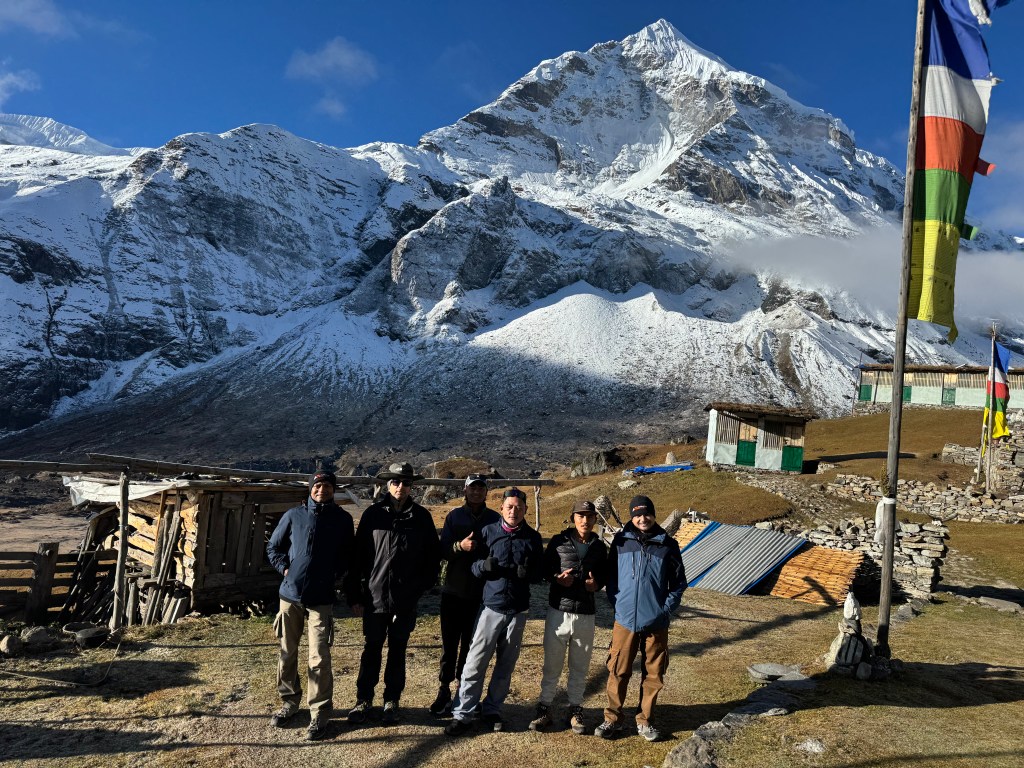
After being told that our breakfast was ready, we headed for the dining area. Our baggage were ready to be picked up by the porters. After breakfast, it was time for a group photograph and then we started.

Tashigaon, picture courtesy, Dhananjoy De
Tashigaon

Today’s journey was all about gaining altitude. Looking at the hill in front of us, the porters pointed towards a top. We would have to cross over the edge and travel further over adulating grounds to reach a place called Khongma. We planned to start from a height of about 2100 m. Our goal was to reach 3500 m. This was a gain of 1400 m in a single day. The maximum gain of altitude in a single day that we’ve experienced before was 800 m. That was from Phakding to Namche Bazar during the Everest base camp trek. Though it was challenging, there was a good part. This was being attempted at the lower section of the trail where there is forest cover. Itineraries are always designed that way. The longest marches or hikes are kept below the tree line. The higher you reach, shorter the travels become. At high altitudes, it is often desirable to reach your destination before lunch and have the remaining day for rest. We started at 8 AM. The target was to hike halfway through the route to reach Danda Kharka and have lunch. The word Danda means a hill in Nepalese language. Similarly, Kharka refers to meadows. The hike should take about 2.5-3 hours. Beyond that, another hike for a similar duration should take us to Khongma. We were told that the hike to Danda Kharka was steep, but the hike beyond that was relatively gradual. The trail left the lodge. It moved past agricultural fields and village homes. After a few bends, it entered the forests. It was covered by a canopy. The shade protected us from the heat. As altitude increased, rocky staircases started appearing and we started feeling pressure on our knees. We came across a few landslides where we had to cross by stepping over loosely held rocks. At another place, a stream flowed over these rocks. We had to cross over it by placing our feet carefully over these rocks which were smoothened by the torrent. Despite the issues, we found our way through to a position. From there, we got a view of the stream, its flowing bed, and the trail beyond. We took time to stand at that position in turns to get our photography done.

En-route Khongma

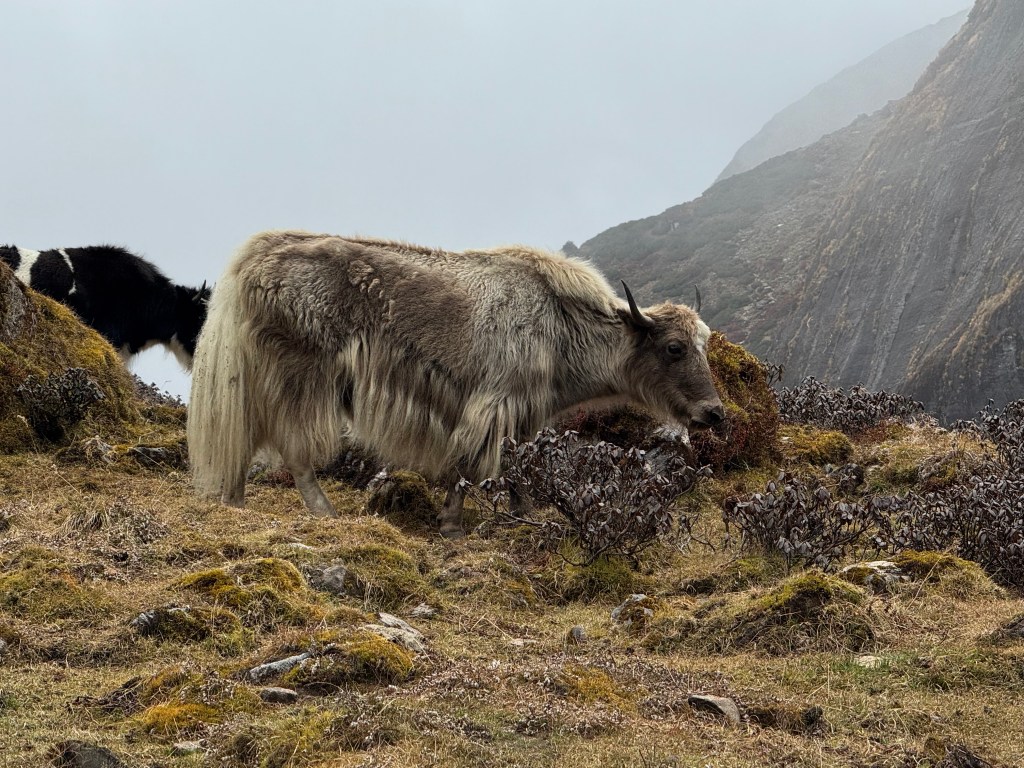
While walking through the trail, we suddenly heard a grunt from the bushes along with sounds of tingling bells. A dark creature was moving through the foliage. It was a grazing yak. We heard similar sounds from the surrounding bushes. Other yaks were grazing in the bushes and the tingling bells hung around their necks.

En-route Khongma
En-route Khongma

We continued moving up the stairs. Standing at the base of a set of stairs, it seemed that the ground beyond the top leveled gently. That gave me incentive, but as I moved closer to the milestone, upper stairs revealed themselves. That pattern repeated as we kept moving. We turned back to look at the trail below. We could see the fields and houses of Tashigaon below us.

En-route Khongma
En-route Khongma

Their diminishing size told us that we were gaining altitude. Then came a place that allowed the porters to sit and rest, leaning against the wall. We took the opportunity to gulp down sips of water. Some of us preferred to sit, but I chose not to. For me, it would have made it more difficult to regain momentum after that. For me, en-route rests are about stopping walks, but still standing on my feet. In this aspect, probably I resemble horses more than humans. Apparently, horses don’t lie fown while sleeping.

En-route Khongma
En-route Khongma

As every toil comes to an end with some rewards, so did this. In our case, the reward was reaching Danda Kharka. We removed our day packs from our backs, rested the hiking poles along the walls. Orders for dal-bhaat were given. While they were being prepared, we sat in the sun. This Lodge also belonged to the same owner who owned the lodge at Tashigaon. We saw his wife and their elder daughter Doma doing the cores. There was a lawn beside another Lodge which overlooked the valley. We went there in search of some photographic views and were not disappointed.

Danda-Kharka, picture courtesy, Dhananjoy De
Danda-Kharka

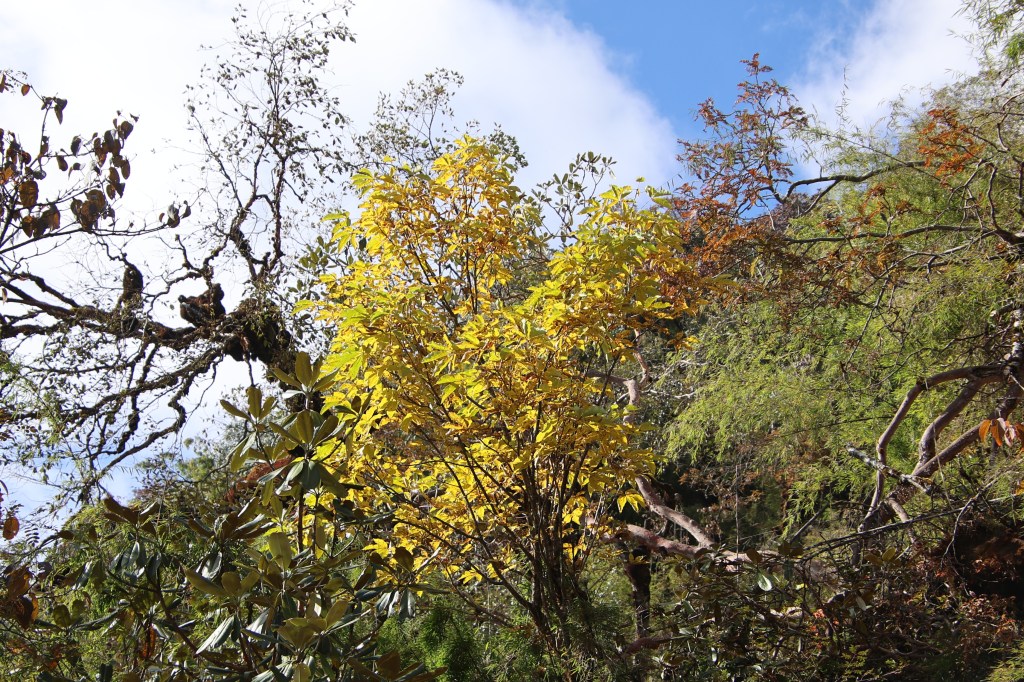
Autumn stamped it’s impact in terms of varied colors of the foliage. The forests were lightened up with crimson, yellow, brown and other shades along with green. In the lawn, a mat was spread out and a little girl sat on it. She was engrossed in her drawing pencils, paper & other artifacts. There was a doll sitting beside. Her attention were divided between the drawing pencils and the doll. I tried to entice her into a pose for photograph but was flatly denied. Dhananjoy succeeded where I failed. He had the necessary skills and was capable of convincing her into a photo shoot. She had all the time and grace in the world to act as a model for many photographs. We got another chance to have her company when we stayed at the lodge on our way back.

Danda-Kharka, picture courtesy, Dhananjoy De

Walking after lunch isn’t easy, at least to start with. Especially when there’s hiking involved. We were told that the slopes would be gentler. It was true initially. The bends came after longer duration. That changed soon and the trail turned into a path fraught with frequent switchbacks. Switchbacks are on trails where the need is to gain altitude briskly within short aerial distances.

En-route Khongma, picture courtesy, Dhananjoy De

I started keeping short milestones. Instead of thinking about the remaining path, I started thinking of attaining the immediate. For example, the next switchback bend. The idea was to reach there, stand, and take a few deep breaths. Then, fix the gaze towards the next milestone. Soon I was traveling alone as Dhananjoy & Kunal moved ahead. I could see them as well as others ascending the trail from my position below.

En-route Khongma

A series of switchbacks continued till the ridge at the top. One couldn’t see what lay beyond that. That makes one feel that the top is the zenith and things would ease after that. In other words, either an adulating trail or a descent would follow. I call this phenomenon as “Altitude illusion”. What could lie beyond the point where the hill seems to end, apart from a flat track or a descent? Only after one reaches near the point, the subsequent hike reveals itself. Earlier it used to give a depressing feeling. That’s why I’ve stopped thinking about it.

En-route Khongma
En-route Khongma, picture courtesy, Dhananjoy De

In the meantime, the slope was getting steeper and I was forced to create milestones even before switchbacks. With every switchback, the lodges of Danda Kharka became smaller and so did Tashigaon (which was still visible). We reached another set of houses. These were mere dwellings and places to keep domestic animals like sheep and yak. We quenched our thirst, popped in some lozenges in our mouths and resumed our hike. We repeated the same pattern of interspersed hikes and halts. Eventually, we reached a place where there was a stupa with prayer flags. I noticed that the trees have reduced. The remaining rhododendron trees have also dwarfed. That told us that we were nearing our destination. It was about 2.30 PM.

En-route Khongma
En-route Khongma
En-route Khongma, picture courtesy, Dhananjoy De

We rested for sometime leaning against the wall. The rays of the afternoon sun started taking a golden hue. We saw glimpses of the distant Himalayan peaks. They were partially shielded by light clouds. After sometime, the slope became gradual and walking became an evening stroll. The trail now meandered through bushes. We reached a flat top where there were two lodges. Our destined lodge was a few steps beyond that point. Now that destination was in sight, we focused on the surrounding bushes. We also looked at the valley and the distant mountains that formed the silhouette.

En-route Khongma

The trail moved ahead along the hill. We saw it rising beyond our destined Lodge. It went all the way up to a top where there was a watch tower. It appeared as a small toy even lesser in size than a matchbox. We have an extra stay at Khongma for acclimatization. That viewpoint was chosen as a destination for the morrow for sunrise views.

Khongma
Khongma
Khongma

The name of our lodge at Khongma was “Makalu Danfe Lodge”. “Danfe” is the name for the bird Monal in Nepalese language. It is a very colorful bird, found at higher altitudes of the Himalayas. They can be found in the Indian states of Himachal Pradesh & Uttarakhand. We also saw it near Namche Bazar. It is designated as the national bird of Nepal. It turned out that this lodge too belonged to the same owner from Tashigaon. It was being run by his son, a Sherpa boy named Ming. The room was not as good as the one at Tashigaon, but it had the basics right. The lodge was two-storied. The dining space & living rooms were at the top floor. A wooden staircase at the center connected to the ground floor which had the toilets. After settling in our rooms, we went out and sat in the open, enjoying the warmth of the afternoon sun. We called our homes using my international roaming pack. The network was very feeble and disappeared quickly. The evening was spent playing cards. The French group (who were targeting the Sherpani Col pass), also stayed with us. We spent time chatting with members of the group. Their porters were very jovial. After dinner, we went under the blankets. The clock alarm was set at 3.30 AM for the next morning. We were sleeping at 3500 m.

Tashigaon Acclimatization