Have you ever imagined your father navigate the ups and downs of a mountain trail at an advanced age when normally they’re expected to lead a less strenuous life at home? Your answer might depend on which part of the world you come from. If you’re from the valleys of SoluKhumbu, it won’t surprise you. You might even expect a couple of summit climbs. However, if you’re from the urban plains of India, this does surprise. It’s still possible to understand if one does it as part of satisfying daily chores. For example, in remote mountain areas, it’s quite common to traverse such terrains even to reach a nearby health center. But what if I say that someone does it as a professional trekking guide and that too, at an age of sixty six? His children are all settled. Some in foreign lands, successful in their respective professions, others in their higher studies in Kathmandu. He has his own house and has enough agricultural land in his native village of rural Nepal. There’s no obvious reason for him to undertake a physically demanding job of a trekking guide at this age. Yet he does it with a broad smile. Would you like your father to be away from home for days on end, at times without any contact? You need to remember these are not predictable trails, at least not in the sense as we have in the plains. Routes get blocked due to unforeseen weather events like landslides or unexpected heavy snowfall. What normally takes hours, could take days. Since I come from an urban home from Indian plains, it takes time for me to comprehend that a senior member of a family could be out for days on end on such tracks. Such a journey is usually followed by a couple of days rest with another starting almost immediately, especially in the spring & autumn tourist seasons of Nepal. Such a long introduction was meant to introduce Dhan Bahadur Gurung, our guide for this trek. He came across more as a fatherly figure, always concerned about the safety & comfort of the group members.
29th October, 2026
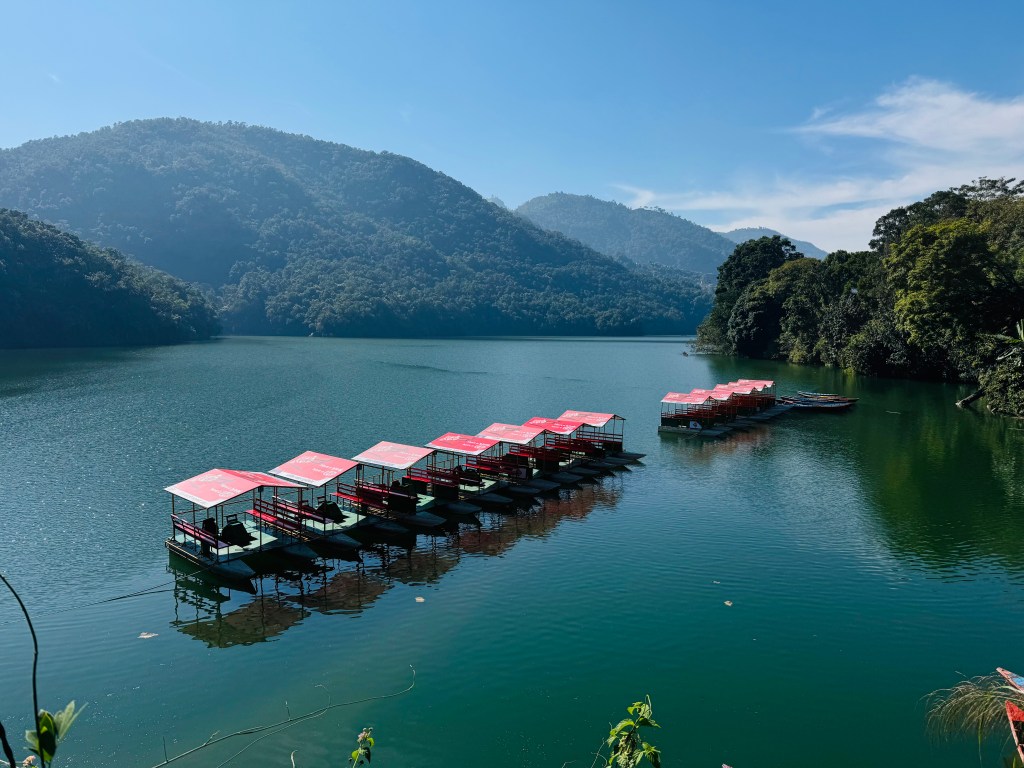
Dhan Bahadur Gurung (I’ll refer to him as Dhan, from hereon for convenience) met Dhananjoy on the evening of 28th October at the Pokhara hotel. He promised to come along with the porters to pick us up at 7 AM from the hotel. We were having breakfast at the roadside dining space, when Dhan arrived with a bus. Deepak, Nirmal & Raj (our companions for the trek) alighted from it. Their eager hands helped loading the duffel bags to the belly of the bus. We bade goodbye to the owner of the hotel “Himalayan Vacation” and took our seats by the windows. It started its journey along the lakeside road. A range of boats floated in the still waters of the Phewa lake, all strung up together to keep them from drifting.
We went past the streets and after the seventeenth street, the bus turned right to take the Prithvi highway. After sometime, as soon it took a left turn, the Annapurna Himalayas emerged on the horizon. Stretches of clouds prevented an unobstructed view. So did local constructions. Nevertheless, they were still the Annapurnas, the Himalayas. After a brief stopover for buying apples & pomegranates, the bus moved on, now along the Muktinath highway. Crowds decreased and cultivation fields started to appear beside the road. Green fields were abundant with paddy. They stretched to the horizon, which is where forested hills started. Beyond them, rose the Annapurna Himalayas. Hemja – the name of the beautiful place was displayed on a signboard. After that, the road narrowed and started to move upwards. Annapurna II & IV kept company and so did Mt Fishtail.
En-route Beni
The latter's angle kept changing as we moved up through the bends. We crossed Kande (the starting point for our Mardi Himal trek). I recalled that journey when we started off in a large group with two guides. They had walkie talkies as well. That celebrated start was for the Australian camp, our first day's destination. Going further up, after a few more switchbacks,we reached Nayapul. The road towards Ulleri branches from here. Ulleri is the starting point for many treks. One of them being the famous Annapurna Base Camp. It is the point where permits get issued/checked. The bus moved beyond Nayapul along the Muktinath highway. We stopped beside a valley. The river Modi khola made its way through it. It was lush green along both banks of the river. Terraced paddy fields went up from the banks till it reached the tree line. From thereon, forests took over. Greenery continued on both sides till the horizon, where, amidst the V-shaped opening, stood the snow capped Annapurna Himalayas.
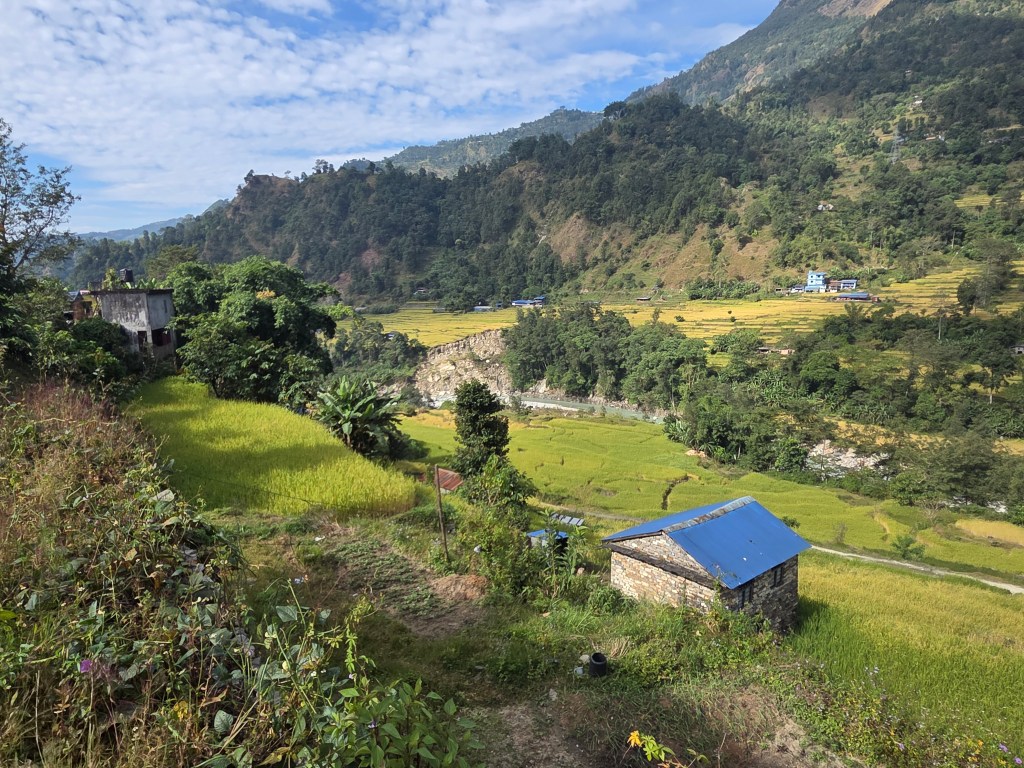
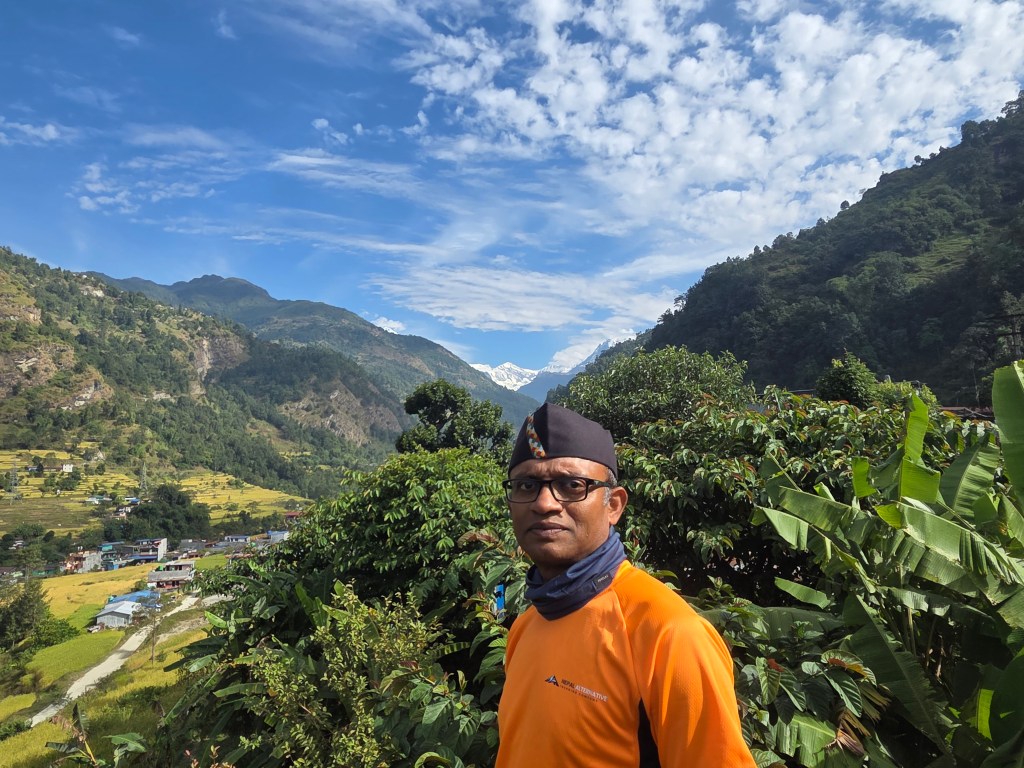
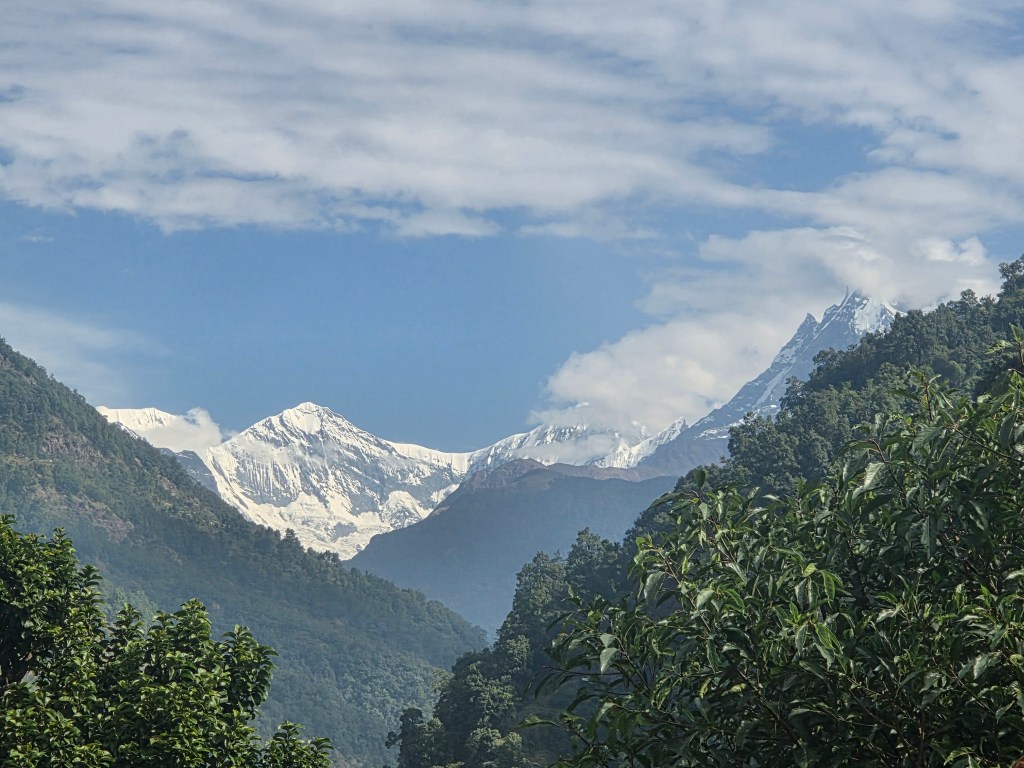
We resumed our journey after this wonderful break along the banks of the Modi khola. After sometime, we reached a confluence. At the confluence, the Modi khola drained it's discharge into a much bigger river. The guide & porters told us, it was the famous Kali Gandaki, coming down from the glaciers of the Upper Mustang region, even beyond the Muktinath shrine. Parts of that route was familiar to us. We followed that route while descending from Muktinath to Pokhara on our way down from the Annapurna circuit trail. It passes through picturesque villages like Kagbeni, Marpha & Jomsom. We were now travelling the same route, rather a part of it, in the opposite direction. The road now traveled beside the immense flow of the Kali Gandaki. A few houses started to appear on the other side of the river. Gradually, it turned out to be a big town nestled along the left bank of the river. We crossed over a bridge and found ourselves in the mid of Beni Bazar. That ended our road travel. It was decided to have lunch. While that was being prepared, some of us took the time to wander around the place. An important town on this route, Beni acts as a stopover and a junction. Many bus routes terminate or originate at Beni from & to different regions of Central & Western Nepal. Beni is a busy town with people travelling in different directions. Sellers went about selling apples, guavas and other local produces. With all its development, Beni has lost the quietness of a remote mountain village. The only place with some solace is the banks of the Kali Gandaki which washes its shores.
The original plan was to start from Galeshwar, but a landslide caused a change of plan. Our guide Dhan showed us the trail. It lay on the other bank of the river. He pointed upwards amidst the forest to show it. At first we couldn't notice, but a careful look revealed the railings. Following these we could see the track moving up through switchbacks to the top. Beyond that, going by what Dhan said, the track went along adulating ground towards Banskharka, our stop for the day. Looking at the trail, some of the members felt the hike to be daunting. But years of travel told us that the hike won't be tiring, given the forest cover. Add to that, the prospect of aerial view of Beni and the flowing Kali Gandaki from vantage points, giving ample scope for photography. After lunch it was time to strap our backpacks and hit the trail. We crossed the river and a gate greeted us. Beyond it, the stairs moved up the slopes.
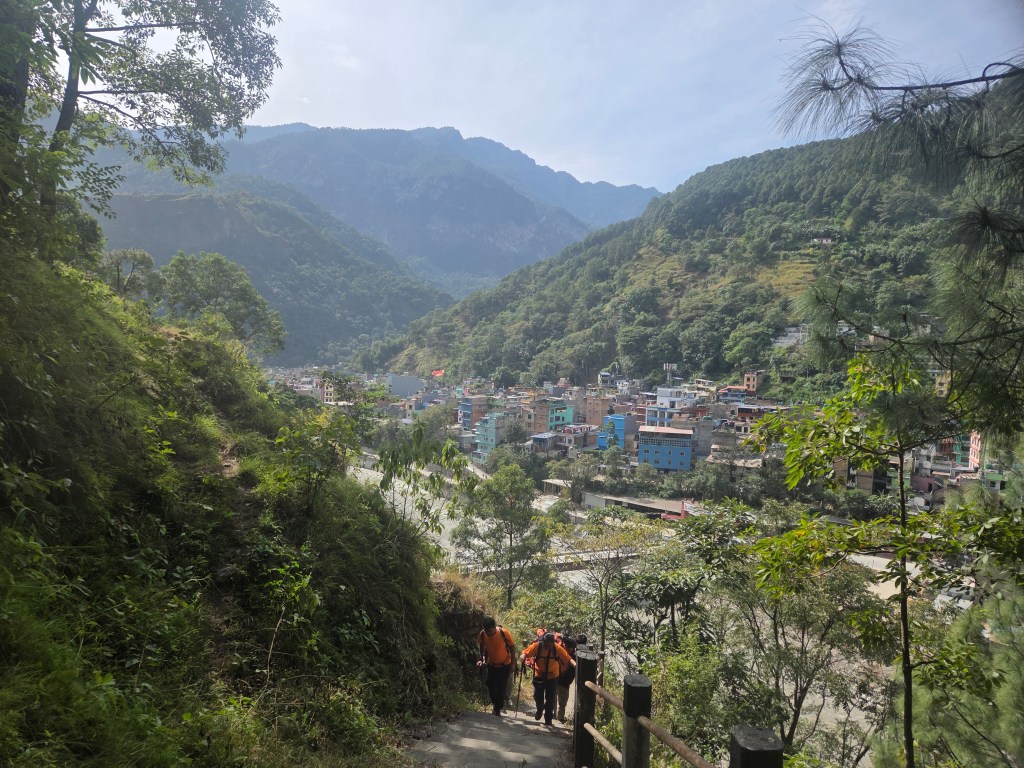
Starting slowly, I kept moving a few steps at a time, stopped at the first bend to look down. The town of Beni lay below with the Kali Gandaki flowing beside it. That view kept changing with every bend, expanding in its coverage but with diminishing size of the objects. It reached a point where the river looked like a flowing serpent. The bridges looked like a strip. The moving vehicles resembled toys. Gentle breeze kept flowing through the pine trees. Walking was easy.
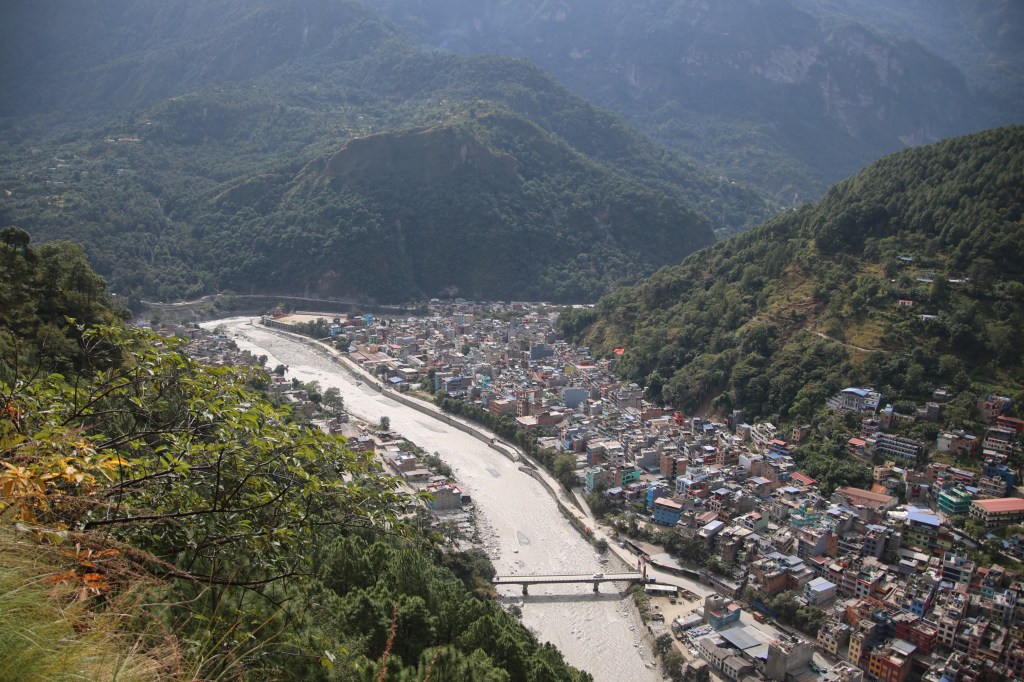
There came a point where two routes diverged. Since there wasn't any signboard, we had to wait for our guide who was behind, bringing up the rear of the group. After their arrival, we resumed in the direction pointed by the guide. As everything does, the hike ended after about two hours and we reached under the shades of a tree. We met a local woman who was travelling along with her daughter. They were going to Beni,on their way to Pokhara. Our conversation revealed that the daughter was learning a foreign language with the hope of travelling to that country in search of higher education & job. That is a very common trend in rural Nepal. I felt a bit sad about the fact that the youth are being forced to leave their beautiful villages to distant lands in search of occupation.
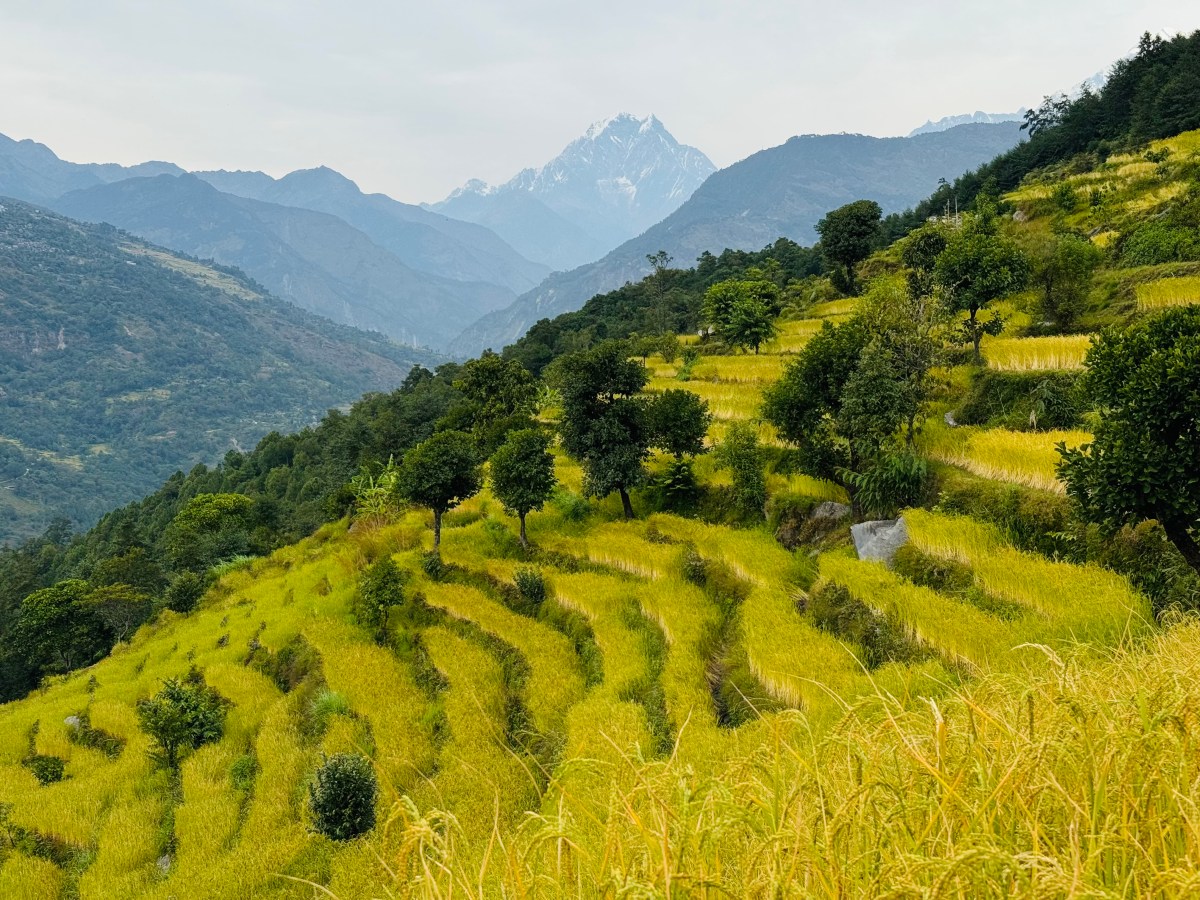
A huge paddy field lay before us. The trail ahead went through it. The next phase was a pleasant stroll through the field. The afternoon breeze created waves along the paddy plants which were ripe with the harvest. Wherever our sights went,it was a carpet of yellow and green. To our left, beyond the greens, the Dhaulagiri massif raised its head. It was partially visible. Cirrus clouds floated in an otherwise clear sky.
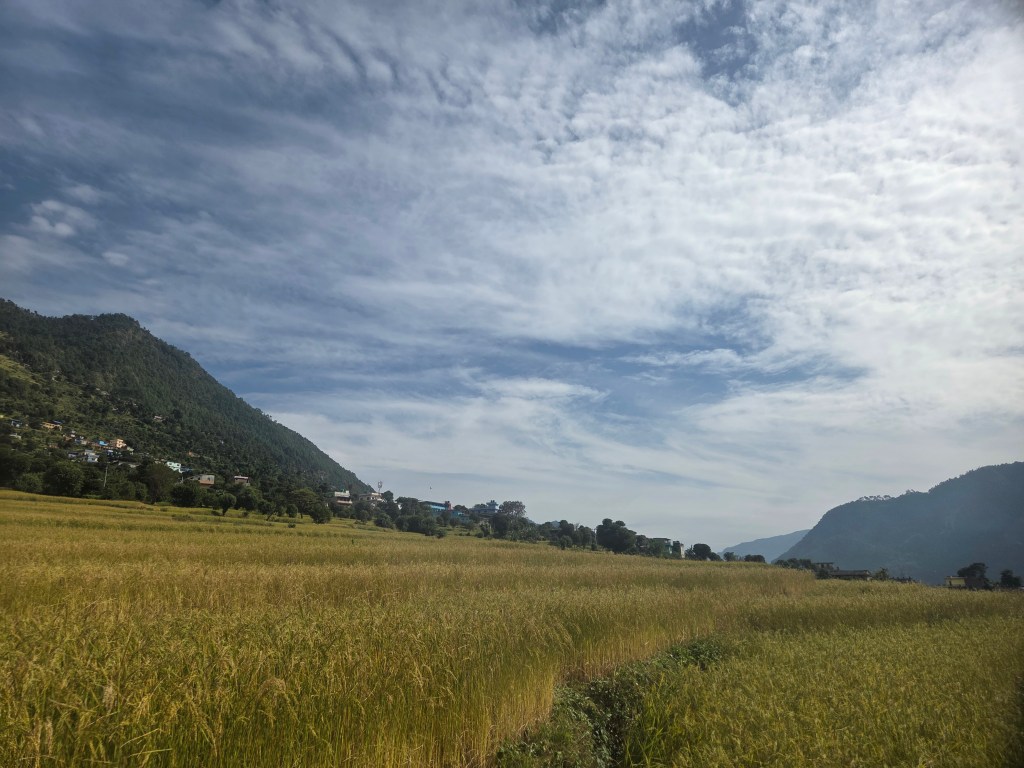
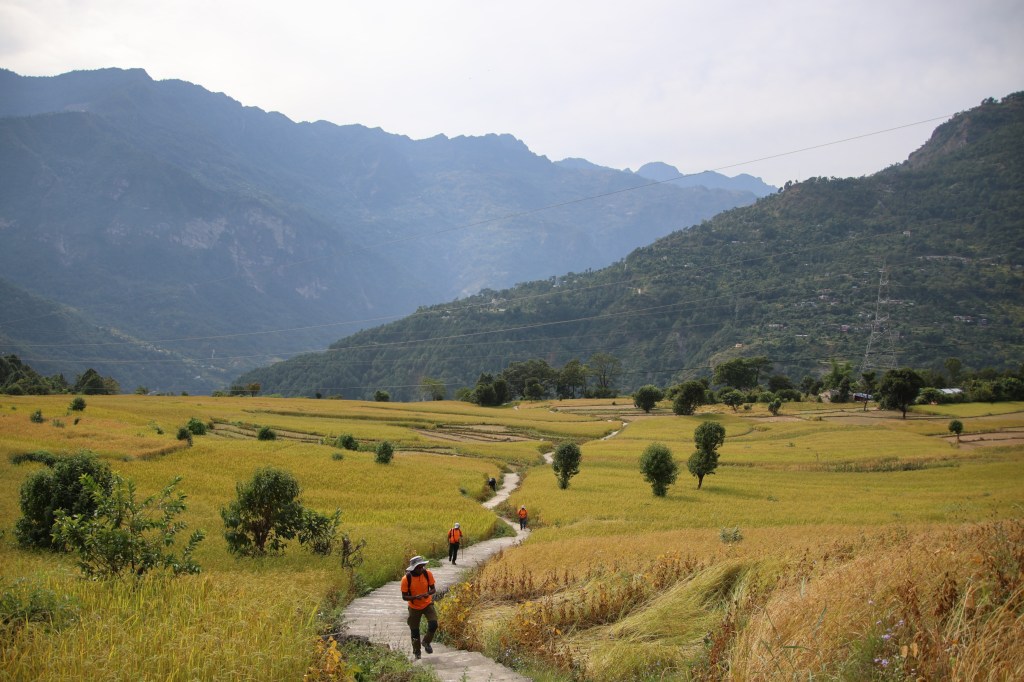
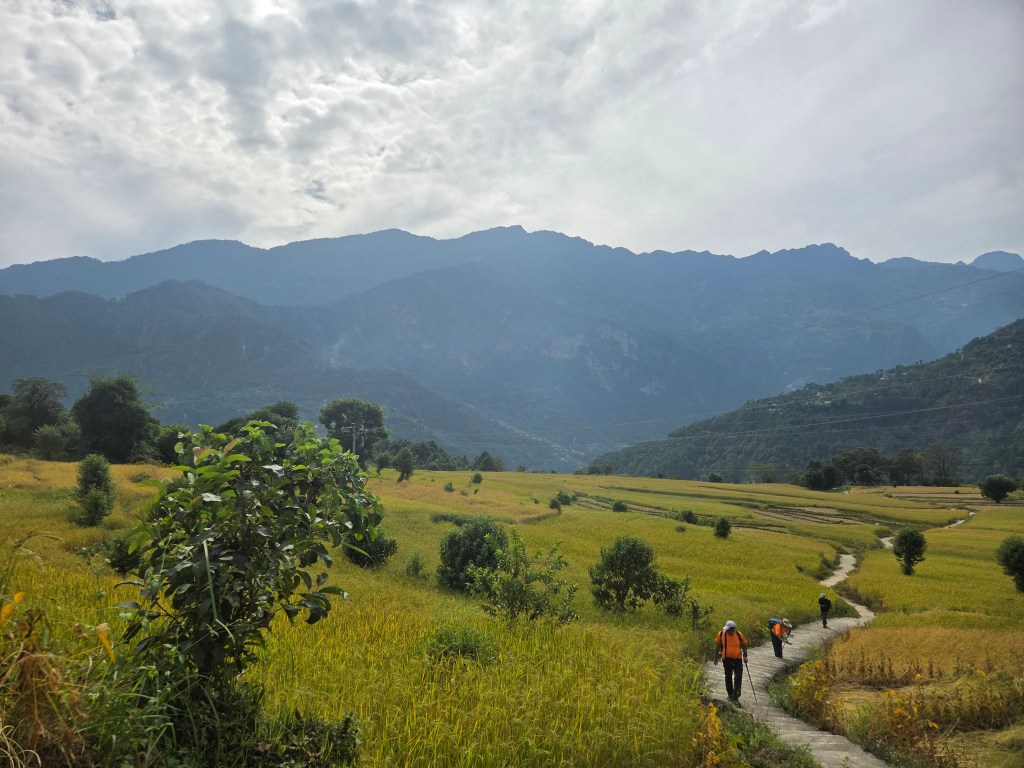
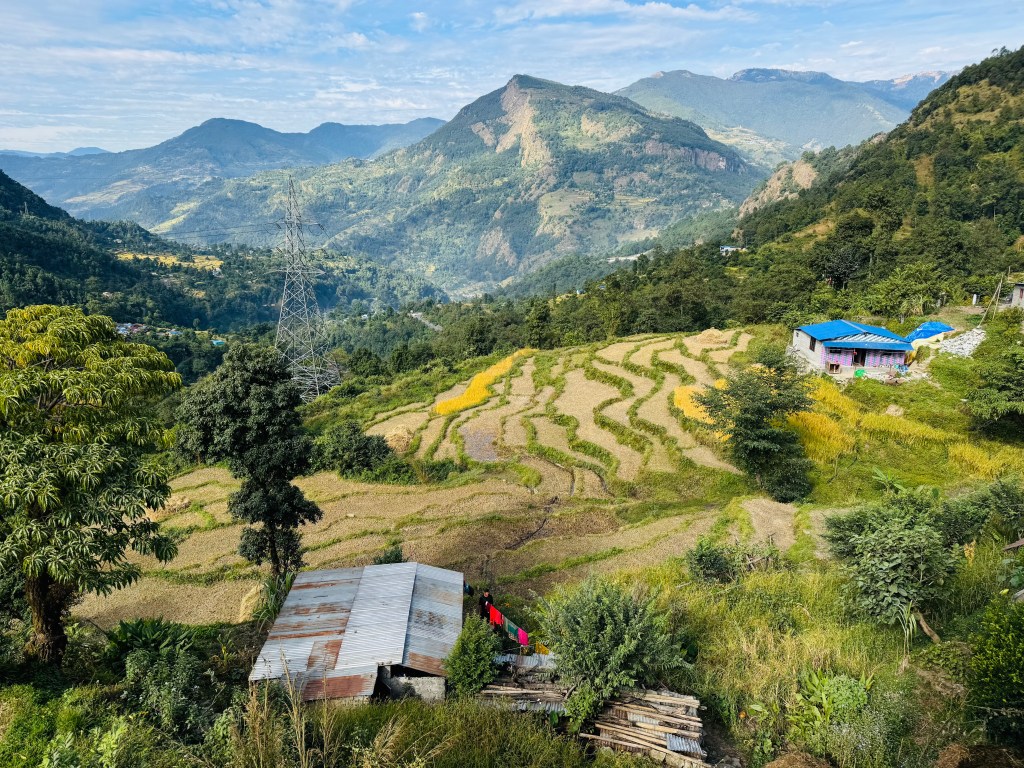
A section which should have been short, took us much longer to cross as we were paused multiple times with marvelous landscapes. We reached a few stairs that led to the village. The next section went amidst the houses. We passed beside a temple of the Goddess Bindhabasini. After that we found ourselves walking on level ground under the shades of tall pine trees. The walk was easy with no pressure on the lungs or knees (the two mostly taxed body parts on the mountain trails). At one point forests gave way to cultivation fields. They moved down in steps all the way down towards the valley.
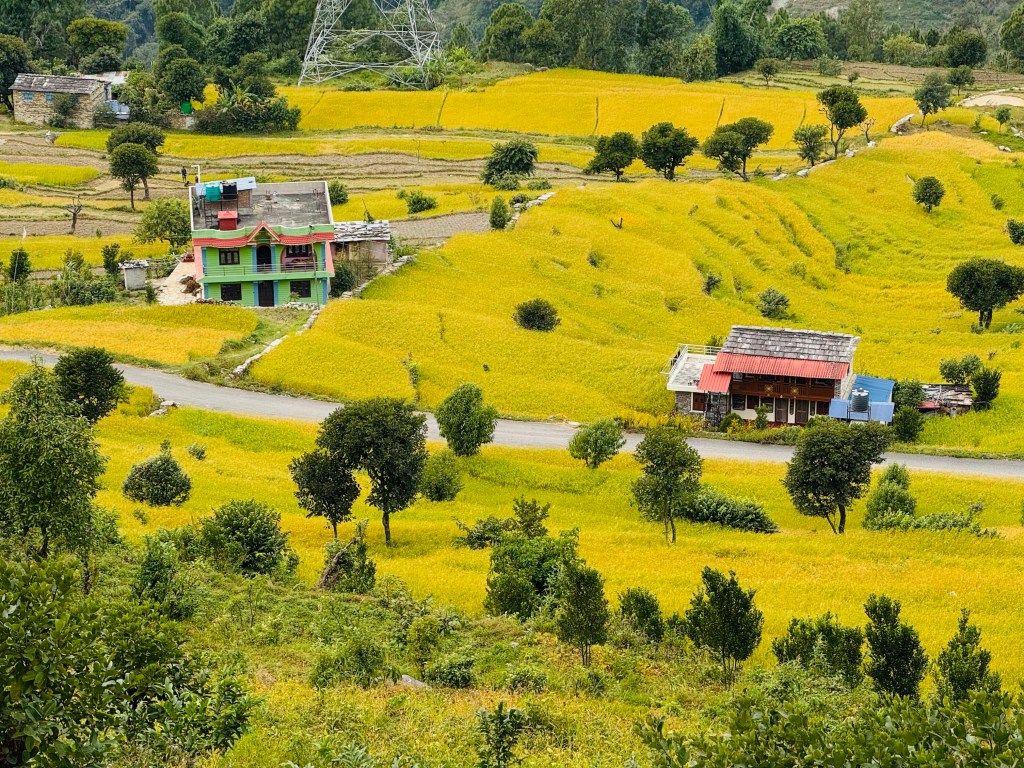
Deep down under we could see the flow of the river travelling via twists & turns. Hills rose from the other side to culminate into the snow capped mountains. Prominent peaks of the Central Himalayas now started emerging. To the west lay Gurja Himal and in front of us, the great Dhaulagiri massif, more prominent & visible than before. Every bend revealed a new angle and new scenes kept unfolding.
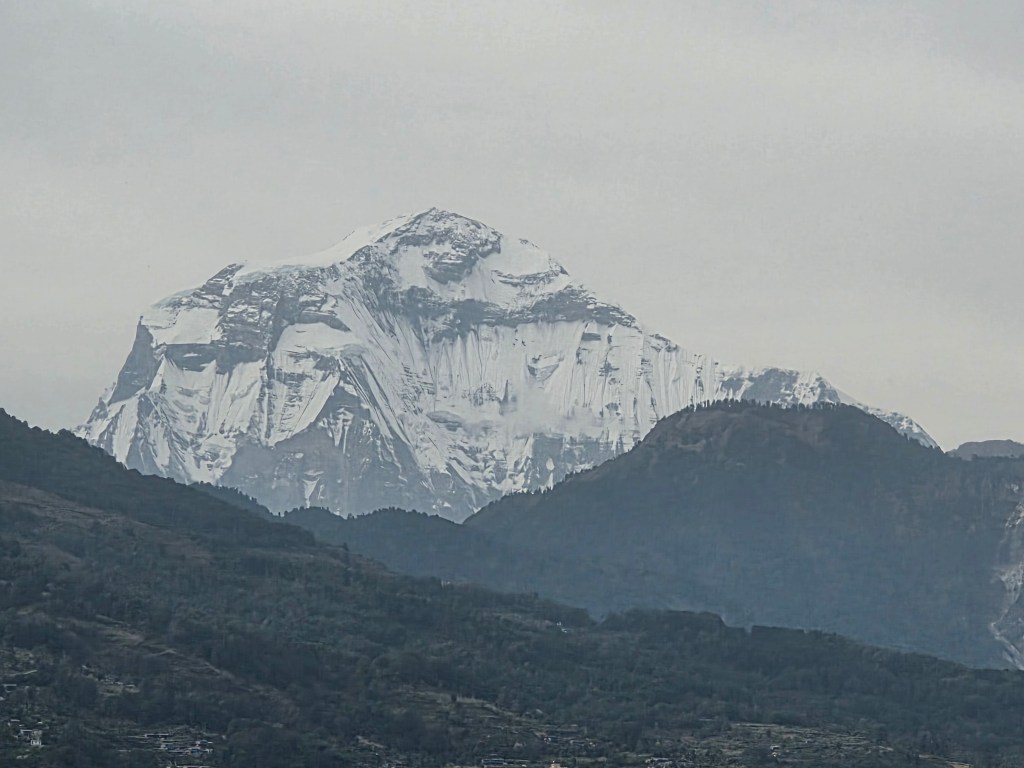
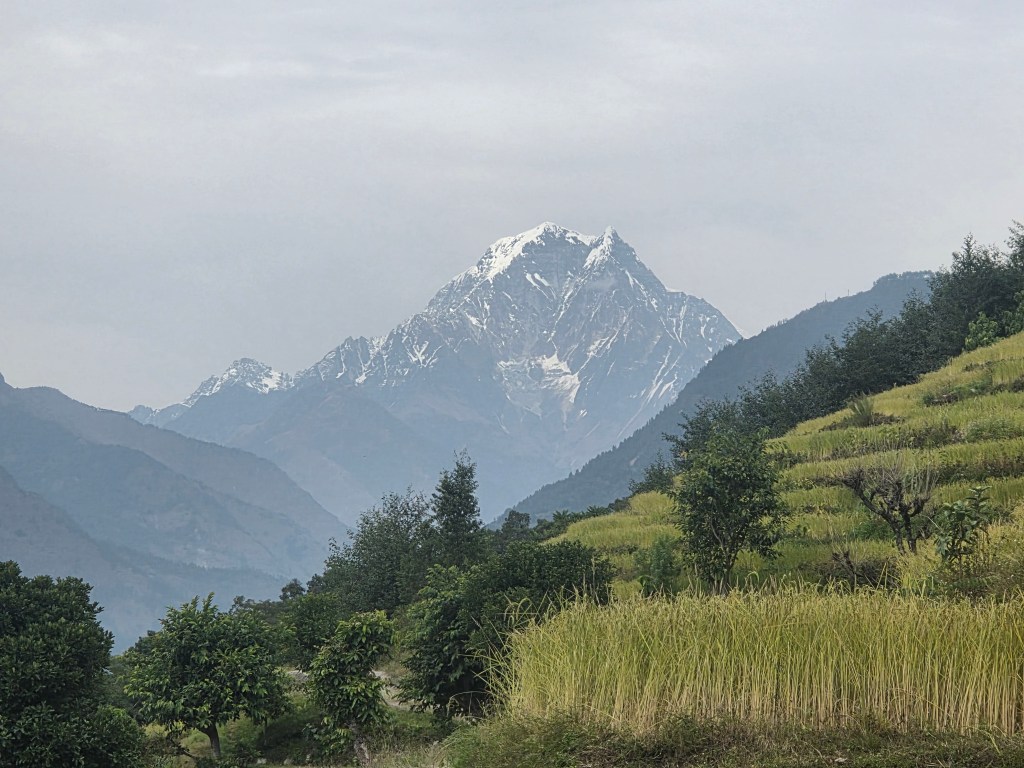
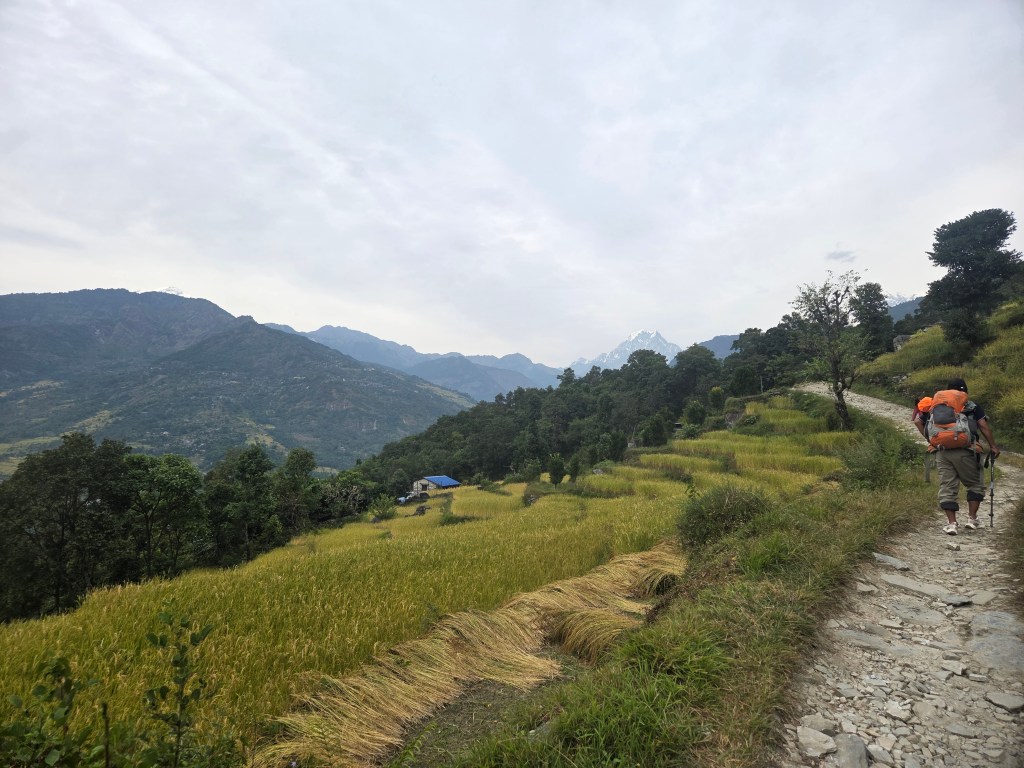
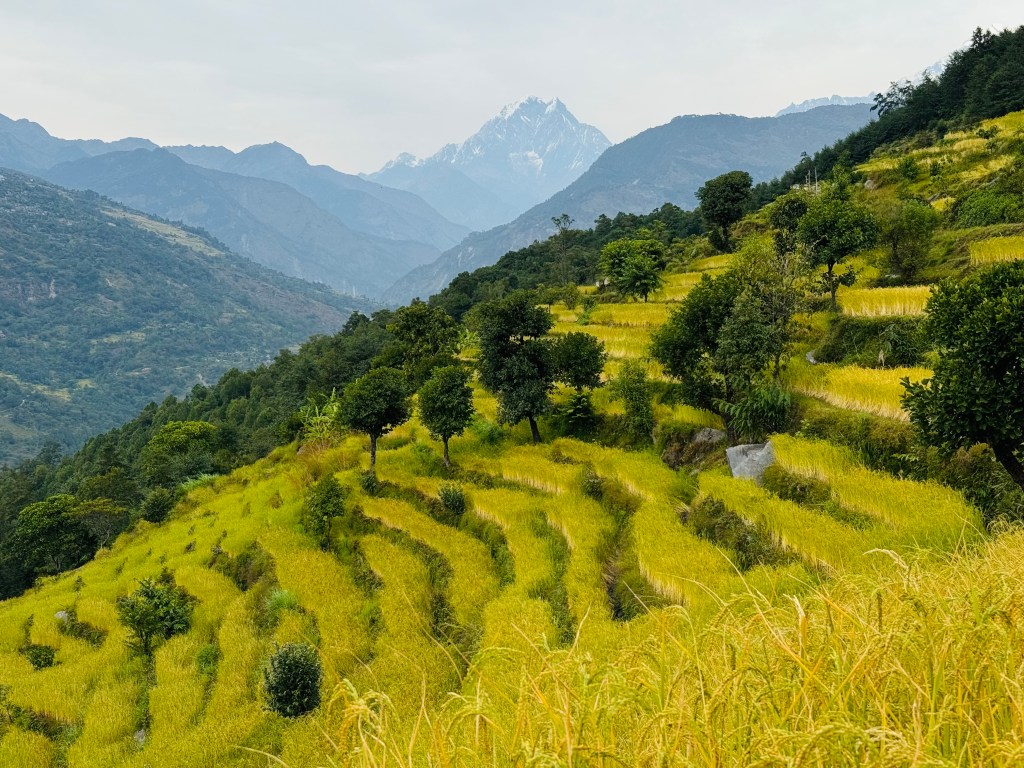
The sun was still high in the sky but colors told us that evening started to kick in. Local houses passed by, habitation increased gradually, which told us that Banskharka wasn't far. It was near yet so far. Deepak, who was walking with me, kept telling we were just about to reach, but it kept eluding us. Finally, there came a point where Deepak pointed towards a direction that left the main trail. We started to move up along stairs and reached a lawn. There was a dining space. I kept my backpack and the camera there. Some chairs were laid out in the lawn. I sat on one of them and spread my legs. Afternoon wore on and the solar rays acquired the yellow tinge. When I asked for the allotted rooms, they asked me to wait for others to arrive, but insisted on giving orders for dinner. That surprised me. When I kept insisting, they revealed the reason. The living rooms were not at the same place. It requires travelling further up through the stairs. It takes time to reach there. Hence their suggestion was to wait, have dinner and then travel at once to the rooms. I thanked them for their suggestion but still preferred to change to homewares before dinner or tea, even if it meant travelling between living rooms and dining space multiple times. The remaining members of our group now came up with tired legs but appeared relaxed having reached the destination. Once we were given the keys, we headed up for our rooms. Once settled, we came down to the dining space and ordered tea. Just at that moment, I suddenly noticed the golden hue over the edges of the distant Dhaulagiri massif.
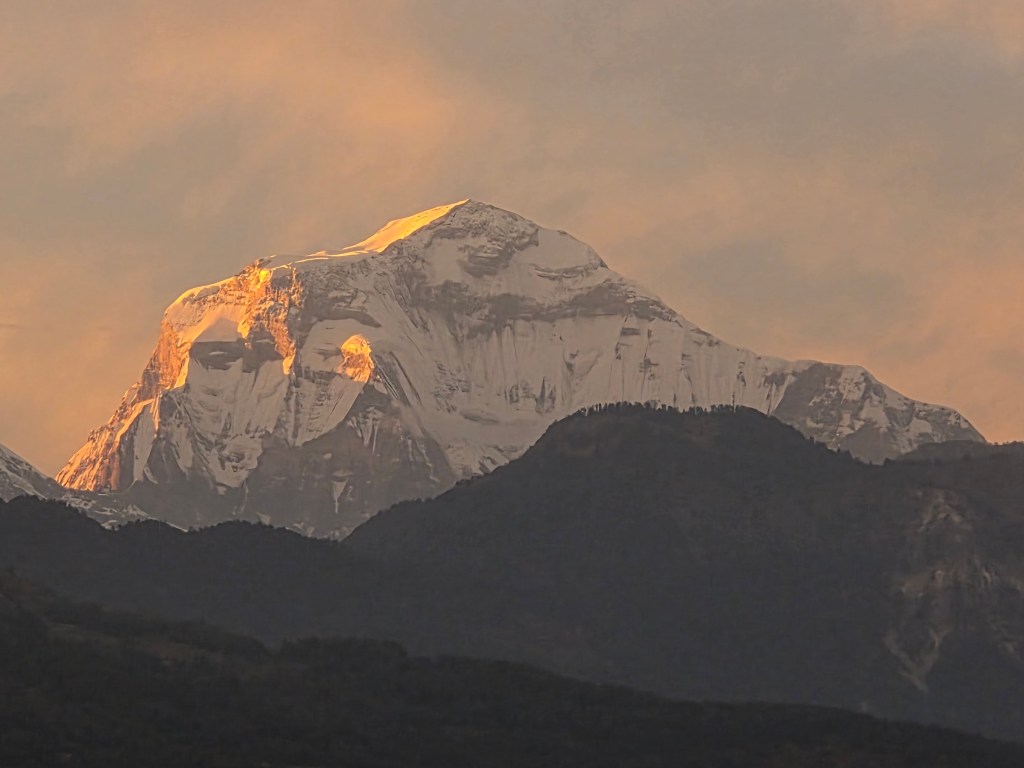
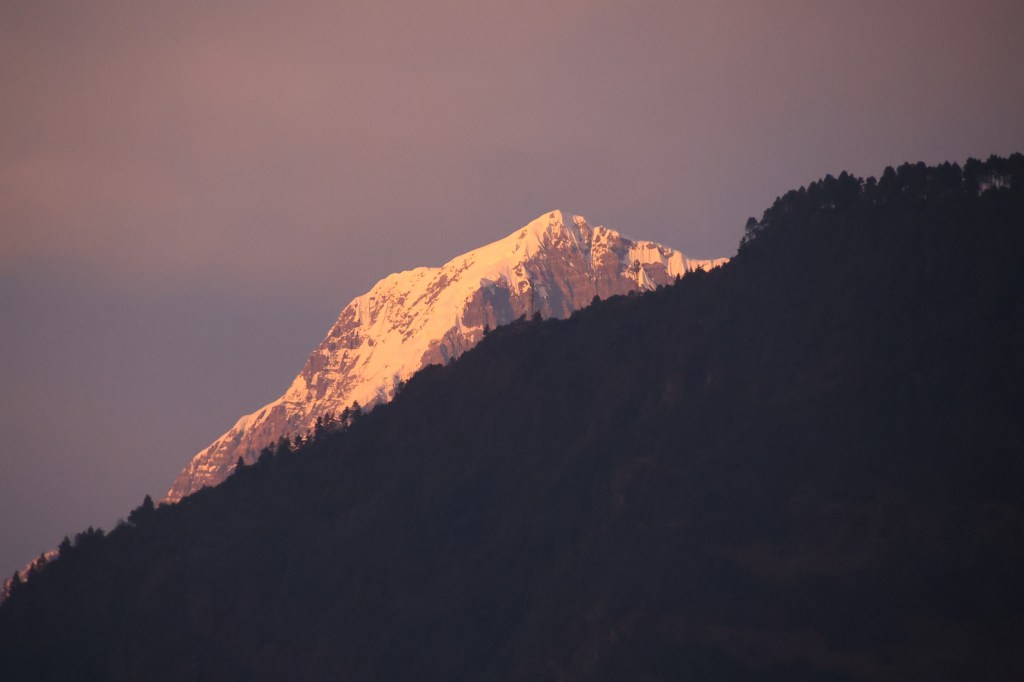
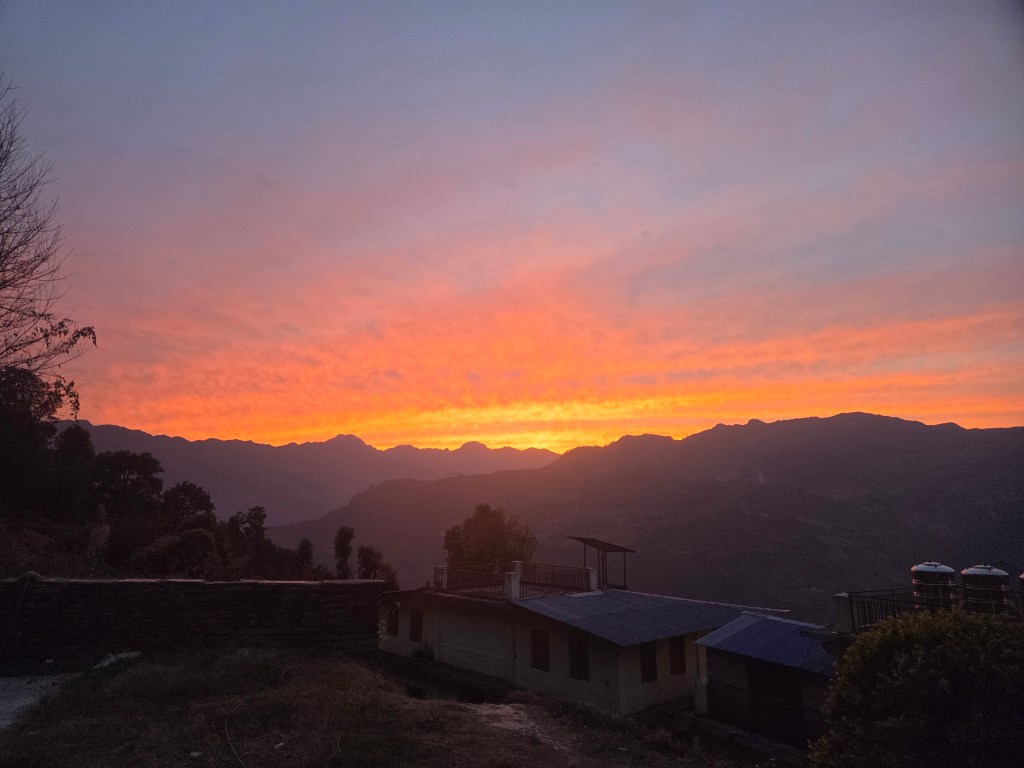
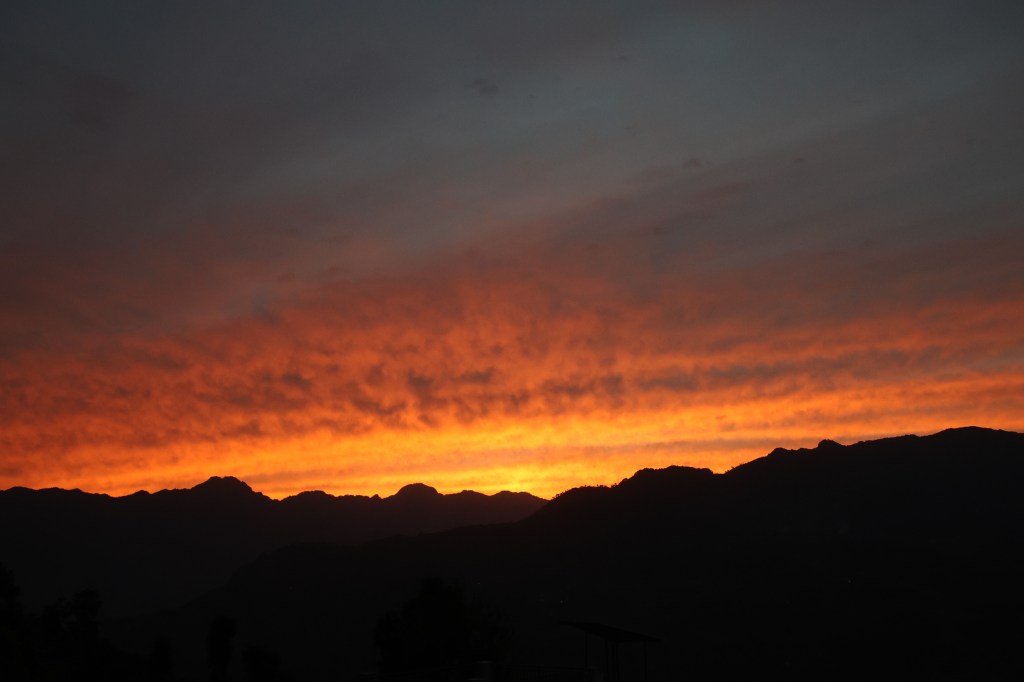
The sunset colors took over the canvas. The western sky was set ablaze with gold & scarlet. The peaks of Gurja Himal and Dhaulagiri acquired the paint. It was a fitting end for the day's trail. The solar rays gradually faded away. After the sun went down, the peaks appeared in white for a few moments before darkness set in. After dinner we retired to our rooms. We were sleeping at 1526 m.


One thought on “A less trodden area of the Annapurna Sanctuary – walking into it”