18th October
It was Diwali. Working migrants who live in the Delhi area were on the move. They were heading towards their homes to spend time with their families. This is an auspicious time of the year and the greatest festival of North India. During this time, we were also leaving Delhi. In fact, we were departing from the country and heading towards the Nepalese capital. It meant that we were competing with the rush. Even in the early hours of the day, one expects heavy traffic towards the exit points from the city, i.e. railway stations or airports. For international flights, one must arrive at least three hours in advance. This time frame allows for security procedures, which are typically more exhaustive than those for domestic flights. Though our flight was at 11:45, I started from home at 6. Dhananjoy started from Lucknow on the previous evening and reached a friend’s place in the morning. He was on his way to airport via metro. I also decided to use metro railway to travel to terminal 1. After my wife dropped me at the starting station, it took about 45 minutes to reach there. A shuttle transported me to terminal 3 in about 15 minutes. I met Dhananjoy and Kunal there. For some reason, web check-in was disallowed for Dhananjoy, so he had to complete it at the terminal. After baggage check-ins, it was time for security checks. As usual, we had to unravel a lot of our belongings only to reassemble them again. After arriving at the boarding gate, we finished our breakfast with chicken sandwiches provided by my wife, Anindita. Dhananjoy ensured window seats for all of us.
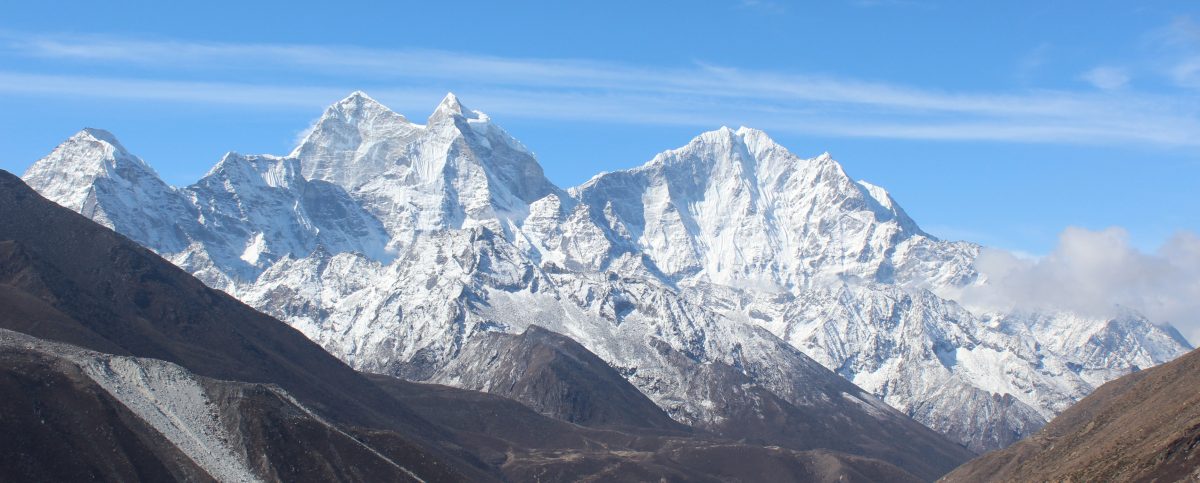
As the flight took off, Delhi turned into a city map, highways turned into lanes, vehicles reduced to toys. We focused our gaze on the Northern horizon. We hoped to view the Himalayas. It was the very reason for booking window side seats. It started with the Uttarakhand Himalayan peaks. The view of the awe-inspiring Dhaulagiri massif and the Annapurna range indicated that we’ve entered the Nepalese skies. We glided past the major regions of Nepalese Himalayas: Dhaulagiri, Annapurna, Manaslu, Ganesh Himal, and finally Langtang. Then the aircraft started its descent towards the Tribhuvan international airport.

After landing, we descended the airstairs to exit the aircraft. Standing on the runway in the bright afternoon sunshine, I looked around. It was surrounded by hills on all sides. Snow capped peaks of the Langtang region were visible beyond the hills on the northern horizon. A bus carried us to the arrival terminal.
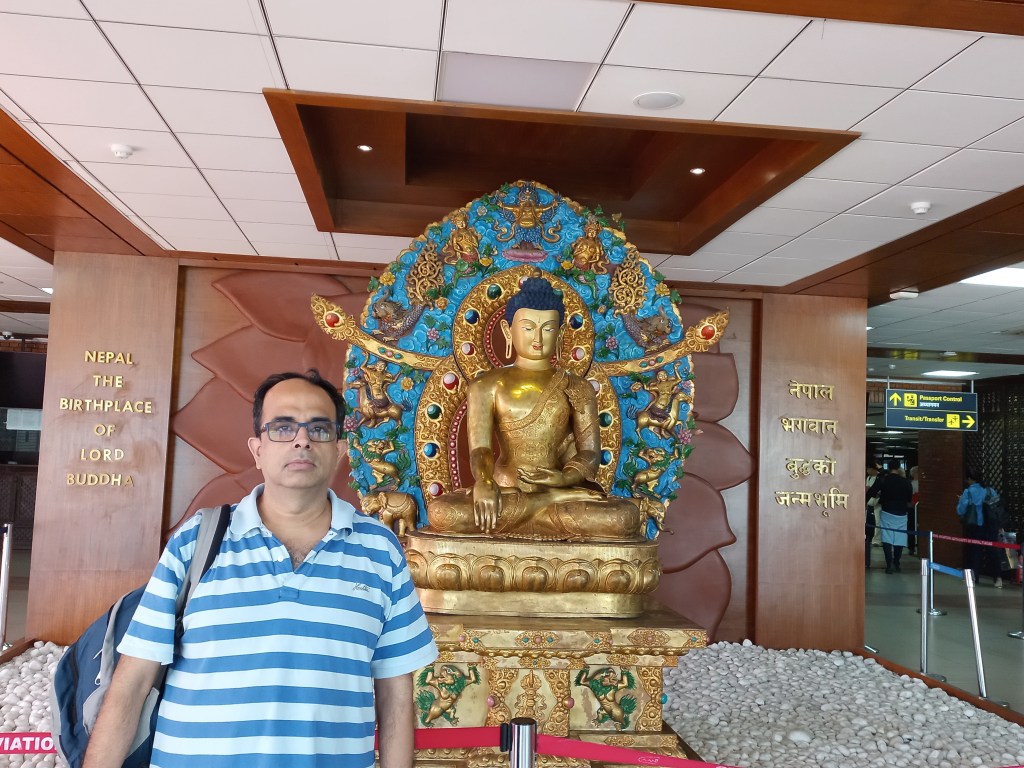
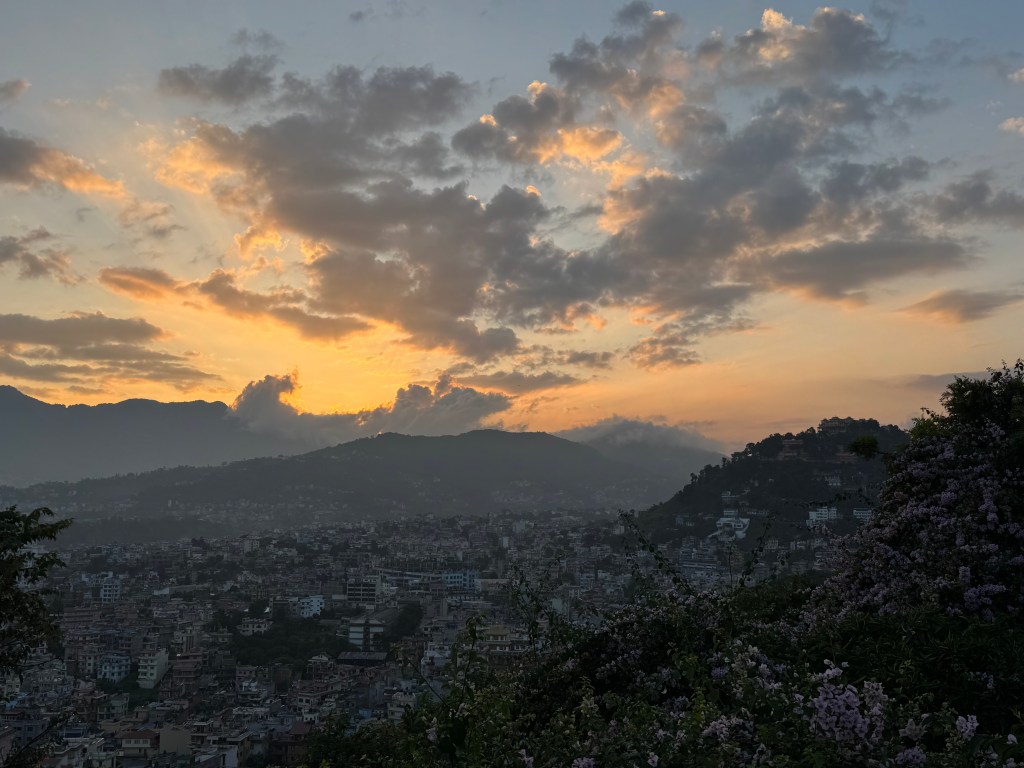
A statue of Budhha greeted the arriving tourists. We posed for photographs in front of it. Immigration formalities in Nepal are one of the simplest that can be found in the world, especially for Indian citizens. In fact there are dedicated counters for Indian passport holders. While traveling in a cab to Thamel, we went past the famous Pasupatinath shrine. It’s golden top, styled like a pagoda, glittered in the afternoon sunshine. Durbar residency is a decent hotel with comfortable rooms. After getting fresh, we sat over glasses of beer at the hotel’s bar. We spoke to Raju and asked him to meet at our hotel in the evening. Since it was still early afternoon, we ventured out to visit Swayambhunath. The breeze was cool at the top of hill at Swayambhu. The views are all familiar as it was the third visit for me. The bird’s eye view of the Kathmandu valley from the top is awe inspiring.
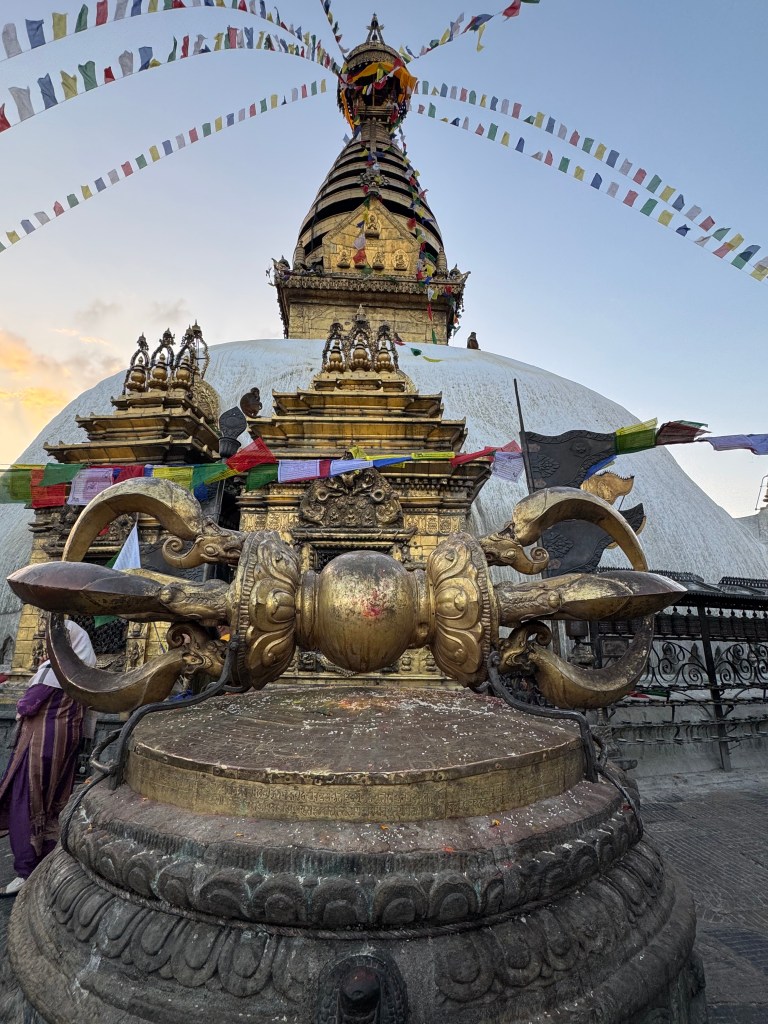
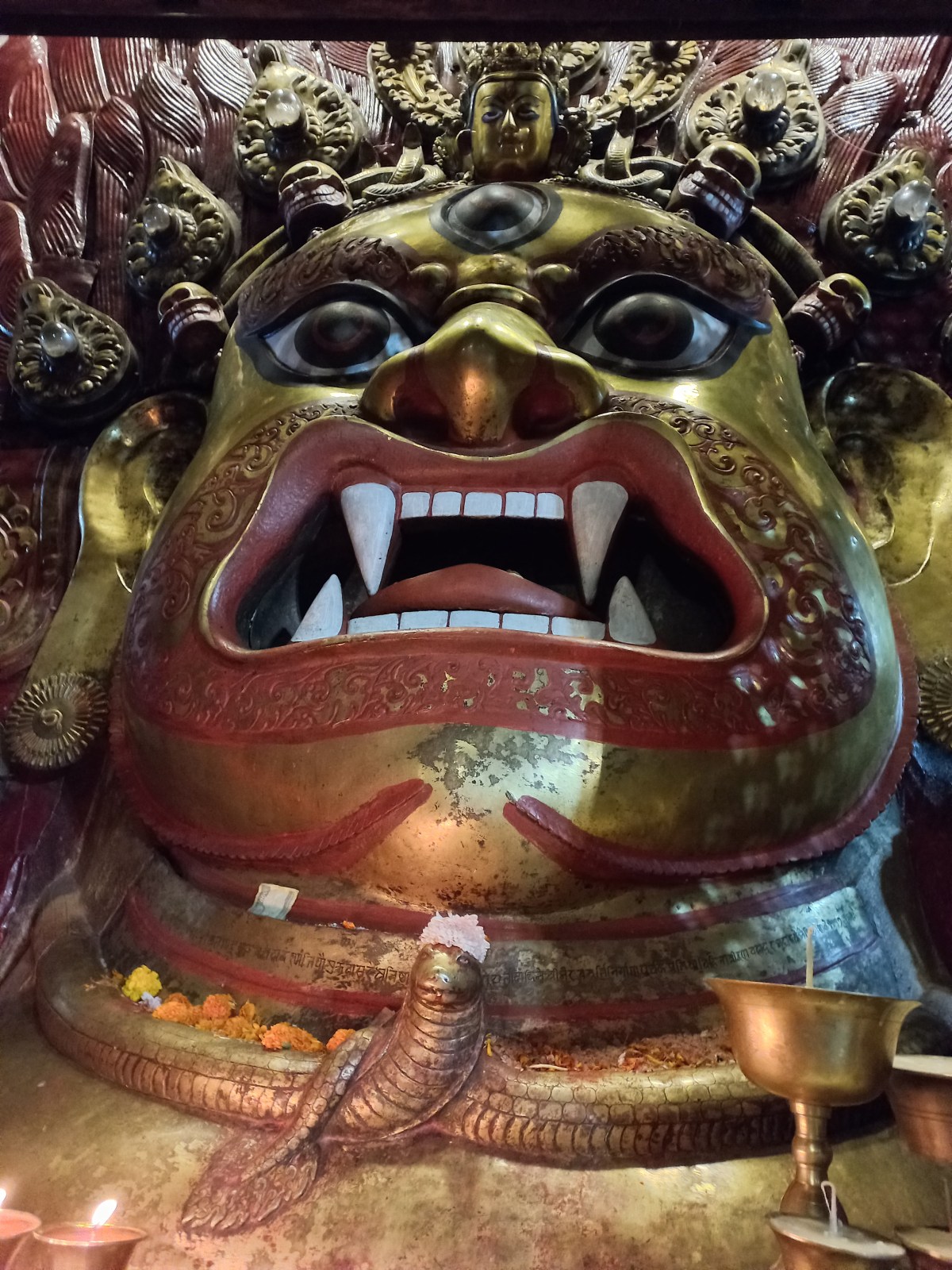
The gymnastics of the monkey brigade is ever enchanting. One can spend an entire afternoon by watching their antics. We then went to Basantapur Durbar square. The ancient wooden temples are mesmerizing. The Shwet and Kal-Bhairav idols captivate with their presence. The scores of burning incense sticks and candles transport one back hundreds of years. This was to the age when the Kathmandu valley was ruled by local kings. This was before the Gorkha ruler Prithvi Narayan Shah attacked and conquered the area. He leaves behind a mixed legacy. Some credit him for consolidating the Nepalese kingdom by defeating the warring chieftains. Others loathe him for his cruelty towards the defeated forces.


The Shah dynasty occupies a significant position in Nepalese history. After Prithvi Narayan Shah, the dynasty was immersed into a succession struggle between warring factions conspiring against each other. This mayhem was capitalized by the powerful prime ministers, the Ranas. They took control of affairs and reduced the Shah kings to puppets. They continued their iron grip over Nepal for centuries. The Ranas maintained a warm relationship with the colonial rulers of India, to the south of their border. They even stood by the British East India Company to help them suppress the revolt of 1857. When the British left India, almost abruptly in 1947, the situation changed dramatically. At that time, Nepal was ruled by its prime minister Mohan Shamsher Jung Bahadur Rana. The king Tribhuvan was it’s ceremonial ruler (who was crowned at the age of five). Inspired by the ideals of the Indian National Congress, the Nepalese Congress party was formed and it started it’s struggle for Democracy in Nepal. But they were suppressed by the Ranas with a strong hand. Tribhuvan sensed an opportunity and started liaising with them, promising to free them from the autocratic rule. He escaped from the Royal palace and took refuge in the Indian embassy. From there he was flown to New Delhi, where Jawaharlal Nehru, the first prime minister of independent India, greeted him. Nehru was in favor of a democratic Nepal, but under the watchful guidance of the monarch. The Rana was forced to relinquish the rule and an accord was signed where Nepal was turned into a semi democracy with power shared between a democratically elected government headed by a prime minister and the monarch. Tribhuvan returned to Nepal, a hero. Seen as the king who ushered in democracy to his country. It could have been a happy ending for Nepalese politics from here on. But Tribhuvan’s successor, King Mahendra, had other ideas. He abolished the Parliament and introduced a Panchayat system where the Panchayat heads directly reported to him. Discontent started brewing against his policies. Rural Nepal witnessed the Maoist insurgency. Protests erupted on the streets of Kathmandu. After the sudden demise of Mahendra, Birendra became the king. He inherited not just the throne, but the political turmoil too, much of which was a result of his predecessor’s repressive policies. Despite relentless loss of civilian lives due to Maoist insurgency, the Army was not called upon. It is said that much of it had to do with Birendra’s reluctance to allow the army to fire upon his own countrymen. He took the unprecedented step of relinquishing much of his power. The power then shifted to the elected government. In doing so, he effectively converted himself into a constitutional monarch. But some say, this neither pleased the insurgents on the streets, much less the royal family members, many of whom favored his father’s policies. Finally, on the fatal night of 1st June, 2001, he was assassinated at the Royal Narayanhithi palace along with his queen and other members of the family by his heir Deependra who later shot himself. Many reasons and conspiracy theories float around, but the official record puts the responsibility on Prince Deependra. As the funeral pyres burnt at the cremation ground on the banks of the Bagmati river behind the Pasupatinath shrine, a mythological legend surfaced from the rears of history.
It is said that Prithvi Narayan Shah, the founder of the Shah dynasty, once met with the saint Gorakhnath (believed to be an incarnation of Lord Shiva). He somehow ended up enraging the saint who cursed him and predicted the destruction of the dynasty during the reign of the 11th Shah king. Birendra was the 11th. After this massacre, younger brother Gyanendra succeeded him. He too, like Mahendra, tried to dissolve the Parliament under the pretence of saving the country from rampant corruption of the political class. This proved to be the final blow to the monarchy and he was forced to abdicate. Monarchy was abolished in Nepal. The country turned into a secular democracy. The monarchs, who once were viewed as incarnations of the revered Hindu God Vishnu, now moved into oblivion. But since then, the political class plunged into one controversy after another. Corruption ran rampant. In a few years, Nepal saw approximately 20 prime ministers come and go. This led to the public protests led by the young generation (called gen-Z) in the month of September 2025 (just a month before our departure). Police firing led to the deaths of 20 young people. Angry mob burnt down every possible signs of the current establishment. It forced the incumbent government to resign. These developments threatened to disrupt our plans but finally, sense prevailed. Things calmed down with a caretaker government taking over under the leadership of a former chief justice of the supreme court. Fresh elections are slated for early next year.
Anyways, let’s get back to our story. After returning to the hotel, we tried to call up Raju but he didn’t pick up the phone. We tried this multiple times while rearranging our baggage (to leave some elements at Kathmandu). Raju’s silence increased our tensions. Normally, we expect a guide to have a conversation about the plan. They should fix the timing of departure. A guide should also give a sense of responsibility and purpose. We started thinking about alternative courses of action. Ideas of reporting to the police also crossed our minds as it was now 8.30 PM. This was late night by the standards of a hill station. Chances of Raju’s appearance seemed to dwindle by the minute. All our payments were already made and we didn’t know about his address. We almost gave up hopes and let our fates rest upon his mercy. Then, suddenly, late at the night, his face appeared. As if a fever subsided from our bodies after running high temperatures for hours! Apparently, his phone discharged while he was busy printing our T-shirts. Nevertheless, all’s well that ends well. Raju would arrive at the hotel with a hired cab. We would start for the airport no later than 8 AM. It was already planned to visit the Pasupatinath shrine at 4 AM in the morning. I went to sleep with mixed feelings. On one hand I was relieved that the trip wasn’t jeopardized. On the other hand, Raju’s casual attitude didn’t bode well for the upcoming days. Did he make the necessary arrangements as claimed by him or there could be unpleasant surprises along the way? Little did we know then that many such fears will turn out to be true. Because of these thoughts, sleep eluded me for long. It was our last comfortable stay before embarking on a fortnight long trip, but I couldn’t enjoy it. The route wasn’t known to be as developed as other parts of Nepal. It demanded more experience and preparedness from a guide but Raju’s attitude seemed on the contrary. I hope he turns up the next day on time! Was it wise to not engage a tour operator? We were planning a trek that lies in a desolate corner of Eastern Nepal. All my thoughts turned to the negative territory. Finally, some factor in my brain resisted. There wasn’t any point pondering over something yet to materialize. It’s wise to cross the bridges as they come along. Why not live in the present? Why not enjoy the moment of being away from work for a fortnight, away from the corporate rat race? Didn’t I wait long enough to embark on the Makalu trail? This itinerary was impossible to attempt a few years ago due to its duration. Now, it seems within our reach! Why not grab the opportunities with both the hands (rather limbs as well). The Himalayas don’t beckon so easily. Whatever comes our way, we will tackle it. We will return to the same hotel after a fortnight with Makalu base camp added as a feather to our illustrious cap!
 Break shackles