28th April, 2025
The views of the Annapurna Himalayas, late in the previous evening, raised our hopes of clear weather, but when I woke up at 5 AM and cast a look outside, my hopes were dashed. Dense fog engulfed every object. I prepared to hike under the gloomy cast of fog and mist for the entire day and just prayed that rain stayed away. Today’s hike was supposed to be longer than yesterday. In fact, today was the first day of full hiking. It would take us to one of the high points on the trail, Dobato. The next morning, we were supposed to hike up to the Muldai view point, which is one of the highest in these regions, promising to offer panoramic Himalayan views. But with the overcast conditions like this, it could be a futile exercise. Ranjan da was already contemplating skipping Muldai view point hike, given the weather conditions, but I decided to defer it till the actual time as one never knows when weather turns merciful, especially, in the mountains. See for a fact, who knew that it’d open up last evening, given the conditions we went through during earlier parts of the day? Hence, I was not ready to throw the towel in yet.
Yugal, our guide, shared a grim information about the death of two laborers high up beyond Dobato, electrocuted by a sudden lightning strike. Apparently, it happened during the brief spell of downpour when we were under the shelter of Bhainsi Kharka yesterday. These laborers were paving stones while establishing a trail towards the “hidden lake”, an side excursion from Dobato. I kept thinking about it while getting prepared for the day’s hike. Once I entered the dining space, all concentration was on the breakfast and the cheerful conversations from fellow hikers from other groups made me divert my attention to the present. We ordered bread toasts along with soup for our breakfast. We asked for two cups hot water to dip the tea bags we carried along with us to prepare our morning tea (that saved at least 100 NPR) and this was a pattern we repeated in the mornings and evenings on everyday of our trek. Nevertheless, after breakfast, we filled our bottles with lukewarm water and hit the trail. The target was still to reach Dobato before lunch. I always face a dilemma about whether or not to put on my jacket during a hike. This is something which I haven’t been able to sort out even after so many treks. The conditions at the start (unless it’s a bright sunny day) mandates wearing it and today was no exception (given the prevailing cloud and mist), but after one starts the hike, the body heats up and causes immense sweating. There have been instances where I’ve taken it off, only to put it on again after winds sent down a chill through the body (especially when one rests at intervals). Hence, the conclusion seems to be to put it on (unless it’s a sunny day) and ignore the sweat. Sweat is a significant factor to consider because once you reach the destination, all your clothes get wet and there are no simple ways to get them dried in these moist mountain climate. The only option is to hang them up near the fireplace at the dining space. Even there, one has to compete for space with other hikers. I also keep a close watch on my backpack. It needs enough space to carry my camera (when there aren’t any chances of snaps), a one litre bottle filled with water, rain coats and sometimes, space for the jacket (when it’s impossible to wear it). This time around, I deliberately chose a smaller bag and left the relatively larger one at Pokhara with some clothes and other items deemed redundant during the trek. That helped reducing the weight of it during the hike.
We started our hike among the mist and visibility was reduced to just the trail and everything around it was behind the shield. After an intial stroll along an adulating track, it started moving up and we were presented with stair cases. Stair cases paved by varied sizes of rocks are a commonplace in the routes spanning the Annapurna sanctuary area. They are a way to shorten the trails, but they take a toll on the hikers’ lungs. Distance gets traded off for angle of slope and I’m not so sure if that helps reducing time. Coming down such slopes also puts stress on the knees and we’ve had some of these tracks during later phases of the trek. Nevertheless, I kept plodding ahead and very soon found myself alone with the mountains (which is always the case in every trek). These are phases where you don’t talk, but introspect about a lot of things. It could be about the trail for the day, the entire trek, some upcoming elements of it, which could be risky to traverse or in general, about life. Unlike earlier treks, this time around, my mind wasn’t able to shelve the prevailing tensions in the current affairs of the country and they kept hovering in my mind while walking.
After sometime, the sun came out and there was some brightness around, but the clouds continued to prevail at the higher altitudes. The Himalayan snow views were out of reach. With the sun coming out, I felt the warmth and decided to peel off my jacket. That made things easier for the moment. Walking through bright sunshine adds color to the surrounding forests. After sometime, I reached an open patch of grassland with a mud hut standing at the center and around it, spread all over the place, a few buffaloes were enjoying their leisure in the sunlight. Some even dozed off amidst the comfort of cool breeze along with the lukewarm sunlight.
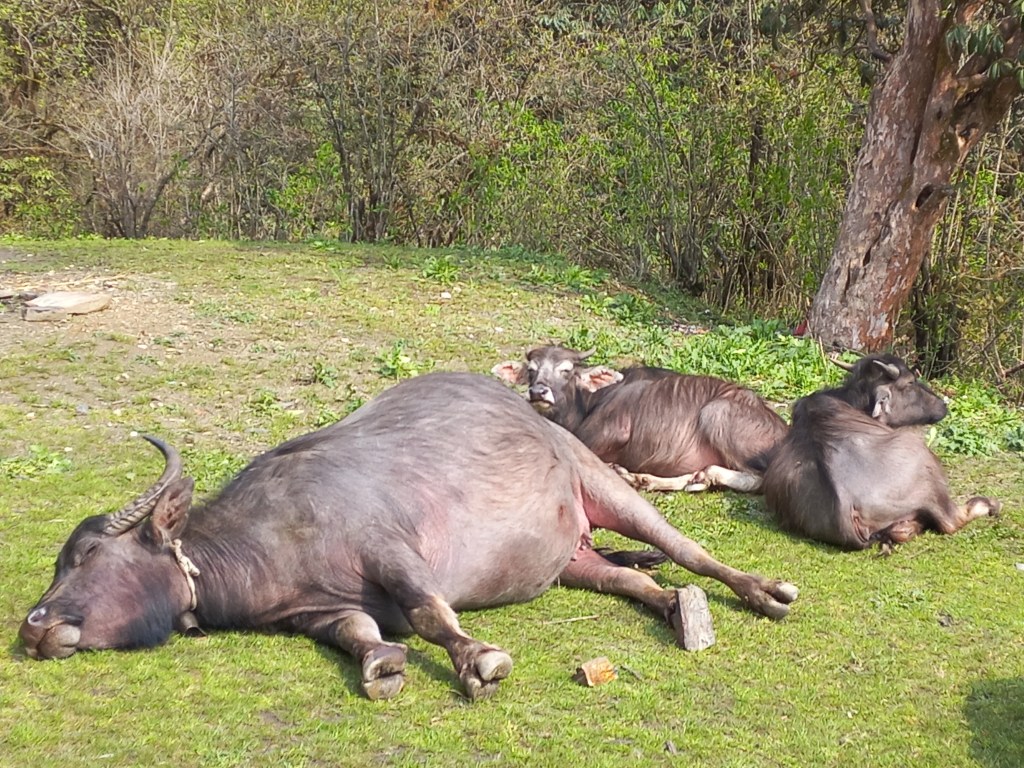
These domestic animals have bells hung around their necks, which keep tinkling along as they roam about in the surroundings. That helps locating them by their owners even if they stray around. But on this ocassion, none of them were interested in strolling around and were perfectly happy to lie down, enjoying the sun and the breeze. After that amusing sight, I moved along towards the next milestone of a little pass. After a few switchbacks, I did reach it. There was a gate adorned with some tibetan paintings. Beyond the gate, I saw the first patches of snow lying beside the trail. By the looks of it, they seemed to be fresh. The track moved gradually downwards beyond the gate amidst some blooming Rhododendron trees. Unlike their counterparts down below, these trees did have considerable blooms and I even saw some buds.

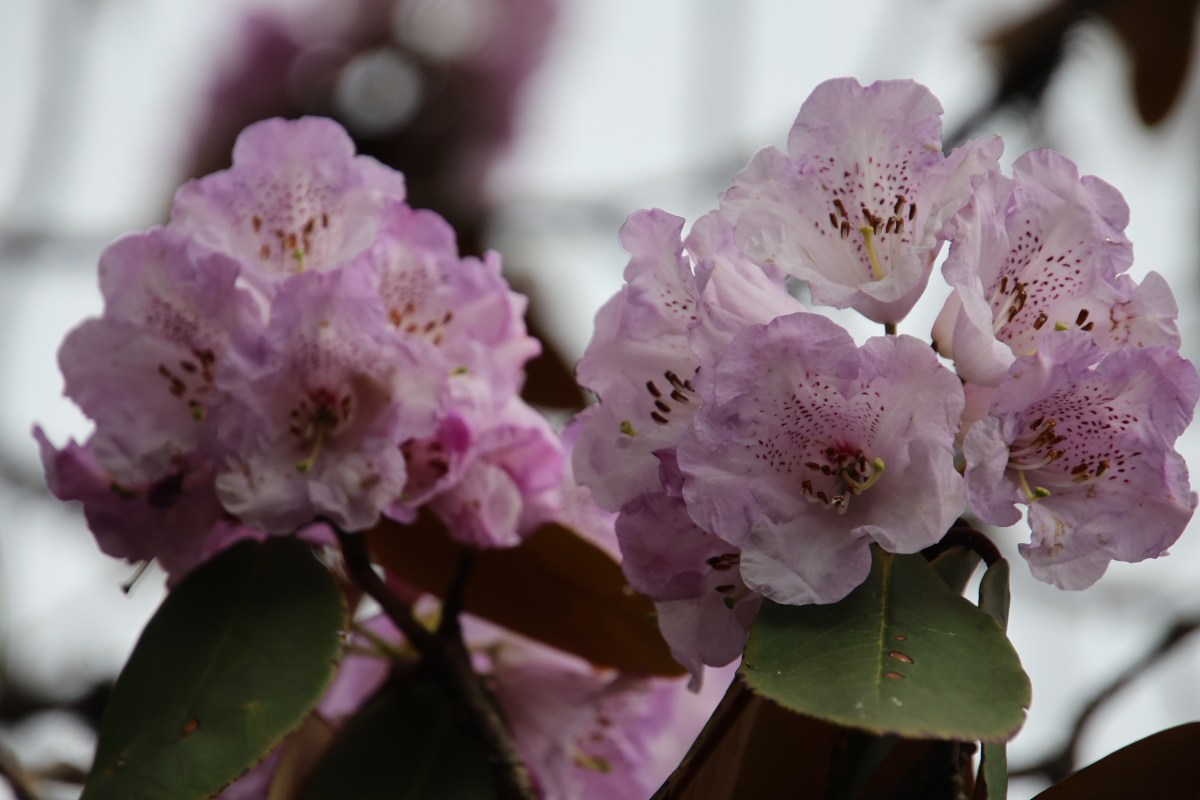
The cycles of flowering for these trees differ by altitude. While flowers have disappeared at the lower altitudes, they were in full bloom or about to start in the higher altitudes. Their colors also differed. The flowers in lower reaches were deep red or dark pink, but up here, the shades were lighter. Some were almost white (with a mix of light purple), some with lighter pink shades and yet others, almost fully white.
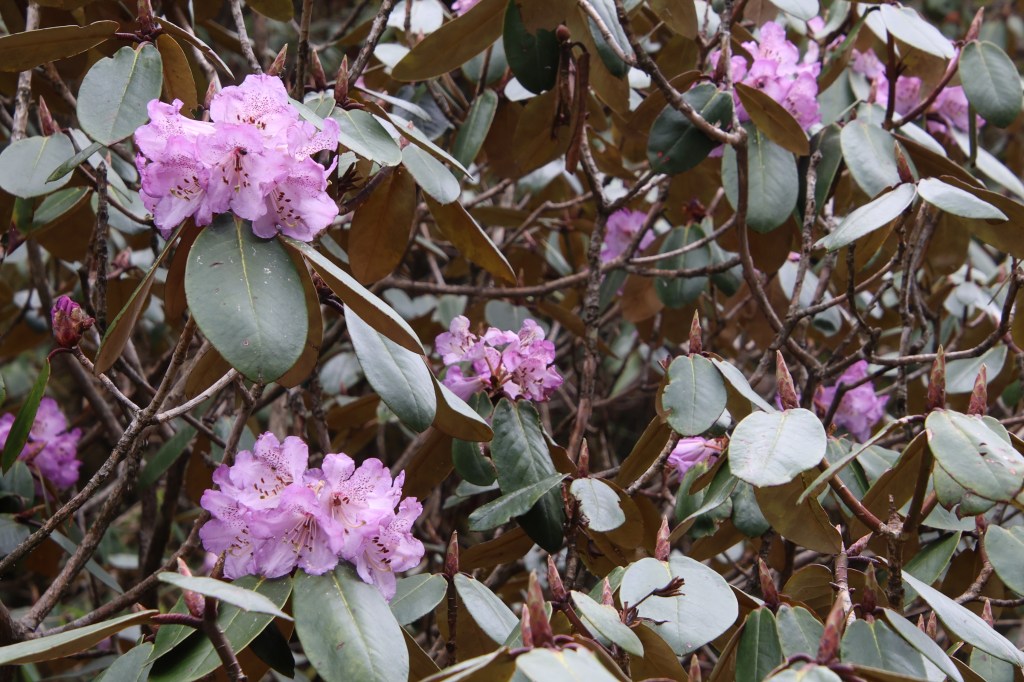
However, the dark pink shades were still visible, though to a lesser extent. The Annapurna sanctuary area is famous for Rhododendron blooms. They cover the landscape during these times of the year. Both the routes leading to North and South base camps of Annapurna go through dense Rhododendron forests and offer such views.
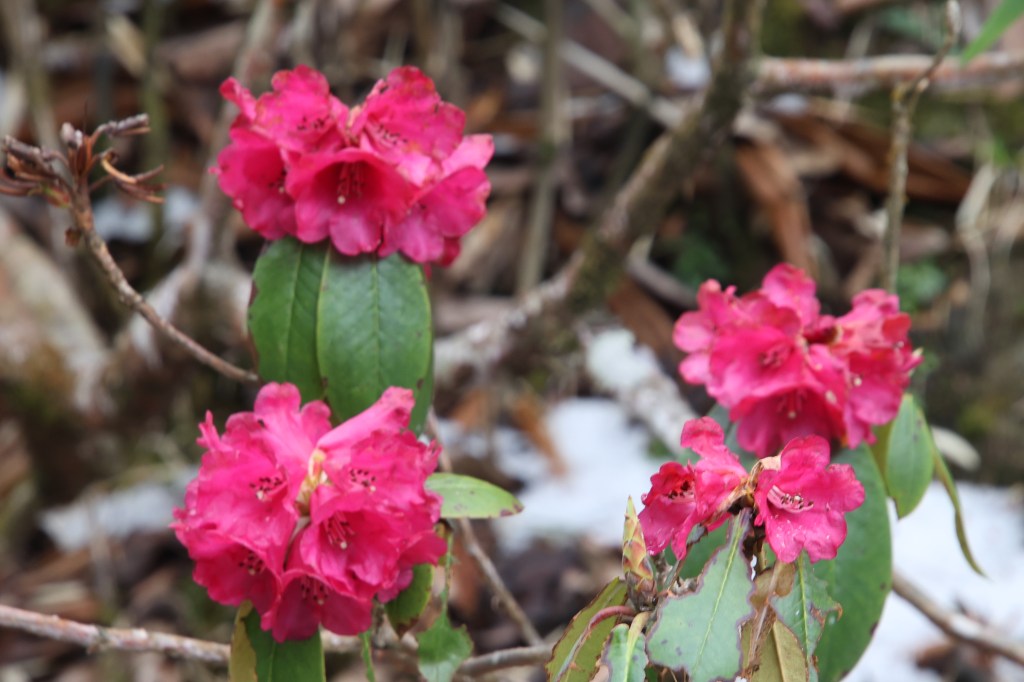
Trails in the Everest region also have them, but to a much lesser extent, especially due to altitudes, the forest cover itself is not that dense as boulders and snow cut the treeline short. As we moved higher up, the density of the flowers kept increasing.
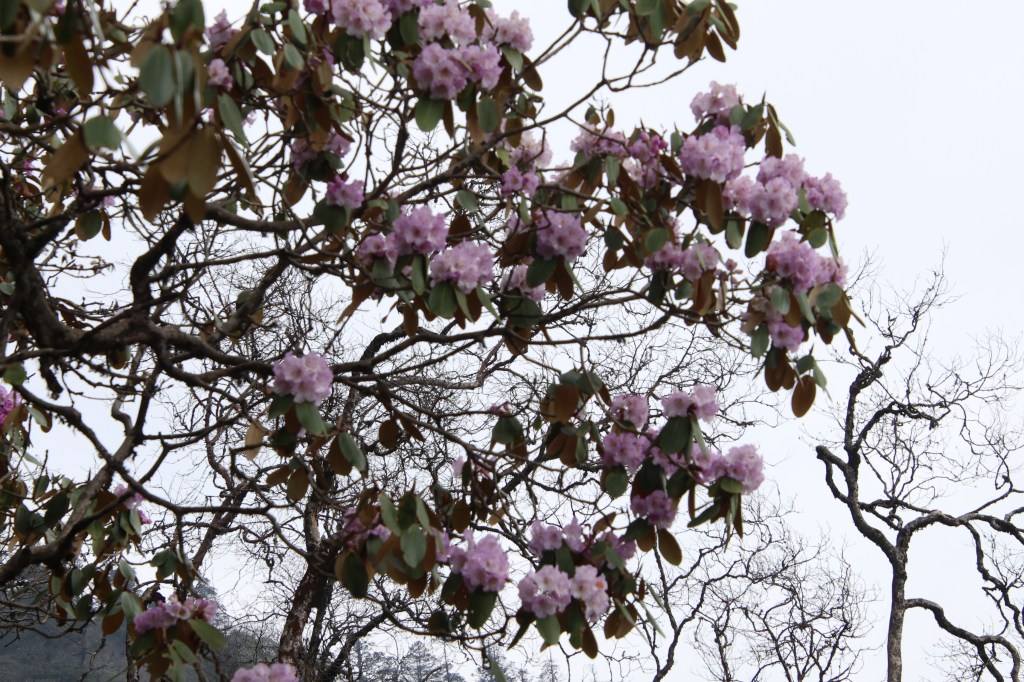
The more we reached closer to Dobato, more awestruck we were by the aura of flowers. The cloudy weather and the lack of the fimilar Himalayan snow views were forgotten by the display of flowers at our disposal. While Rhododendrons were at plenty in the trees, but the flowers on the ground, along the slopes or by the side of the walking trail, were equally mesmerizing.

While walking amidst them, after a few bends, the lodges of Dobato made an appearance. It was just a few metres ahead of us, but we had no hurry to reach there and our shutters kept rolling. That single stretch of the trail, not even half a km in length, offered so much, we took almost an hour to cover it.

Finally, we entered the tea house, rather it’s dining space. “Dal-bhat” was ordered and as lunch started getting prepared, we were handed the keys of our room. After changing our trekking gears to simple warm wears, we re-entered the dining space, which was abuzz with other hikers. The weather was gloomy and it started playing in our minds. Ranjan da already started contemplating skipping the hike to Muldai viewpoint. In clear weather, we could have had the option to hike to it during sunset as well as sunrise, but senset was out of question. The only feeble hope remained is of the sunrise view. After lunch, Ranjan da decided to take a nap and headed towards the room, while I remained at the dining space, hung up my trekking clothes with the hope to dry them up and spent time chatting with the guide and a fellow hiker, a student from Germany. I walked past her on my way up to Dobato. During our conversations, she revealed that she has been in Nepal for the past one month. She had entered Nepal from it’s western frontiers, visited some wonderful places there (including the Phoksundo lake), then moved on to Bardia National Park in the lower Terai regions (bordering with India) and now she was, in the Annapurna Sanctuary area. We’ve come across such travelers before, who spend long duration in Nepal, traveling to different parts of it. After Dobato, she’d be going down as her trip draws to a close.
On our way up to Dobato, we met a group of Nepalese policemen who were going for an official duty. It later turned out tht they were heading to complete formal investigation around the two unfortunate deaths that happened at the “hidden lake” area. Late in the afternoon, a group of four laborers came down the slopes beyond Dobato, carrying a human body wrapped in a plastic and lowered it at the open space outside. The policemen we met on our way up, followed the laborers. There was an immediate hush and curiosity amongst all the people who looked through the window and some even ventured outside. We heard that another body was following this and soon we saw the carriers of it and it was laid beside the other one. The carriers needed rest and the owners of the lodge gave them food and drink. We couldn’t see the faces but we were told, these were bodies of a pair of uncle and nephew (who was just 18 years old). They hailed from distant villages in the Makalu area of eastern Nepal, came as loborers to pave the trails but to their misfortune, a sudden strike of lightning electrocuted them while they were preparing their food. Someone burnt a few incense sticks beside the bodies, while the carriers rested.
It was a stark reminder of life’s realities. They came with the hope of earning some money to sustain their lives, but ended up losing them. Even yesterday, when we started our hike, they must have been alive, oblivious to the fact about what lay in store for them. After a considerable time, the carriers resumed their work and the bodies were carried down the slopes. They’d be reaching Pokhara, the same day, where standard formalities of autopsy would be carried out and after that, they’d make their final journies to the distant lands where they came from.
After darkness settled in, we had our dinner and headed for our room. We were sleeping at 3426 m.
 Break shackles
3 thoughts on “The solitude of Khopra ridge – Dobato”